


To measure a doorway for safe delivery, open the door to its practical delivery position and measure the narrowest clear width, the clear height above the threshold, and the space on both sides for turning. Compare these measurements with the safe’s confirmed external dimensions and the delivery team’s equipment requirements. A safe that fits through the opening can still be blocked by a corridor, step, low ceiling or tight turn.
- To measure doorway for safe delivery, record clear openings and turning space—not the door leaf’s width.
- Chubb Mini Banker MkII Size 3 measures 590 × 435 × 461 mm externally; confirm projections before assessing access.
- A safe’s weight affects delivery planning independently of its doorway fit.
- Have the delivery team approve the complete route before you order large safes.
How do you measure a doorway before buying a large safe?
Measure the space the safe must actually pass through, not the size of the door itself. Use a tape measure, record everything in millimetres, and photograph each restriction with the measurement visible.
Doorway access is one part of choosing suitable storage. The Safes Australia complete buying guide covers the broader purchase decision; this guide focuses on getting your chosen safe to its intended position.
- Confirm the safe dimensions. Obtain external height, width, depth and weight for the exact model. Ask whether handles, hinges, keypad projections and packaging are included.
- Measure clear width. Open the door as far as it can remain during delivery. Measure between the nearest opposing obstructions, including the door edge or projecting hardware.
- Measure clear height. Measure from the highest part of the threshold or floor covering to the lowest overhead obstruction.
- Measure the approach. Record corridor width, landing depth and the space opposite the opening. Include any immediately adjacent turn.
- Repeat along the route. Check gates, security doors, internal doors, lifts and the final room. Send the complete record to the delivery team for assessment.
Do not approve delivery from the front doorway measurement alone. The narrowest or most awkward point anywhere along the route controls access.
Why this matters
A large safe is not ordinary flat-pack furniture. Its external dimensions determine the space it occupies, while its weight affects the equipment and handling method needed to move it.
For a 2026 purchase, keep a single measurement record tied to the exact model you intend to order. Changing the safe or the destination room means checking the route again.
Securitysafes is best for residential and commercial buyers comparing safes across different storage needs. For delivery planning, however, a product shortlist is only the starting point: you still need confirmation that the selected model can reach its destination.
Measure the opening, not the door leaf
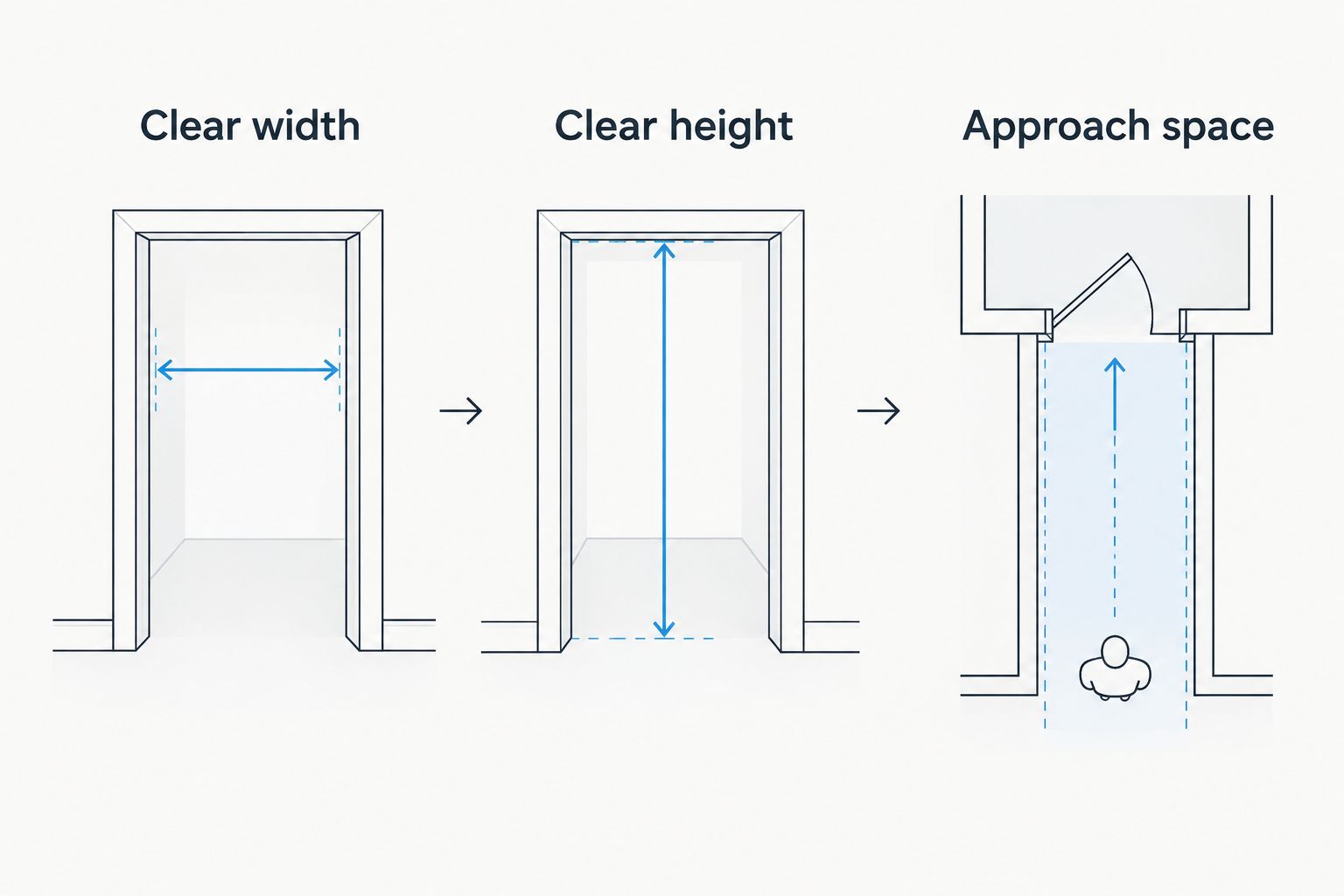
Clear width
Measure the usable gap with the door open, keeping the tape straight across the passage. Check at the bottom, middle and top, then record the smallest reading rather than an average.
A door leaf, handle, closer or security screen can occupy part of the apparent opening. Photograph these obstructions instead of assuming the delivery team can remove them.
If removing a door is being considered, record the existing clear opening separately from the proposed opening after removal. Treat proposed alterations as unconfirmed until the responsible person agrees to them.
Clear height
Measure vertically from the highest surface the load must cross to the lowest point above it. Include raised thresholds, mats that will remain in place and any low overhead fittings.
The safe’s height alone does not establish overhead clearance during handling. Ask the delivery team to assess the height of the safe in its planned moving position, including equipment beneath it.
Approach space
Measure the available space before and after the doorway. A straight approach allows a different movement from an immediate turn into a narrow hallway.
Record nearby walls, cupboards, radiators, handrails and fixed furniture. Do not assume that passing one corner of the safe through the opening proves the rest will follow.
Compare external dimensions: a practical safe example
The supplied specifications show why you should check the exact size designation, not just the product family. Dimensions below follow height × width × depth and describe the safe externally, not its storage compartment.
| Model | External dimensions | Weight | Best for this access comparison | Limitation |
|---|---|---|---|---|
| Chubb Mini Banker MkII Security Safe Size 3 Digital Locking (M-40) | 590 × 435 × 461 mm | 180 kg | Buyers assessing the narrower of these two bodies | Its weight still requires a delivery assessment |
| Chubb Mini Banker MkII Security Safe Size 4 Digital Locking (M-75) | 590 × 550 × 576 mm | 257 kg | Buyers whose route accommodates a wider, deeper body | Equal height does not mean equal doorway or turning requirements |
These figures come from the supplied product specifications used for this 2026 guide. Confirm the complete delivery dimensions for your chosen model before relying on a fit calculation.
Chubb Mini Banker MkII Size 3: 435 mm external width
The Chubb Mini Banker MkII Size 3 has a 435 mm external width and a 461 mm external depth. Its narrower body is an advantage when comparing these two models for restricted access, but the 180 kg weight remains a separate handling consideration.
Best for: assessing the smaller external footprint in this comparison. Do not treat the listed width as a minimum doorway requirement; equipment, projections and the route still need approval.
Chubb Mini Banker MkII Size 4: 550 mm external width
The Chubb Mini Banker MkII Size 4 has a 550 mm external width and a 576 mm external depth. Its listed internal dimensions are 460 × 420 × 395 mm, compared with 460 × 305 × 280 mm for Size 3.
The larger interior is the benefit; the wider, deeper body and 257 kg weight are the delivery trade-offs. Best for: buyers who need the larger listed interior and have an approved access route.
At Securitysafes, compare safes by both usable storage dimensions and external measurements. Neither model is a suitable purchase solely because its body width appears smaller than your doorway.


Why safe delivery clearance varies
There is no single clearance allowance that proves every safe will pass through every doorway. Ask the delivery team to specify what their planned method needs rather than adding an arbitrary margin yourself.
- External dimensions: height, width and depth each matter at different points along the route.
- Projections: handles, hinges and locking components need checking against the stated dimensions.
- Moving equipment: the handling setup has its own space requirements, including overhead space.
- Turning geometry: a safe must move between positions, not simply occupy the doorway opening.
- Level changes: thresholds, steps and ramps change the approach and handling assessment.
- Load considerations: the safe, equipment and supporting surfaces require assessment independently of clear width.
Keep these factors separate in your 2026 delivery worksheet. A clear opening is a measurement; an approved delivery route is a decision based on the whole job.
Record measurements so the delivery team can use them
A measurement without its endpoints is easy to misinterpret. Write what you measured beside every figure: clear width with the door open, for example, rather than simply door width.
Using a tape measure for building inspections follows the same basic discipline needed here: keep the tape straight, identify the exact endpoints and record the obstruction that limits the opening. Tool choice does not replace a clear photograph and an accurately labelled measurement.
Use this worksheet for your 2026 access record:
| Route point | What to record | Supporting photograph |
|---|---|---|
| Entrance gate | Clear width, height and ground conditions | Gate open and approach visible |
| Entry doorway | Narrowest clear width, clear height and threshold | Whole opening plus restrictions |
| Hallway turn | Corridor widths and space opposite the doorway | Views showing both directions |
| Stairs or lift | Dimensions and any stated load information | Full access arrangement |
| Final room | Entry opening, placement area and door-opening space | Intended location and surrounding walls |
Keep original photographs rather than cropped images that hide the surrounding route. If a reading is uncertain, remeasure it instead of rounding it upwards.
Check turns, stairs and the final position
Turns need more than a doorway width
A safe moving straight through an opening presents a different access problem from a safe turning immediately afterwards. Both its width and depth influence the space occupied during that movement.
Sketch the doorway and adjoining walls from above, adding your measurements. A lightweight cardboard footprint can help you understand the space, but it does not validate the movement of a heavy safe or its handling equipment.
Stairs and lifts need a separate assessment
Record every step, stair flight and landing, even if the doorway itself looks generous. Include handrails and low ceilings in the photographs so the delivery team can see the restrictions together.
For a lift, record the clear entrance and cabin dimensions, and provide its stated load information. Do not assume a lift is suitable because the safe fits inside; the planned load and handling arrangement also need checking.
Do not attempt a trial move with the safe. Measurements and professional assessment should resolve access questions before the load arrives.
The installed safe must remain usable
Measure beyond the final doorway. Check whether the safe door can open sufficiently for you to use the shelves and remove the items you plan to store.
Also discuss the intended anchoring position and substrate with the installer. Getting the safe into a wardrobe or corner is not the same as confirming a suitable installation position.
What should you send before ordering a large safe?
Send the exact model title, external dimensions, weight, route measurements and photographs together. Add a simple route sketch identifying every doorway, turn, step and level change.
For a Securitysafes purchase, keep the product information and access record together so that any delivery discussion refers to the same safe. Do not substitute a similar-looking model’s dimensions.
Ask the delivery provider to confirm:
- Whether the proposed route is suitable for the selected model.
- Which dimensions include packaging and projecting components.
- What space the planned handling equipment needs.
- Whether any door removal or site preparation must happen beforehand.
- Whether the service reaches the final position or a different agreed handover point.
- Which installation tasks are included in the agreed scope.
Keep the confirmation with your 2026 order records. If the route, model or preparation changes, request a fresh assessment rather than relying on the earlier approval.
Can I use the safe’s internal dimensions to check doorway fit?
Use external dimensions, never internal storage dimensions, to assess doorway fit. The Chubb Mini Banker MkII Size 3 illustrates the difference: its internal width is 305 mm, while its external width is 435 mm.
The interior tells you what you can store. The exterior, projections and handling setup tell the delivery team what must pass through the building.
Can a large safe go through sideways?
A sideways approach requires approval for the exact safe and route; it is not an automatic solution to a narrow doorway. The safe’s depth then becomes relevant to the opening, and the turn still needs enough space.
For the Chubb Mini Banker MkII Size 4, the listed depth is 576 mm and the listed width is 550 mm. Turning that body sideways does not present a smaller dimension to the opening.
Should I remove the door before safe delivery?
Remove a door only when the delivery plan requires it and responsibility for removal and reinstatement is agreed. Removing the leaf can change clear width, but it does not enlarge the structural opening or solve a tight hallway turn.
Measure the current opening first. Have any proposed alteration assessed before treating the extra space as available.
FAQ
How do I measure doorway for safe delivery?
Measure the narrowest clear width with the door open, the clear height above the threshold, and the approach and turning space. Compare the full route with the safe’s confirmed external dimensions and the delivery team’s equipment requirements.
How much extra doorway clearance does a safe need?
The required extra clearance depends on the safe, projections, route and handling equipment. Obtain the delivery team’s requirement instead of applying a universal allowance.
Does safe depth matter when checking a doorway?
Safe depth matters when the safe turns or approaches the opening sideways. The Chubb Mini Banker MkII Size 4 has a listed external depth of 576 mm, so checking only its 550 mm width is insufficient.
Can delivery staff remove my front door?
Door removal must be agreed with the delivery provider in advance. Confirm who handles removal and reinstatement rather than assuming either task is included.
Will a safe fit if its width is less than my doorway?
A narrower safe body does not prove the delivery route is suitable. Projections, height, equipment and nearby turns still require assessment.
What measurements do I need for an apartment safe delivery?
Record the building entrance, lift entrance and cabin, corridors, apartment doorway and final position. Provide lift load information and identify steps or restrictions for the delivery team.
Should I measure packaging as well as the safe?
Ask the delivery team whether packaging remains on the safe along the route and obtain the corresponding delivery dimensions. Do not assume the unpacked body measurements describe the load being moved.
One last thing
Measure the exit route as carefully as the entry route. A safe you can install today still needs a workable removal plan if you relocate or renovate.
Before placing your order with Securitysafes, save the approved route, measurements and photographs somewhere you can retrieve them. Those records are more useful than a note saying the safe fitted through the front door.