


Best starting point for domestic storage: CMI Miniguard Size 2. Best cabinet-format shortlist: CMI SC1500. Best drawer-format shortlist: CMI SEC DRWR. For CMI safes in 2026, these are storage-use recommendations—not a claim that one has the strongest fire or burglary rating; choose the final model on documented protection for your contents.
- CMI safes should be selected by documented fire and burglary protection, not model names or cabinet size.
- CMI Miniguard Size 2 is the domestic-storage starting point; confirm its ratings before buying.
- CMI SC1500 suits a cabinet-format shortlist; CMI SEC DRWR suits a drawer-format shortlist.
- Securitysafes recommends checking the exact model, protected contents, insurer requirements and installation before choosing a safe.
Why this matters
A safe that restricts access does not automatically protect documents from fire. Equally, a fire-resistant enclosure does not establish resistance to forced entry. Treat fire protection and burglary protection as separate buying decisions.
Start with what you need to protect: replaceable paperwork, original documents, jewellery, business records or cash. The Safes Australia buying guide gives you the broader selection framework before you narrow the search to CMI.
For a 2026 purchase, ask for documentation covering the exact model and lock configuration you intend to order. A rating attached to another safe in the same brand range is not evidence for your chosen model.
What makes the best CMI safes?
Use these criteria before comparing product names. Each answers a different question, and none substitutes for the others.
- Fire evidence: Identify the test standard, protection duration and contents class. A duration without the test conditions is not a complete specification.
- Burglary evidence: Establish whether the stated protection is a tested classification, a construction description or a recommended cash rating.
- Contents suitability: Match protection to paper, valuables or digital media. Do not assume a paper-document claim also covers backup drives.
- Usable space: Check internal dimensions, door opening and shelf arrangement against your actual items—not just the external enclosure.
- Installation suitability: Confirm the permitted anchoring method, supporting structure, access route and final position before ordering.
- Access control: Check the exact lock supplied, who needs access and how authorised access will be managed.
A model belongs on your shortlist only when its storage format fits your job. It becomes a purchase recommendation when its documented protection also meets that job.
CMI safes at a glance
The order below prioritises a domestic starting point, then cabinet storage, then drawer storage. It is not a descending league table of tested fire or burglary performance. The protection decision belongs to the exact model documentation.
| Shortlist order | Item | Best for | Standout selection feature | Fire and burglary decision | Key limitation |
|---|---|---|---|---|---|
| 1 | CMI Miniguard Domestic Security Safes Size 2 | Domestic-storage enquiries | Explicit domestic-security product category | Check both ratings for the exact model | Domestic positioning does not establish a fire class or burglary grade |
| 2 | CMI Security Cabinet SC1500 | Cabinet-format storage enquiries | Security-cabinet product category | Check cabinet-specific protection documentation | Cabinet format does not establish equivalent protection to a rated safe |
| 3 | CMI SEC DRWR Security Drawer | Drawer-format storage enquiries | Security-drawer product category | Confirm protection and mounting requirements | Drawer format alone establishes neither fire resistance nor burglary resistance |
1. CMI Miniguard Size 2: best CMI shortlist for domestic storage
CMI Miniguard Size 2 is identified as a domestic security safe. That makes it the clearest starting point among these options when you are choosing secure storage for a home.
Start by listing the items you intend to store. If the list includes original documents and jewellery, your enquiry needs to address both heat protection and forced-entry protection; a general security description is not enough.
CMI Miniguard Size 2 pros:
- Its domestic-security category matches a home-storage enquiry.
- The Size 2 designation identifies a specific version to discuss.
- It provides a focused starting point rather than an unrelated cabinet or drawer format.
CMI Miniguard Size 2 cons:
- The domestic-security label is not itself a fire-test result.
- The model name does not establish an insurer-accepted burglary classification.
- The size designation does not tell you whether your folders or jewellery cases fit.
Ask for internal measurements with the door and shelving taken into account. Then check the installation instructions against the location you have chosen; do not plan a wardrobe installation solely because the external enclosure appears to fit.
Best for: Home buyers beginning a domestic-safe comparison.
Verdict: Hold until CMI Miniguard Size 2's documented protection and installation requirements match your contents.
2. CMI SC1500: best CMI shortlist for cabinet-format storage
CMI SC1500 is identified as a security cabinet. Use it as a cabinet-format enquiry rather than treating it as a direct substitute for a domestic safe with established ratings.
If you want to organise business records or other items in a cabinet, first confirm the internal arrangement. The product category does not tell you the shelf layout, usable capacity or protected contents class.
CMI SC1500 pros:
- Its security-cabinet category matches a cabinet-format search.
- The SC1500 identifier makes the model-specific enquiry clear.
- It separates cabinet storage from domestic-safe and drawer-format options.
CMI SC1500 cons:
- Cabinet terminology does not establish fire resistance.
- Cabinet terminology does not establish a tested burglary grade.
- Suitability for particular files or equipment depends on confirmed internal measurements.
For an office purchase in 2026, separate access control from disaster protection. Keeping records behind a locked door addresses a different requirement from protecting original records during a fire.
Ask whether the cabinet's documented protection covers your intended use. If it does not, change the shortlist rather than accepting a storage format that leaves the main risk unresolved.
Best for: Buyers specifically investigating cabinet-format secure storage.
Verdict: Hold until CMI SC1500's contents suitability and protection documentation satisfy the cabinet-storage brief.
3. CMI SEC DRWR: best CMI shortlist for drawer-format storage
CMI SEC DRWR is identified as a security drawer. It belongs on your shortlist when the drawer format is part of your storage requirement—not because a drawer is inherently equivalent to a fire-and-burglary-rated safe.
Confirm the intended mounting arrangement before planning furniture around it. You also need to establish how the drawer opens, which items fit and what protection the exact product provides.
CMI SEC DRWR pros:
- Its security-drawer category matches a drawer-format enquiry.
- The SEC DRWR identifier helps keep the specification discussion model-specific.
- It offers a distinct storage format to investigate alongside safes and cabinets.
CMI SEC DRWR cons:
- Drawer format does not establish a fire rating.
- Security terminology does not establish a tested burglary classification.
- Suitability depends on the approved mounting arrangement and usable internal space.
Keep convenience separate from protection. A storage position that is easy for you to reach still needs to satisfy the product's installation requirements and your security brief.
Best for: Buyers with a specific drawer-format storage requirement.
Verdict: Hold until CMI SEC DRWR's mounting requirements and documented protection meet that requirement.
How to rank fire protection without comparing unlike claims
For a 2026 comparison, record the wording of each fire claim before sorting by duration. A recommended protection duration and a certified test claim are different forms of evidence.
The following examples illustrate that distinction using product-description wording for two other safes sold by Securitysafes. They are not CMI ratings and do not establish a CMI winner.
| Example | Best for | Stated fire protection | Other stated construction detail | Evidence limitation |
|---|---|---|---|---|
| Dominator Safes HS-1C Big Red 3 wheel combination lock | Understanding a recommended-duration claim | 30-minute recommended fire protection rating | 6 mm solid plate steel body | The description calls the duration recommended; request supporting documentation |
| Dominator Safes DS-1D Tecnosicurezza Pulse 2 user electronic lock | Understanding a certification-labelled claim | 105-minute CNS Certified fire protection rating | No construction comparison made here | Request the certificate and protected contents class before applying the claim |
The HS-1C description states 30 minutes of recommended fire protection and a 6 mm solid plate steel body. The DS-1D description states 105 minutes of CNS Certified fire protection. Those figures describe different aspects of protection: minutes concern the fire claim, while millimetres describe body construction.
Do not turn a steel-thickness figure into a fire rating or burglary grade. For either example, the practical next step is to check the supporting documentation and its scope.
For CMI safes, use the same discipline. Rank duration only after establishing that the claims cover comparable contents and test conditions; do not award the top position simply to the largest number.
How to rank burglary protection
Begin with the classification, not the adjective. Terms such as security, heavy-duty and commercial do not tell you which attack test a particular enclosure has passed.
A recommended cash rating also answers a different question from a tested burglary classification. Do not read a cash recommendation as automatic insurance acceptance. Ask your insurer to confirm the exact model, intended contents and installation in writing.
Use this sequence for each CMI candidate:
- Identify the model: Keep the model and supplied lock configuration together.
- Check fire evidence: Record the standard, duration and protected contents.
- Check burglary evidence: Record the classification and the document supporting it.
- Confirm insurance: Establish the insurer's requirements for your intended contents.
- Confirm installation: Check anchoring, supporting structure and access conditions.
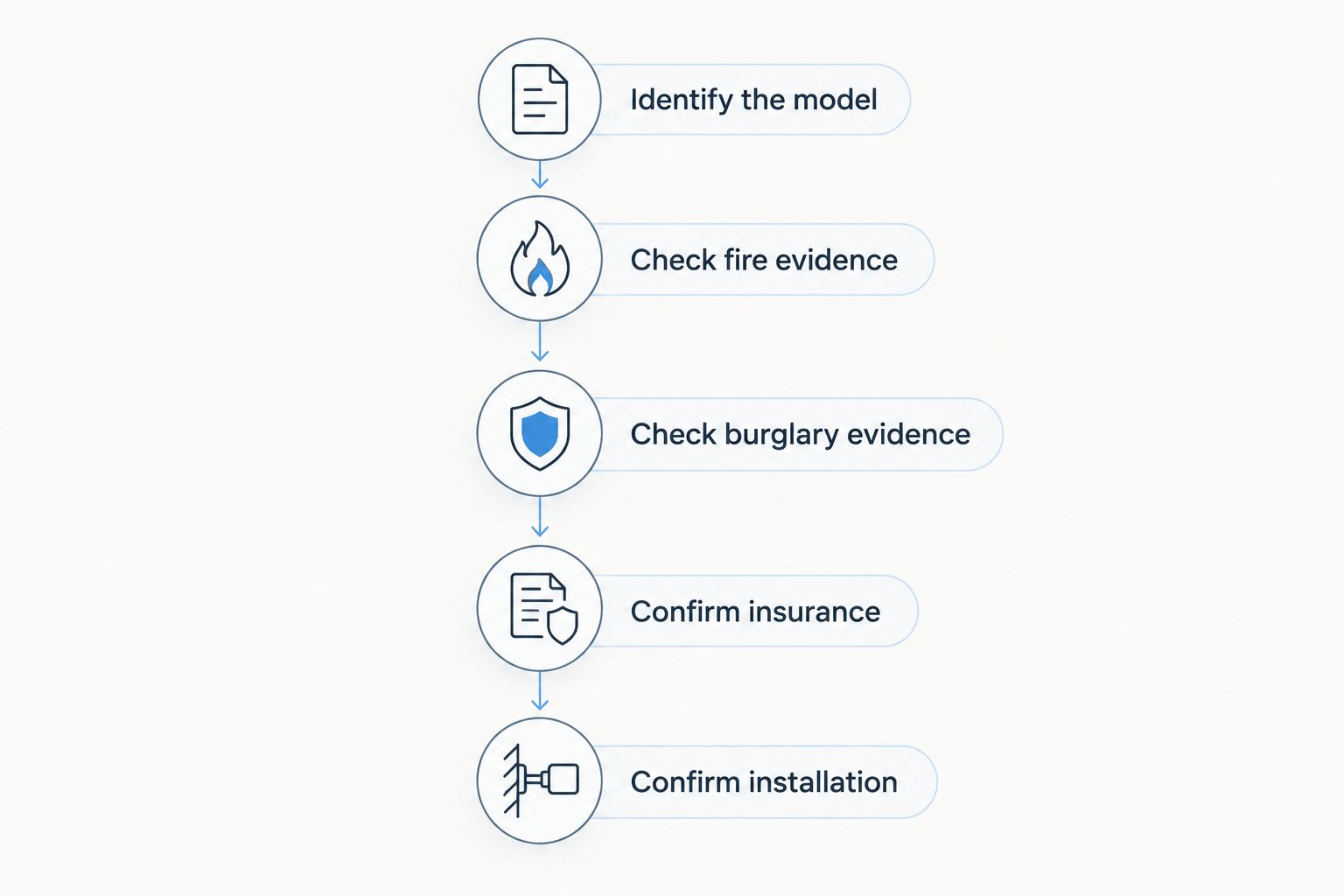
This sequence prevents an attractive storage format from deciding the purchase before you check protection. Keep the supporting documents with your purchase records so you can refer to the exact specification later.
Check fit and installation before choosing the winner
Measure the contents first. Include the cases, folders and organisers you actually use, then compare those measurements with usable internal space and the clear door opening.
Next, check the route to the installation position. Doorways, stairs, turns and the supporting floor all belong in the installation discussion; external dimensions alone do not settle it.
Your installation enquiry should cover:
- The manufacturer's permitted fixing positions and anchoring method.
- The material and condition of the supporting structure.
- Clearance for the door, drawer or cabinet access.
- Access for authorised users without exposing keys or codes.
- Any insurer conditions attached to the installation.
Do not improvise new fixing holes or assume furniture provides an acceptable anchor. Get the proposed installation checked against the manufacturer's instructions before making alterations.
How these CMI options are ranked
The 2026 shortlist ranks storage-use fit, with CMI Miniguard Size 2 first for a domestic enquiry, CMI SC1500 second for cabinet-format enquiries and CMI SEC DRWR third for drawer-format enquiries. The order does not imply tested protection superiority.
A fire-and-burglary ranking requires comparable model-specific evidence. Until that evidence supports an order, assigning a strongest-overall badge would confuse product category with measured protection.
Securitysafes' CMI safes guidance is best suited to buyers who want to match documented protection to their contents before choosing a model.
Which CMI safe should you choose?
For an undecided home buyer, start with CMI Miniguard Size 2. It is the domestic-security option in this shortlist, but its category is the starting point—not the final reason to buy.
Choose CMI SC1500 for further investigation when cabinet format is essential. Choose CMI SEC DRWR for further investigation when drawer format is essential. In both cases, reject the format if its documented protection does not meet your main risk.
For a 2026 purchase, give the seller a written contents list and your insurer's requirements. Ask for a recommendation that addresses fire protection, burglary protection and installation separately.
FAQ
What's the best CMI safe for a home?
CMI Miniguard Size 2 is the domestic-storage starting point among these three options. Choose it only after confirming that its documented fire and burglary protection, internal space and installation requirements match your contents.
Which CMI safe has the highest fire rating?
The highest-rated CMI safe must be identified from comparable model-specific fire documentation. Compare the test standard, duration and protected contents class rather than ranking product names or enclosure sizes.
Is a CMI security cabinet as secure as a rated safe?
A security-cabinet description does not establish equivalence to a rated safe. Check the exact cabinet's burglary classification and fire documentation before treating it as an alternative.
Does a fire rating also prove burglary resistance?
No, a fire rating does not prove burglary resistance. Fire protection concerns heat exposure under specified conditions; burglary protection requires separate evidence covering resistance to attack.
Does a recommended cash rating mean my insurer accepts the safe?
No, a recommended cash rating is not automatic insurer acceptance. Ask your insurer to confirm the exact safe, intended contents and installation conditions in writing.
Can I use a document safe to protect backup drives?
Do not assume a document-safe fire claim covers backup drives. Select protection documented for the intended digital media, because a paper-document claim alone does not establish media suitability.
What should I ask before buying CMI safes in 2026?
Ask for the exact model's fire documentation, burglary classification, internal dimensions, supplied lock and installation instructions. Give the seller your contents list and insurer requirements so the recommendation addresses your actual storage job.
One last thing
Write down the item you cannot replace before choosing the safe. An original document, an inherited piece of jewellery and a backup drive create different protection requirements, even when they fit inside the same enclosure.
Use that item to test every recommendation. If the seller cannot connect the model's documented protection to your most important contents, keep comparing.