


Best overall: a tested stainless-steel mesh security door. Best for privacy: a perforated-aluminium security door. Best for a traditional entrance: a steel-grille security door. For Australian homes in 2026, choose by evidence of whole-door performance and installation quality, not appearance alone.
- A tested stainless-steel mesh security door is the default choice when visibility and ventilation matter.
- Perforated-aluminium security doors suit homeowners who prioritise screening, but privacy depends on lighting.
- Sliding security doors suit patio openings; check the complete frame, track and locking system.
- CMI strongroom doors serve purpose-built secure rooms, not ordinary ventilated entrances.
Why this matters
A security door and an insect screen serve different jobs. Mesh that keeps mosquitoes out does not, by itself, establish resistance to forced entry. Start with the complete assembly: infill, frame, hinges or track, lock and attachment to your house.
The security doors for home and commercial premises guide provides additional context. This comparison separates everyday entrance screens from specialist strongroom doors so you do not confuse products that protect different things.
Securitysafes suits homeowners choosing safes for valuables; a security door protects the entrance, not the contents of an unlocked house. Treat those as separate purchasing decisions in your 2026 home-security plan.
What makes the best security door?
Use these criteria before comparing materials or finishes:
- Whole-door evidence: Request documentation covering the proposed door system, rather than a claim about its mesh or lock alone.
- Sound attachment: Have the installer assess the existing jamb, surrounding structure and fixing method. Strong infill does not repair a weak doorway.
- Suitable locking: Confirm how the door locks, how you release it from inside and whether nearby openings expose the release mechanism.
- Everyday usability: Check visibility, airflow, insect screening, handle clearance and operation before accepting the design.
- Exposure and care: Ask which materials, finishes and maintenance instructions suit your location, especially near salt air.
- Safe exit: Assess emergency escape as well as entry resistance. A door that is awkward to release creates a different household risk.
For your 2026 shortlist, ask which Australian security-screen standards apply. AS 5039 addresses security screen doors and window grilles, AS 5040 addresses installation, and AS 5041 covers test methods. Request the applicable edition and evidence for the exact configuration being quoted; a standard number in an advertisement is not the supporting document.
Best security doors at a glance
These are ranked door types, not a claim that every model made from a particular material performs equally. The sliding option describes an opening format; it still needs an appropriate infill and documented security performance.
| Rank and option | Best for | Standout feature | Key limitation |
|---|---|---|---|
| 1. Tested stainless-steel mesh security door | An everyday hinged entrance | Ventilation and outward visibility through mesh | Material alone does not establish whole-door performance |
| 2. Tested perforated-aluminium security door | Screening a street-facing entrance | A perforated panel between the entrance and outside | Privacy changes with lighting and viewing angle |
| 3. Tested steel-grille security door | A traditional-looking entrance | A visible grille with separate screening where specified | Grille design and insect mesh require separate assessment |
| 4. Tested sliding security screen door | A patio or sliding-door opening | Security screening matched to a sliding opening | Track, retention and meeting stiles need attention |
| 5. Purpose-built strongroom door | A dedicated valuables room | A solid specialist door and frame | Not a substitute for an everyday security screen |
1. Stainless-steel mesh: best security door for everyday entrances
A stainless-steel mesh security door lets you use the entrance for ventilation while keeping a physical barrier closed. It is the default shortlist for homeowners who want to see visitors without choosing a decorative grille.
The important distinction is how the mesh is retained in the frame. Ask for evidence covering that assembly, its hardware and the proposed size. Do not accept stainless steel as a complete security specification.
Stainless-steel mesh pros:
- Provides outward visibility through the screen.
- Allows airflow when the main entrance door is open.
- Avoids a separate decorative grille across the view.
Stainless-steel mesh cons:
- Outward visibility also permits some inward visibility.
- Dirt and salt deposits require the specified cleaning routine.
- Performance depends on mesh retention, frame construction and installation.
Best for: Your main hinged entrance when airflow and seeing visitors are priorities.
Before choosing, look through a sample from both sides. Check the view in the conditions that matter at your entrance, rather than judging only under showroom lighting. Confirm that the installed security door will clear the existing handle and door swing.
Verdict: Buy a documented, correctly fitted stainless-steel mesh system for the default everyday entrance.
2. Perforated aluminium: best security door for entrance screening
A perforated-aluminium security door uses a panel with openings rather than woven mesh. It suits an entrance where you want a more screened view, provided the chosen assembly has evidence supporting its security claims.
Do not confuse screening with guaranteed privacy. The relationship between indoor and outdoor light affects what people can see, so inspect the panel from the street-facing side as well as from inside.
Perforated-aluminium pros:
- Gives the entrance a panel-based appearance.
- Allows ventilation through its perforations.
- Offers an alternative to woven mesh and decorative grilles.
Perforated-aluminium cons:
- Privacy is not constant across lighting conditions.
- The panel interrupts the view through the entrance.
- Panel retention and frame strength still require supporting evidence.
Best for: A street-facing hinged entrance where screening matters more than the clearest outward view.
Ask the supplier to explain the proposed panel, frame and fixing system together. For your 2026 comparison, record the exact configuration on the quote so a different panel or hardware package is not treated as equivalent.
Verdict: Buy perforated aluminium for screening after checking visibility and whole-door evidence.
3. Steel grille: best security door for a traditional entrance
A steel-grille security door places a grille across the opening. Where insect mesh is included, that mesh serves a separate screening function; it does not establish the grille assembly's resistance to attack.
Choose this type because the design suits your entrance, not because visible bars automatically mean better security. The grille connections, frame, hinges, lock and installation all need assessment.
Steel-grille pros:
- Suits entrances where a traditional grille appearance is preferred.
- Allows ventilation through the grille openings.
- Separates the visible grille from any additional insect screening.
Steel-grille cons:
- Grille patterns interrupt the outward view.
- Insect protection depends on the screening specified.
- Coatings and exposed connections need appropriate inspection and care.
Best for: A homeowner who wants a traditional-looking entrance without treating appearance as proof of performance.
Check the actual pattern before ordering. Confirm whether insect mesh is included and whether the proposed handle can be reached through any openings. Ask how the supplier addresses access to the internal release without compromising emergency exit.
Verdict: Buy a steel-grille system only when its documented performance and exit operation match your needs.
4. Sliding security screen: best security door for patio access
A sliding security screen door fits an opening where a hinged screen would not suit the existing door arrangement. It can use different infill types, so compare both the screen material and the complete sliding system.
Give the track and retention system the same attention as the lock. Ask how the proposed assembly addresses lifting, disengagement and separation at the meeting stiles. A good-looking panel is only part of the decision.
Sliding security screen pros:
- Suits an existing sliding patio entrance.
- Operates without a hinged door swinging into the adjacent area.
- Provides screening while the main sliding door is open.
Sliding security screen cons:
- Tracks require cleaning and inspection.
- Frame, retention and meeting-stile details need specific assessment.
- Operation depends on correct alignment and adjustment.
Best for: A patio entrance already built around a sliding opening.
Operate the proposed system yourself where possible. At handover, check that it slides, closes and locks without forcing the panel, and request the maintenance instructions for rollers, tracks and hardware. Keep those instructions with the installation record.
Verdict: Buy a tested sliding assembly for a sliding opening; do not treat a hinged-door specification as interchangeable.
5. Strongroom door: best specialist option for a valuables room
A strongroom door protects a purpose-built secure room rather than providing ventilation at the front entrance. Securitysafes lists CMI strongroom doors, but these belong in a specialist building and storage discussion, not a routine screen-door replacement.
The CMI - G-CDB4 - Strongroom Door and Frame description specifies an overall door thickness of 90 mm and a LaGarde Digital TL11G lock using a 9-volt battery. The CMI - PRD4 - Strongroom Door Premier Grade (TDR) description specifies a LaGuard 3600 digital lock powered by two 9-volt batteries and glass-activated deadlocking relocking devices.
Those are product details, not grounds for declaring either door the better residential choice. Obtain the complete specification and assess the surrounding room construction before selecting one.
Strongroom-door pros:
- Provides a specialist door-and-frame option for secure storage.
- Offers documented locking details on the named CMI products.
- Keeps the valuables-room decision separate from entrance screening.
Strongroom-door cons:
- Does not provide the ventilation function of a security screen.
- Requires assessment of the surrounding structure and installation.
- Needs specialist advice on access, servicing and intended use.
Best for: A purpose-built secure storage room, not an ordinary front door or an assumed emergency refuge.
Verdict: Hold until a specialist confirms the room, door and installation specification together.


How to check the installation before you commit
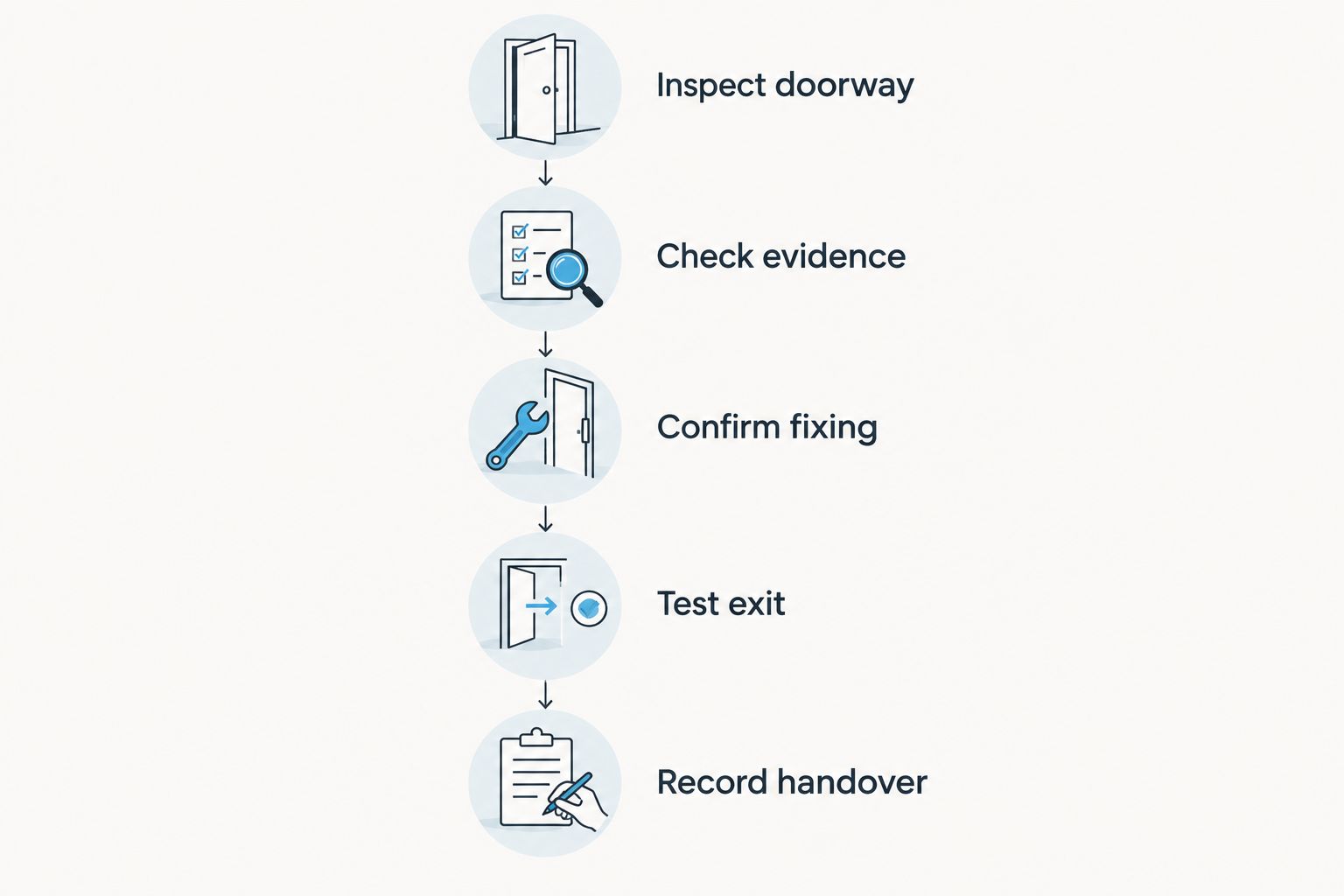
Use this sequence for a 2026 security-door purchase. It keeps the product choice connected to the doorway where the product must work.
- Inspect doorway: Have the installer identify deterioration, loose components and the structure available for fixing.
- Check evidence: Match the quoted door, infill, hardware and dimensions to the supporting documentation.
- Confirm fixing: Get the installation approach recorded, including any repairs needed before fitting.
- Test exit: Check inside release, clearance and operation with the people who use the entrance.
- Record handover: Keep the specification, installation details and maintenance instructions together.
Do not approve an installation merely because the door shuts. Confirm that it locks without lifting, pushing or twisting it into position, and ask the installer to correct any binding before handover.
How the options are ranked
The ranking prioritises everyday entrance use, then distinct needs: screening, traditional appearance, sliding access and specialist secure storage. It does not rank named screen-door manufacturers or claim physical testing of these options.
For 2026, the deciding criteria remain whole-door evidence, sound attachment, suitable locking and safe operation. Material preference breaks a tie only after those requirements are satisfied. Reject an option that cannot be documented for the proposed installation, regardless of its position here.
Which security door should you choose?
Start with a tested stainless-steel mesh security door for an ordinary hinged entrance. Choose perforated aluminium when screening takes priority, a steel grille when you prefer its appearance, or a sliding security screen when the opening requires it.
Keep strongroom doors out of the everyday entrance shortlist. If you need secure storage rather than entrance screening, Securitysafes offers safes and specialist storage products; the safes Australia buying guide addresses that separate decision.
FAQ
What's the best security door for an Australian home?
A tested stainless-steel mesh security door is the default shortlist for a hinged entrance where visibility and ventilation matter. Confirm evidence for the complete assembly and the proposed installation before choosing.
Is stainless-steel mesh better than perforated aluminium?
Neither material alone establishes better security. Choose between the documented assemblies, then compare visibility, screening, care requirements and suitability for your doorway.
Does a security door give complete privacy?
A security door does not automatically provide complete privacy. Mesh and perforated panels have different viewing characteristics, and indoor and outdoor lighting affect visibility.
What Australian standards should I ask about?
Ask about AS 5039 for security screen doors and window grilles, AS 5040 for installation, and AS 5041 for test methods. Request the applicable edition and documentation covering the exact system being quoted.
Can I fit a security door to a damaged door frame?
Have the damaged frame assessed and any required repairs specified before fitting a security door. The installer needs suitable surrounding structure for the proposed fixing method.
Is a strongroom door suitable for my front entrance?
A strongroom door is a specialist secure-room product, not a direct substitute for a ventilated entrance screen. Assess its intended use, surrounding construction, access and installation with a specialist.
Do I still need a safe if I have a security door?
A security door and a safe protect different things: the entrance and stored valuables. Securitysafes supplies safes for residential and commercial customers, so choose storage protection separately from your entrance door.
One last thing
Check the release from inside before admiring the finish. Ask every household member who uses that exit to operate the installed door, and assess it without assuming someone will always have a key nearby. Entry resistance and a usable escape route belong in the same decision.