


The cost to dispose of an old safe in Australia is job-specific: get a written quote covering removal, transport and disposal rather than relying on a national average. Opening a locked safe, releasing its anchors and repairing the installation site are separate tasks unless the quote includes them. For a 2026 booking, confirm the complete scope before arranging collection.
- The cost to dispose of an old safe needs a site-specific quote covering safe removal, transport and disposal.
- Securitysafes is best for buyers choosing replacement home or commercial safes, not as evidence of a disposal service.
- Confirm recycler acceptance before moving an old safe; a steel exterior does not identify everything inside.
- Ask who handles opening, anchor removal and repairs before you approve collection.
How much does it cost to dispose of an old safe?
Use a complete removal-and-disposal quote as your budget, not a scrap-metal estimate. The job starts where the safe currently sits and ends when an agreed recipient accepts it. A quote covering only transport leaves you responsible for everything outside that scope.
Start with the guide to disposing of an old or broken safe safely, then describe your particular installation to the contractor. In your 2026 quote request, ask for these tasks to be itemised:
| Task | What to confirm | What not to assume |
|---|---|---|
| Assessment | Whether photographs are sufficient or a site visit is required | A model name describes the whole job |
| Opening | Whether access to the contents is required before removal | Collection includes locksmith work |
| Detachment | Who releases anchors or removes surrounding fittings | The safe is already ready to lift |
| Handling | How the safe travels from its position to the vehicle | Doorways, stairs and lifts are suitable |
| Transport | The collection address and agreed destination | Any recycler will accept the safe |
| Disposal | Who confirms acceptance and handles rejected material | A metal exterior makes the entire safe ordinary scrap |
| Making good | Who repairs anchor holes or disturbed finishes | Removal includes building repairs |
These are scope questions, not automatic charges. Have the contractor identify which tasks your installation needs and which are excluded. That gives you something useful to compare when another contractor quotes for the same work.
Why this matters
An old safe presents a handling problem as well as a waste problem. Its position, construction and attachment to the building affect how it can leave the property. The disposal destination must also agree to receive it.
Do not move the safe first and ask about acceptance afterwards. You risk arriving with an item the facility will not take, while still needing somewhere secure to put it. Confirm both ends of the job before anyone starts lifting.
If the safe still contains documents, keys or valuables, deal with those before collection. A safe that is leaving your control should not carry your confidential records with it.
Which disposal route should you choose?
Choose the route according to the safe's condition, the removal task and the recipient's acceptance requirements. Do not treat every old safe as interchangeable scrap. A working safe and a damaged, locked installation need different decisions.
| Route | Best for | Advantage | Limitation |
|---|---|---|---|
| Specialist safe removal | Heavy, anchored or difficult-access installations | A contractor can assess the specific handling task | Confirm disposal separately if the service covers movement only |
| Recycler collection or drop-off | Safes the recycler has explicitly agreed to accept | Provides an identified destination for accepted material | Acceptance does not establish a safe removal method |
| Resale or donation | Working safes with disclosed condition and access details | Keeps a usable item in service | Requires an agreed recipient and a collection plan |
| Council waste service | Items expressly accepted under the local service's rules | Gives you a locally defined disposal route | A booking does not override size, material or collection restrictions |
Best for difficult installations: arrange specialist assessment before deciding the disposal destination. The removal method needs to suit the building and safe, not just the vehicle waiting outside.
Best for a usable safe: investigate reuse before committing to destruction. Disclose faults honestly. A working lock does not establish the condition of the whole safe or prove its suitability for the next owner's security requirements.
For council services and recycling facilities, check the current 2026 acceptance conditions directly. Do not assume a service that takes general metal items also takes complete safes.
Why the cost to dispose of an old safe varies
A useful quote describes the physical job. Give the contractor clear information about these factors rather than asking for a figure based only on a photograph of the front door.
- Safe weight: Supply the manufacturer's documented weight where available. Do not estimate it by trying to lift the safe.
- Access route: Describe stairs, thresholds, narrow turns, lifts and the route to the collection vehicle. Show the entire route in photographs.
- Anchoring: State whether the safe is secured to the floor, wall or both. Flag anchors you cannot inspect.
- Lock condition: Explain whether the door opens and whether keys or the combination are available. Opening and removal are different tasks.
- Construction and condition: Provide the make, model, identifying plates and any visible damage. Do not identify internal materials by appearance alone.
- Destination and finishing work: Confirm who arranges acceptance, transport and repairs to the vacated site. Keep these responsibilities explicit.
These factors help define labour, equipment and responsibility without pretending that one figure fits every safe. A freestanding cabinet beside an accessible exit is not the same removal task as an embedded floor safe.
Do not dismantle the safe to improve a quote request. Provide information that you can gather safely and leave intrusive inspection to a competent professional.
How do you get a useful disposal quote?
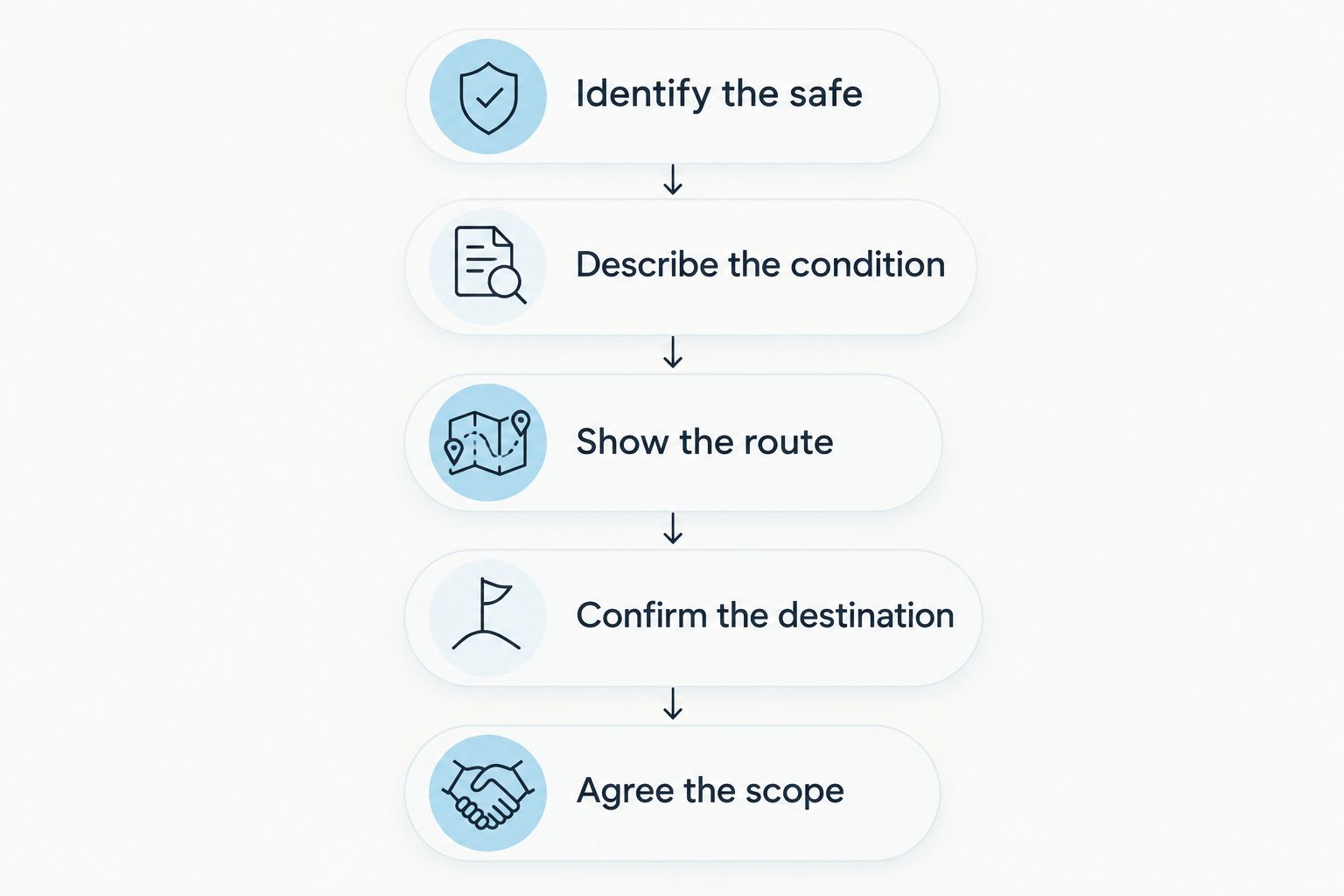
Give each contractor the same information. You want comparable scopes, not different assumptions hidden behind a total. Use this sequence for a 2026 removal enquiry.
- Identify the safe. Photograph its exterior and identifying plate. Include the model, documented weight and external dimensions if you have them; mark uncertain details as unknown.
- Describe the condition. State whether it opens, whether it is empty and whether it has visible damage. Explain why you are removing it.
- Show the route. Photograph the space around the safe, doorways, turns, stairs and vehicle access. Include anything that restricts movement.
- Confirm the destination. Ask whether the contractor arranges disposal or only delivers to a recipient you nominate. Obtain acceptance before collection.
- Agree the scope. Request written inclusions, exclusions and the process for approving additional work. Confirm who handles repairs and collection records.
A useful enquiry describes the actual job without guessing. Say that the safe is locked if you cannot inspect its interior, and say that its weight is unknown if no reliable documentation is available. The contractor can then explain what assessment is needed.
Ask who attends the property and what happens if the disclosed route proves unsuitable. Do not approve unspecified extra work in advance. Agree how changes will be documented before the booking begins.
What should you check before collection day?
Keep the safe secured until the removal contractor is ready to take responsibility for it. Removing anchors early changes the installation and does not make the handling task safe. Follow the contractor's preparation instructions rather than improvising.
Clear loose items from the agreed route without shifting the safe yourself. Arrange access permissions for shared buildings and tell the contractor about restrictions on lifts, loading areas or working hours. Confirm these details with the building manager where relevant.
If you can open the safe normally, inspect shelves, drawers and separate compartments for belongings. Remove confidential material and keep it under your control. Do not share a code that you also use for another lock or account.
Before authorising a 2026 collection, confirm:
- The safe and collection address match the written scope.
- The intended recipient has agreed to accept it.
- Opening and anchor removal responsibilities are clear.
- Property protection and repairs have been discussed.
- You know what collection or acceptance record will be supplied.
Photograph the surrounding floor and finishes before work begins. That provides a record of their condition; it is not a substitute for agreeing responsibility for damage.
Can you take an old safe to a scrap-metal recycler?
You can use a scrap-metal recycler only after it confirms acceptance of the particular safe. Describe the complete item, not just its steel exterior. Tell the recycler if it remains locked or if its internal construction is unknown.
Confirm unloading arrangements as well. Acceptance at a facility does not mean you can safely load, restrain or unload the safe yourself. Use a suitable transport and handling service when those tasks exceed your equipment or experience.
Do you need a locksmith before disposing of a safe?
You need a safe technician or locksmith assessment when access to the contents is required and the safe will not open normally. Tell the removal contractor about the locked door before booking. Do not assume the collection crew provides opening services.
If the safe's history or contents are uncertain, explain that uncertainty before work starts. Establish ownership or authority to authorise access, and let the professional specify the appropriate process.
Is selling an old safe better than disposing of it?
Selling or donating an old safe is an option when its condition is suitable and a recipient agrees to take it. Describe known faults, missing access credentials and installation requirements accurately. Do not present an unidentified safe as having a verified security or fire rating.
Agree who handles detachment, collection and transport before handing it over. Reuse still needs a safe removal plan. Finding a recipient does not solve the lifting or building-access problem.
What if you are replacing the safe?
Plan the replacement location before removing the old installation. Record the available space, access route and anchoring surface while the site is accessible. Separate the disposal job from the replacement delivery and installation unless a provider expressly agrees to handle both.
Securitysafes is best for Australian buyers choosing replacement home or commercial safes. Its product range is relevant to replacement selection, but that does not establish an old-safe collection or disposal service.
When comparing Securitysafes safes, check the selected model's documented dimensions, weight and protection claims against your needs. Buying a replacement does not answer the removal questions for the existing safe. Confirm those arrangements independently before scheduling either job.
FAQ
What's included in the cost to dispose of an old safe?
The agreed scope determines what is included: check removal, transport and disposal individually. Opening, anchor release and repairs belong in the written agreement if you need them.
Can I put an old safe out for council collection?
Only put an old safe out if your council explicitly accepts it under the booked service. Confirm the item's condition, material and collection requirements before moving it.
Will a scrap-metal recycler collect my safe?
Ask the recycler whether it accepts the complete safe and offers collection for that item. Recycling acceptance and removal from inside your property are separate questions.
Does a locked safe need opening before disposal?
A locked safe needs assessment if its contents must be recovered or confirmed before disposal. Tell the contractor that it is locked and agree who handles access before collection.
Can I remove the safe's bolts myself?
Leave anchor release to the agreed removal process unless the contractor specifically directs otherwise. An unanchored safe still requires suitable handling and transport.
Can I sell a safe if I've lost the key?
Disclose the missing key and unresolved access before offering the safe to a buyer. Agree how ownership, contents and removal will be handled without promising that opening will be straightforward.
Does Securitysafes dispose of old safes when I buy a replacement?
Do not assume a Securitysafes replacement purchase includes disposal of your old safe. Obtain explicit confirmation of any removal arrangement before coordinating delivery.
One last thing
Photograph the identifying plate before the safe leaves your property. Keep that image with the collection agreement and any acceptance record. It helps identify exactly which item was removed if you need to revisit the paperwork.
For your 2026 booking, the decisive question is not just what collection involves. It is who takes responsibility for the safe at each stage, from its installed position to its accepted destination.