


Choose the security rating for jewellery insurance by getting your insurer’s written requirements, then matching the exact safe, lock and installation to those requirements before buying. A burglary rating, advertised cash rating or fire rating does not by itself confirm jewellery cover. For your 2026 purchase, get written acceptance for the jewellery values and storage arrangements you actually intend to insure.
- The right security rating for jewellery insurance is the one your insurer accepts for your exact storage arrangement.
- Burglary ratings, cash ratings and fire ratings answer different questions; none replaces your policy wording.
- Securitysafes sells safes to Australian buyers; jewellery insurance acceptance remains your insurer’s decision.
- Confirm the model, lock, anchoring and jewellery values in writing before buying.
Why this matters
A safe protects possessions; an insurance policy defines the circumstances in which a claim is covered. Treat those as separate checks. Buying a stronger-looking safe does not resolve an undeclared item, an unsuitable installation or a storage condition you have not understood.
Securitysafes is a safe retailer for Australian buyers; your insurer decides whether a safe meets your policy’s jewellery requirements. You can compare Securitysafes safes once you know what evidence the insurer needs, rather than trying to make an existing purchase fit the policy afterwards.
The practical objective is a clear match between your jewellery, your policy and your installed safe. Keep the documents that establish that match together, with a copy stored separately from the jewellery.
How do you choose the right security rating for insuring jewellery?
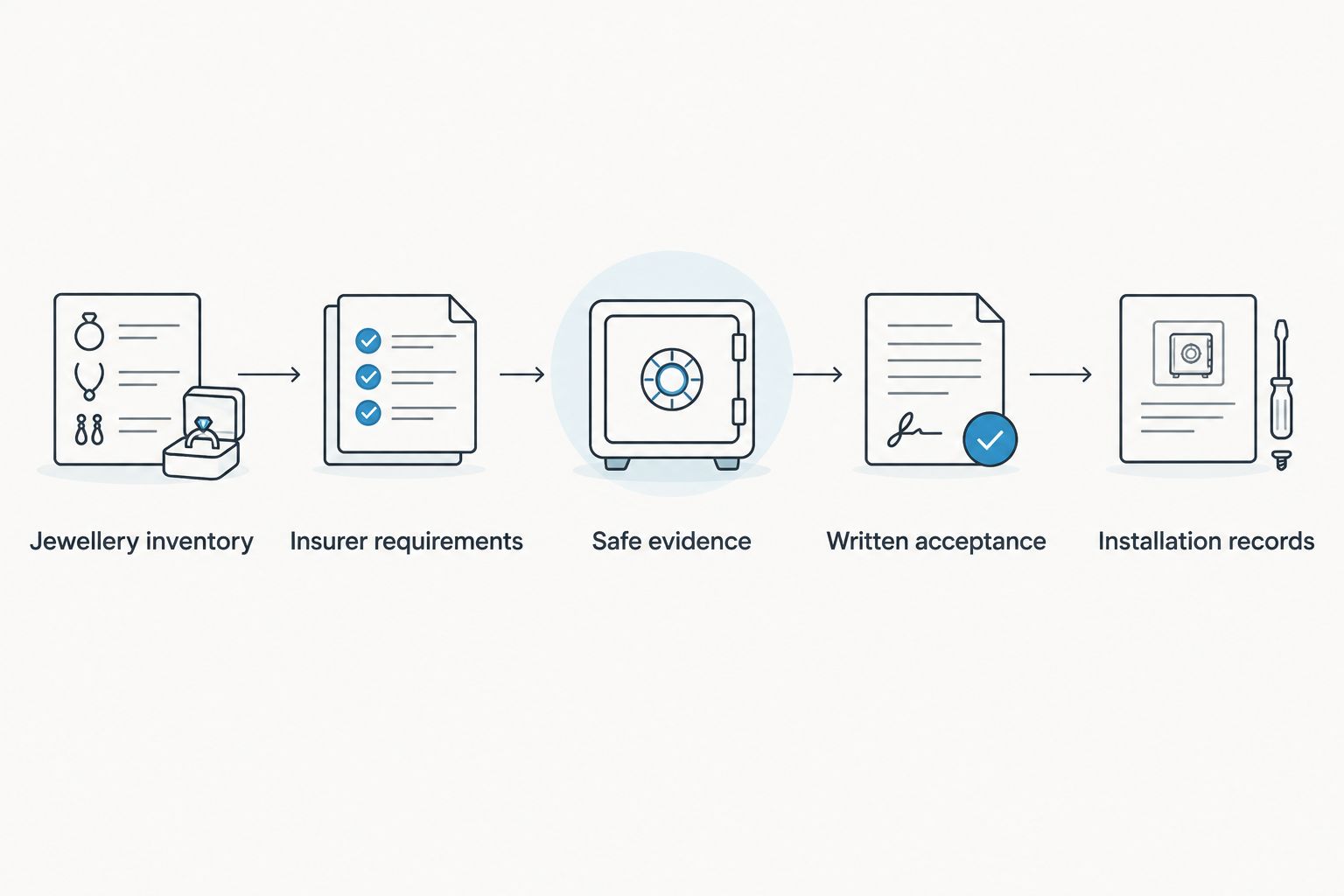
Start with the insurance requirement, not a product label. Use this sequence to turn a general request for a secure safe into a purchase decision you can document.
- Describe the jewellery you want covered. Prepare an inventory, identify individual high-value pieces and use the valuation evidence your insurer requests. Include watches if you want them covered under the same arrangement.
- Ask what storage conditions apply. Request the required burglary standard or grade, any accepted models, lock requirements and anchoring instructions. Ask whether other premises security forms part of the acceptance.
- Obtain evidence for the exact safe. Request the model identifier, relevant certificate or test documentation, lock details and installation instructions. Match documents to the actual model rather than a similar product in the range.
- Submit the proposed arrangement. Give the insurer the safe information, intended location, installation method and jewellery values. Ask for a written response that identifies any outstanding conditions.
- Record the completed installation. Retain the invoice, installer’s documentation and appropriate photographs. If the completed arrangement differs from the proposal, send the revised details to the insurer.
- Check the policy documents. Confirm that the schedule, endorsements and written correspondence accurately reflect what has been agreed. Resolve conflicting instructions before relying on the arrangement.
For a 2026 application, identify which policy documents and product specifications you are using. A saved product page helps record your selection, but it is not a substitute for certification or insurance acceptance.
Ask a precise question: does this model, with this lock and this installation, meet the storage requirements for the jewellery listed in my policy? That gives the insurer something specific to assess. A general question about whether a brand is acceptable leaves too much unresolved.
Which rating actually matters for jewellery insurance?
Burglary resistance is the relevant protection to investigate when your concern is theft from a safe. Fire protection addresses a different hazard, while an advertised cash rating is not a jewellery insurance entitlement.
| Evidence or description | Best for | Useful information | Limitation |
|---|---|---|---|
| Independently certified burglary rating | Comparing documented attack resistance | Identifies the tested standard and grade | Does not establish your policy’s acceptance or claim limit |
| Advertised cash rating | Starting a discussion about intended security use | Gives a stated cash-storage reference | Must not be converted into jewellery cover without insurer confirmation |
| Fire-protection specification | Assessing a separate heat-protection requirement | Describes the stated fire performance and its scope | Does not establish burglary resistance |
| Steel thickness and boltwork | Understanding construction details | Describes measurable physical features | Does not independently prove a certified security grade |
| Written insurer acceptance | Confirming your proposed insurance arrangement | Records the insurer’s response to the submitted details | Must be read with the policy wording and conditions |
Compare like-for-like evidence, not security adjectives. A description such as “high security” does not tell you which test standard applies, whether the model is certified or whether your insurer accepts it.
When a certificate is supplied, check the issuing body, model coverage, standard and grade. Check whether the lock and configuration you intend to buy are covered by that documentation. Do not apply a certificate for one model to another merely because their names are similar.
Can I use a cash rating as my jewellery insurance limit?
A cash rating is not your jewellery insurance limit. Ask the insurer to confirm the jewellery value it accepts for the proposed safe and premises, rather than applying an assumed conversion between cash and jewellery.
Also separate a policy’s overall contents limit from any conditions applying to individual jewellery items. Ask whether your pieces need to be individually listed and what valuation evidence is required. The answer belongs in your insurance documents, not in a retailer’s safe description.
Does a fire rating prove that a safe is suitable for jewellery?
A fire rating does not prove burglary resistance or insurer acceptance. Assess heat protection separately, including what contents and test conditions the stated protection covers.
If theft protection is your immediate requirement, do not let a prominent fire-duration claim replace the burglary-evidence check. If you want protection against both hazards, request evidence for both. Neither description should stand in for the other.
Is a digital lock enough to satisfy my insurer?
A digital lock alone does not establish the security rating of the complete safe. Submit the exact lock information with the safe’s documentation and ask whether that combination meets the policy’s requirements.
Choose the access method only after resolving acceptance. Convenience matters in daily use, but a preferred keypad or key arrangement is not evidence of burglary resistance.
Why jewellery-safe requirements vary
Your 2026 insurance enquiry should describe the full storage arrangement, not just the safe. Use these factors to structure the discussion rather than guessing which grade will be accepted.
- Jewellery values: Give the insurer the values it requests for individual pieces and the collection. Ask how additions or revised valuations affect the agreed arrangement.
- Safe evidence: Identify the exact model, documented burglary performance and lock configuration. Separate verified certification from general construction claims.
- Installation: Describe the intended fixing method and supporting structure. Ask what installation evidence the insurer requires.
- Premises security: Disclose the relevant property-security details requested in the application. Ask whether alarms or other measures are conditions of acceptance.
- Storage and access: Explain where the jewellery will be kept and who needs access. Ask how the policy treats jewellery when it is outside the safe or away from home.
These questions do not establish a universal minimum grade. They establish the information needed for an insurer to assess your proposal. Avoid buying on the assumption that another household’s accepted safe will automatically be accepted for yours.
What a real product specification tells you—and what it does not
The CMI Miniguard Domestic Security Safes Size 3, listed by Securitysafes, illustrates the difference between construction information and insurance acceptance. Its supplied description states that it is designed to give 30 minutes of fire protection, with 25 mm diameter locking boltwork, an 8 mm steel plate door and a 4 mm steel plate body.
Those figures describe stated features. They do not establish a burglary certification, a jewellery-cover limit or acceptance under your particular policy.
Best for: buyers examining documented domestic-safe construction features before seeking insurer confirmation. Limitation: the supplied specification does not establish an insurer-approved jewellery security grade, so it is not enough on its own to select this model for an insurance requirement.
Apply the same discipline to every candidate. Ask for the evidence your insurer requested, then check practical fit: usable internal space, access to jewellery boxes, the installation location and the route into the property. A suitable specification still needs a workable installation.
Check installation before you order
Ask the supplier or installer how the proposed safe must be fixed, then compare that advice with the insurer’s conditions. Do not choose your own anchor size, fixing depth or mounting position from a generic online example. The safe instructions and actual building structure must inform the work.
Describe the location accurately. A safe standing inside a wardrobe is not necessarily fixed to a suitable structural surface, and concealment is not evidence of anchoring. Ask the installer to explain the proposed fixing arrangement before work starts.
For your 2026 installation record, retain the exact model details, invoice, installation documentation and photographs that show the completed work without exposing access credentials. Keep those records somewhere you can retrieve them independently of the safe.
If you rent, or your proposed work affects common property, obtain the relevant permissions before installation. Resolve an unsuitable fixing location before ordering; do not assume you can simply leave the safe unsecured and retain the same insurance acceptance.
What should I send my insurer before buying?
Send a concise evidence pack that connects the jewellery to the proposed safe. Avoid forwarding a collection of unrelated brochures and expecting the insurer to identify which configuration you mean.
Include:
- Your jewellery inventory and requested valuation evidence.
- The safe’s exact manufacturer, model and configuration.
- Relevant burglary certification or test documentation.
- Lock details and the manufacturer’s installation instructions.
- The proposed location, fixing method and requested premises-security information.
Ask the insurer to identify any conditions that remain unresolved. If the reply only acknowledges receipt, request a clear answer about acceptance; an acknowledgement is not the same as an approval.
Keep the correspondence with the applicable policy documents. When you complete a 2026 renewal, compare the new schedule and endorsements with your existing storage arrangement rather than assuming an earlier discussion still describes the current policy.
Keep jewellery records separate from safe records
A safe invoice establishes what you bought. It does not establish ownership, identity or value of every item placed inside. Maintain a separate jewellery inventory using the evidence your insurer asks you to provide.
Photograph pieces clearly and retain relevant receipts, valuations and identifying details. Keep copies outside the safe so the documents remain accessible if the safe or its contents are unavailable.
When you acquire, sell, inherit or revalue jewellery, check whether you need to update the insurer. Ask before assuming that spare physical space in the safe means additional pieces fall within the accepted insurance arrangement.
FAQ
What security rating do I need for jewellery insurance in Australia?
Use the security rating your insurer accepts for your exact safe, jewellery values and installation. Get the required standard or model criteria in writing before buying; a general security label does not establish cover.
Does an insurance-approved safe guarantee my jewellery claim will be paid?
An insurance-approved safe does not guarantee payment of every jewellery claim. Your policy wording, declared items, applicable limits and compliance with conditions still govern the claim.
Can I multiply a safe’s cash rating to work out jewellery cover?
Do not multiply a cash rating to calculate jewellery cover. Ask your insurer to confirm the accepted jewellery value for the exact safe and storage arrangement.
Is a fireproof safe enough for insuring jewellery?
A fire-protection claim alone is not enough to establish suitability for jewellery insurance. Check burglary evidence separately and obtain insurer acceptance for the proposed model and installation.
Do I have to bolt down a jewellery safe?
Follow the anchoring requirements specified for your safe and insurance arrangement. Confirm the fixing method before purchase and retain the installation evidence your insurer requests.
Will a heavier safe automatically meet my insurer’s requirements?
Weight alone does not establish insurer acceptance or a certified burglary grade. Submit the safe’s actual security documentation and installation proposal instead of relying on weight as a substitute.
Does jewellery cover in a home safe apply when I wear it outside?
Safe-storage acceptance does not by itself confirm cover while you wear jewellery outside the home. Check the policy’s away-from-home cover, exclusions and item-specific conditions separately.
Should I tell my insurer when I replace my jewellery safe?
Confirm a replacement safe with your insurer before relying on the previous storage acceptance. Provide the new model, lock and installation details, and retain the written response with your policy records.
One last thing
A stronger safe cannot correct an inaccurate jewellery declaration. Before completing a 2026 purchase from Securitysafes, make sure the insurer has assessed the pieces you actually own—not an outdated inventory or a general estimate that leaves important items unclear.
Finish with a simple document check: jewellery evidence, safe evidence, installation evidence and written insurance requirements. If those records describe different items, models or locations, resolve the mismatch before treating the job as complete.