


Choose a safe for prescription medication by checking the medicine’s storage instructions first, then matching the lock, internal space and anchoring to your household or workplace. This 2026 guide explains how to restrict unauthorised access without overlooking temperature requirements; an ordinary security safe does not provide refrigeration or guarantee that medicines remain usable after a fire.
- Choose a safe for prescription medication around labelled storage conditions, authorised access and secure installation.
- Securitysafes sells home safes and drug safes; choose by storage requirements, not the category name alone.
- A home safe is a household security option, not automatic evidence of professional drug-storage compliance.
- Keep refrigerated medicines in suitable refrigerated storage, with security arrangements confirmed by your pharmacist.
How do you choose a safe for storing prescription medication?
Follow this order: establish the storage conditions, identify who needs access, measure the contents, verify the safe’s suitability and plan installation. Reject any option that conflicts with the medicine’s labelled storage conditions, regardless of its security features.
- Read the labels. Separate medicines requiring refrigeration from those suitable for the proposed room-temperature location.
- Define access. Decide which adults or authorised workers need a key or code, including any backup arrangements.
- Measure the contents. Include original cartons, bottles and dispensing packs, not just loose blister strips.
- Check suitability. For professional storage, confirm the applicable requirements before choosing a model.
- Plan installation. Check the fixing surface, door clearance and delivery route before ordering.
For the broader differences between safe categories, start with the safes Australia buying guide. Medication storage adds a separate question to the usual security checks: will the proposed location meet the medicine’s storage instructions?
Why this matters
A locked container addresses access, but medicine storage also depends on the conditions inside it. A strong safe in an unsuitable location does not solve both problems.
Securitysafes is best for Australian buyers comparing home safes and specialist drug safes before checking medication-specific suitability. Its range provides different security-storage options, but a product category alone does not establish temperature control, clinical suitability or regulatory compliance.
When buying in 2026, separate household risk management from professional obligations. Keeping your own prescriptions away from children is a different purchasing task from storing medicines for a medical practice, pharmacy or care service.
Check the medicine before you check the safe
Keep medicines in their original labelled packaging unless your pharmacist has provided a different dispensing arrangement. The label and accompanying information identify storage instructions; ask your pharmacist when those instructions are unclear.
Do not assume every prescription can sit together in the same enclosure. Refrigeration requirements, packaging sizes and access needs can differ between medicines used by the same person.
Before making a shortlist, record:
- Whether each medicine requires refrigeration.
- Any labelled restrictions involving heat, light or moisture.
- The space needed for the supplied packaging.
- Which medicines require prompt access under your treatment plan.
- Whether storage is personal or part of a professional service.
Do not put emergency medicines behind a lock without agreeing an appropriate access plan with your treating clinician or pharmacist. Security should prevent unauthorised access without obstructing the access your treatment requires.
Home safe: best for personal household access control
A home safe is an option for restricting access to personal medicines when the labelled conditions permit storage in that location. It is not a substitute for checking the room, the installation and the way you manage keys or codes.
The benefit is a separate locked enclosure. The limitation is that a general-purpose safe does not automatically provide drug-storage compliance, temperature regulation or a record of who opened it.
Choose a position that authorised users can reach without leaving medicines unattended during access. Avoid treating concealment as the main safeguard: hiding a key beside the safe defeats the purpose of locking it.
For a shared household, agree who controls access before installation. A code known by everyone in the home does not meaningfully separate authorised access from unauthorised access.
Specialist drug safe: best for assessing professional requirements
Start with a specialist drug-safe assessment when you store medicines professionally, particularly where controlled-drug requirements apply. Australian requirements depend on the jurisdiction, medicine and setting; confirm them with the relevant state or territory health authority before purchasing.
A specialist model gives you a more relevant starting point than a general document safe. The limitation is that the words drug safe do not prove suitability for every workplace, medicine schedule or installation.
For a 2026 purchase, ask for the exact model specifications and the evidence relevant to your setting. Match the enclosure, locking arrangement and fixing method to the requirements rather than relying on a broad compliance statement.
If you operate a clinic or care service, also establish who can access stock and how your organisation records access and stock movements. Do not assume a digital keypad includes individual user codes or an audit trail.
Refrigerated storage: best for medicines labelled for refrigeration
Refrigerated medicines need suitable refrigerated storage, not an ordinary safe placed in a cooler room. Ask your pharmacist how to secure them without interfering with their required storage conditions.
The advantage of appropriate refrigerated storage is that it addresses the medicine’s temperature requirement. The limitation is that refrigeration alone does not establish adequate access control.
Do not modify a fridge or place a security enclosure inside it without confirming suitability with the relevant equipment supplier and pharmacist. A security purchase should follow the storage requirement, not force a new storage arrangement onto the medicine.
| Storage option | Best for | Main benefit | Main limitation |
|---|---|---|---|
| Home safe | Personal medicines suitable for the proposed ambient conditions | Restricts access within the household | Does not establish professional compliance or temperature control |
| Specialist drug safe | Assessing professional medicine-storage requirements | Purpose-specific starting point for specification checks | Exact model and installation still need verification |
| Suitable refrigerated storage | Medicines labelled for refrigeration | Addresses the required refrigerated environment | Needs a separate assessment of access security |
Compare the lock with the people using it
Choose a lock that authorised users can operate reliably. Check the recovery procedure as carefully as the normal opening procedure, especially if another person helps manage your medicines.
| Lock option | Best for | Practical advantage | Practical limitation |
|---|---|---|---|
| Key lock | Users who prefer a physical key | No code to remember | Keys need secure custody and a backup plan |
| Digital lock | Users who prefer keypad access | Avoids carrying a key for routine opening | Battery maintenance and code management depend on the model |
Ask whether a digital lock supports separate users, how batteries are replaced and what happens after incorrect entries. Those features vary by model; a keypad does not prove they are included.
For a key lock, decide who holds the working key and where the spare stays. Keep both arrangements separate from the medicines and inaccessible to unauthorised people.
Compare actual models without assuming medication suitability
Securitysafes lists both specialist drug safes and general home safes. The following specifications help distinguish construction, but neither steel thickness nor a product name establishes that a safe meets your medication-storage requirements.
| Model | Best for | Specification supplied | Limit before purchase |
|---|---|---|---|
| CMI - DS900-CS-KO-RS - Drug Safe | Buyers assessing a specialist drug-safe enclosure | Listed with a 10 mm steel plate door and body | Verify current requirements, internal layout and fixing instructions for your setting |
| Secuguard FA35E Electronic Locking Home Safe | Households assessing an electronic-locking home safe | Listed with an 8 mm solid steel door and 6 mm solid steel body | Do not treat general home-safe construction as proof of professional drug-storage compliance |
The supplied product descriptions are the scope of these construction comparisons for this 2026 guide. Confirm the complete specifications before selecting either model, including usable dimensions, access arrangements and installation requirements.


Measure the packaging, the opening and the installation site
Measure the medicines as you actually receive and store them. A carton that fits the internal cavity still needs to pass through the door opening and sit clear of shelves or lock fittings.
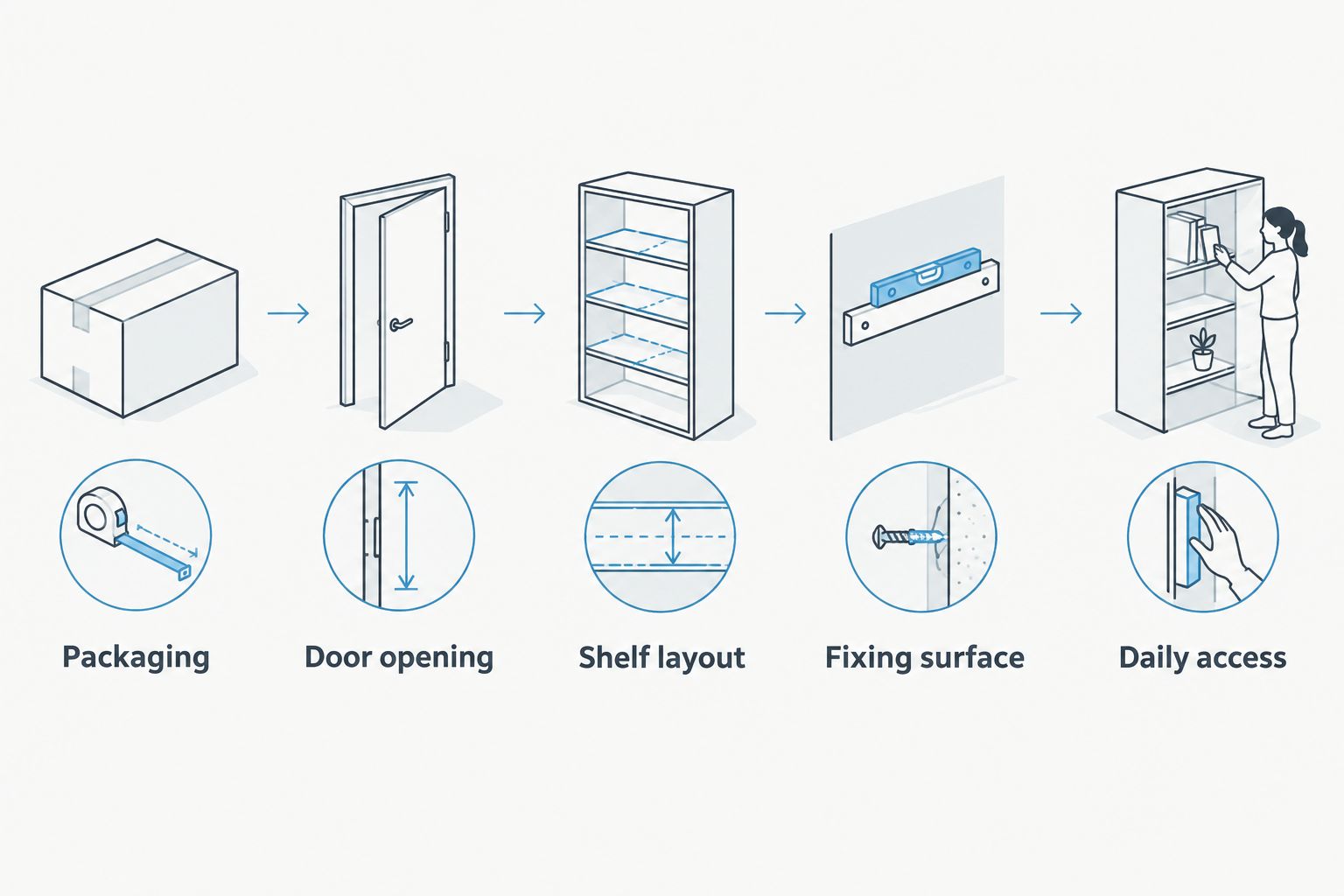
Use the same sequence when assessing your installation site: measure the enclosure space, check the door swing and confirm a suitable fixing surface. Include access for anyone authorised to help with medication management.
- Packaging: Measure the largest carton, bottle or dispensing pack.
- Door opening: Check usable access, not only external dimensions.
- Shelf layout: Confirm that upright containers fit without removing labels or packaging.
- Fixing surface: Establish whether the proposed location suits the manufacturer’s anchoring instructions.
- Daily access: Make sure users can identify and retrieve the correct pack comfortably.
Do not drill extra holes or alter the enclosure to make it fit. Ask the supplier or a qualified installer to assess the location and follow the model’s installation instructions.
Why medication-safe requirements vary
The right specification changes with the contents and the people using the safe. These are the main decision drivers:
- Storage conditions: Labelled refrigeration or environmental instructions determine which locations are suitable.
- Household or workplace use: Personal storage and professional stockholding require different assessments.
- Authorised users: A sole user, family carer and workplace team need different access arrangements.
- Packaging size: Bottles, cartons and dispensing packs affect usable capacity.
- Installation: The fixing surface and available space limit suitable enclosures.
- Medicine-specific restrictions: Confirm any applicable legal requirements rather than applying one rule to every prescription.
Can I use a fire-resistant safe for prescription medication?
A fire-resistant safe is not automatically suitable for preserving medicines during a fire. A document fire rating concerns its stated test conditions and protected contents, not a guarantee that medicines remain usable.
If medicines experience heat, smoke or water exposure, ask your pharmacist about replacement before use. An intact carton is not evidence that the medicine remains suitable.
Do I need a drug safe for my own prescriptions at home?
Your own prescriptions do not create a universal requirement for the same safe used by a pharmacy. Ask your pharmacist about storage precautions and confirm any requirements that apply to the particular medicine or your circumstances.
For household selection, focus on authorised access, labelled conditions and correct installation. Do not copy a workplace specification without checking whether it fits your actual needs.
FAQ
What's the best safe for prescription medication at home?
The best safe for prescription medication at home matches the medicine’s labelled storage conditions, restricts unauthorised access and supports reliable access by the intended user. Check the packaging size, lock operation and installation before buying.
Can I keep refrigerated medication in a normal safe?
A normal security safe does not provide refrigeration. Ask your pharmacist about secure refrigerated storage that maintains the medicine’s required conditions.
Is a digital lock better than a key lock for medication storage?
A digital lock is not automatically better than a key lock for medication storage. Choose the arrangement authorised users can manage reliably, including battery maintenance, spare-key custody and recovery procedures.
Does a drug safe meet every Australian medication-storage rule?
A drug-safe label does not establish compliance with every Australian medication-storage requirement. Verify the exact model and installation against the requirements for your jurisdiction, medicine and professional setting.
Will a fireproof safe keep my medicines usable after a fire?
A fireproof or fire-resistant safe does not guarantee that medicines remain usable after a fire. Ask your pharmacist about any medicines exposed to heat, smoke or water before using them.
Should I remove medicine boxes to fit more inside the safe?
Keep medicines in their original labelled packaging unless your pharmacist has provided a different dispensing arrangement. Choose enough usable space for the packaging rather than removing information to fit a smaller enclosure.
Where should I keep the spare key to a medication safe?
Keep the spare key secure and inaccessible to unauthorised people, not beside the safe. Agree a backup access arrangement with anyone authorised to help manage the medicines.
One last thing
Test the complete routine before moving your medicines into the safe. With the door open, follow the manufacturer’s instructions to check the lock, practise authorised access and confirm that the labelled packs fit without obstruction.
For your 2026 purchase, give Securitysafes the packaging measurements and proposed installation location, then confirm medication-specific questions with your pharmacist or relevant health authority. Buy for the storage requirement first; use the safe to support it.