


A safe can be shipped to a regional address in Australia when the retailer and freight provider confirm service for the exact address, safe and unloading requirements. Delivery to your property does not automatically include moving the safe indoors or bolting it down. Before ordering in 2026, get written confirmation of the delivery endpoint, unloading arrangements and responsibility for the final move.
- Safe shipping regional Australia: confirm the exact address, unloading method and delivery endpoint before ordering.
- Securitysafes sells home and commercial safes; request address-specific freight confirmation before committing to a model.
- Regional safe delivery and safe installation are separate tasks unless your written agreement includes both.
- Compare packed freight dimensions and weight, not just the safe’s internal storage capacity.
Why this matters
A safe reaching your postcode is not the same as a safe reaching its installation position. Your delivery plan needs to cover the entire route: the freight vehicle’s stopping point, unloading, movement through the property and final placement.
Securitysafes suits buyers comparing home and commercial safes before requesting address-specific freight confirmation. Use the contact page to provide the model, full address and access details rather than asking only whether regional delivery is possible.
Keep security requirements separate from transport convenience. Choose a safe that meets your storage needs, then establish a workable delivery plan; do not substitute a lighter model solely because it looks easier to move.
Can a safe be shipped to a regional address in Australia?
Yes, subject to confirmation for the particular shipment. Follow these steps before paying for a regional safe delivery in 2026:
- Identify the exact model. Supply the complete product name so the freight enquiry concerns the correct safe.
- Provide the full destination. Include the street address, locality, postcode and whether it is residential, commercial or a rural property.
- Describe vehicle access. Explain gates, driveway surfaces, gradients, overhead obstructions and space to turn around.
- Confirm unloading. Ask who supplies the equipment and who takes responsibility for unloading the packed safe.
- Name the delivery endpoint. Specify whether you need depot collection, an external handover or placement inside the building.
- Arrange installation separately if necessary. Establish who moves the safe from the handover point and who secures it in position.
Ask for these arrangements in writing. A confirmation that mentions only your postcode leaves the unloading method and final placement unresolved.
If someone else receives the shipment, give that person the agreed scope and the relevant contact details. They should know where the vehicle is expected to stop and what the delivery crew has actually agreed to do.
Which delivery arrangement should you request?
The following arrangements describe different handover scopes, not services promised by a particular retailer. Ask which arrangement can be provided for your address and selected safe.
| Arrangement to ask about | Best for | Practical advantage | Limitation to resolve |
|---|---|---|---|
| Depot collection | Buyers with suitable onward transport and handling arrangements | Gives you a defined collection point | You must arrange safe loading, transport and unloading afterwards |
| External property handover | Sites with a suitable agreed unloading area | Brings the shipment to the agreed property location | Does not establish who moves the safe indoors |
| Placement inside | Buyers needing the safe moved to a nominated room | Addresses the route beyond the vehicle | Doorways, steps, flooring and equipment need assessment |
| Placement and anchoring | Buyers wanting delivery and securing coordinated | Connects final placement with installation | Requires an agreed fixing method and suitable installation surface |
Choose the handover scope you can safely complete, not the shortest description on a freight enquiry. Depot collection is not a complete solution unless the onward journey is already organised.
For an external handover, nominate a precise location. A driveway entrance, shed doorway and internal storeroom are different destinations, even when they share the same street address.
A 104 kg safe: plan handling despite the compact footprint
The Chubb Mini Banker MkII Security Safe Size 1 Digital Locking (M-15) has listed external dimensions of 410 × 360 × 386 mm, measured height × width × depth. Its listed weight is 104 kg.
Those figures make the distinction between size and handling clear. A compact footprint does not make this safe suitable for an improvised manual lift; give the listed weight to whoever assesses transport and installation.
Best for: buyers comparing a smaller external footprint within the Mini Banker range. The advantage is its smaller cabinet size compared with Size 4; the limitation is that its weight still requires a deliberate handling plan.
Its listed internal dimensions are 280 × 230 × 205 mm. Use internal measurements to check your belongings and external measurements to assess the installation location—neither replaces the packed dimensions required for freight planning.
A 257 kg safe: confirm the full route before dispatch
The Chubb Mini Banker MkII Security Safe Size 4 Digital Locking (M-75) has listed external dimensions of 590 × 550 × 576 mm and a listed weight of 257 kg. Its listed internal dimensions are 460 × 420 × 395 mm.
Best for: buyers needing more internal room than the Size 1 model provides and whose site can accommodate the larger cabinet. The benefit is greater usable space; the trade-off is a heavier, larger object to transport and position.
Before dispatch, have the delivery or installation provider assess the route to the intended room. If a suspended floor, stairs or another structural concern is involved, obtain an appropriate professional assessment rather than treating doorway clearance as the only check.
How do these safe dimensions compare?
These are product specifications, not packed freight measurements or a delivery feasibility assessment. Securitysafes lists the following dimensions and weights for these safes; confirm the shipment details separately when requesting your 2026 freight arrangement.
| Model | External dimensions, H × W × D | Internal dimensions, H × W × D | Listed weight | Best for |
|---|---|---|---|---|
| Chubb Mini Banker MkII Security Safe Size 1 Digital Locking (M-15) | 410 × 360 × 386 mm | 280 × 230 × 205 mm | 104 kg | Comparing a smaller cabinet footprint |
| Chubb Mini Banker MkII Security Safe Size 4 Digital Locking (M-75) | 590 × 550 × 576 mm | 460 × 420 × 395 mm | 257 kg | Comparing greater internal storage space |
Do not treat either model as a recommendation based on shipping alone. Check the protection requirements, contents and installation position before deciding whether either safe belongs on your shortlist.


Why regional safe delivery arrangements vary
Your address and selected model need to be assessed together. Give the provider enough information to resolve these factors instead of expecting a postcode check to answer every question:
- Destination: provide the complete address and identify the intended handover point.
- Safe specifications: supply the model, listed weight and external dimensions, then request packed shipment details.
- Vehicle access: describe the driveway, gates, turning space and any restrictions between the road and unloading area.
- Unloading requirements: identify the proposed equipment and confirm who supplies and operates it.
- Internal access: disclose steps, narrow openings, tight turns and the intended room.
- Installation scope: confirm whether positioning, anchoring and packaging removal form part of the agreement.
These are questions to settle, not assumptions about what a regional service includes. In particular, do not describe a site as straightforward simply because it is on the ground floor.
An uninterrupted route still needs enough clearance for the safe and the handling method. Ask the provider what measurements and photographs they require before declaring access suitable.
What should you send with a regional freight enquiry?
For a useful 2026 enquiry, send a short site description alongside the product name. Keep delivery information together so the retailer, freight provider and installer can assess the same destination.
Include:
- Full address, postcode and a contact person who understands the site.
- Exact safe model and intended installation room.
- Photographs from the road to the proposed unloading point.
- Photographs of gates, steps, thresholds and restricted turns.
- Clear opening measurements along the internal route.
- Details of any loading equipment you propose to provide.
- A request to confirm where freight handling ends and installation begins.
Describe the route honestly, including the awkward sections. A photograph showing a threshold or sloping approach is more useful than a general assurance that access is easy.
Keep safe codes, keys and details of the intended contents out of the delivery enquiry. Access planning needs the model and physical route, not information that compromises the security of the finished installation.
How should you prepare the property?
Walk the proposed route before the delivery date is agreed. Start where the freight vehicle is expected to stop, then follow the exact path to the final location—not an alternative entrance the crew has not assessed.
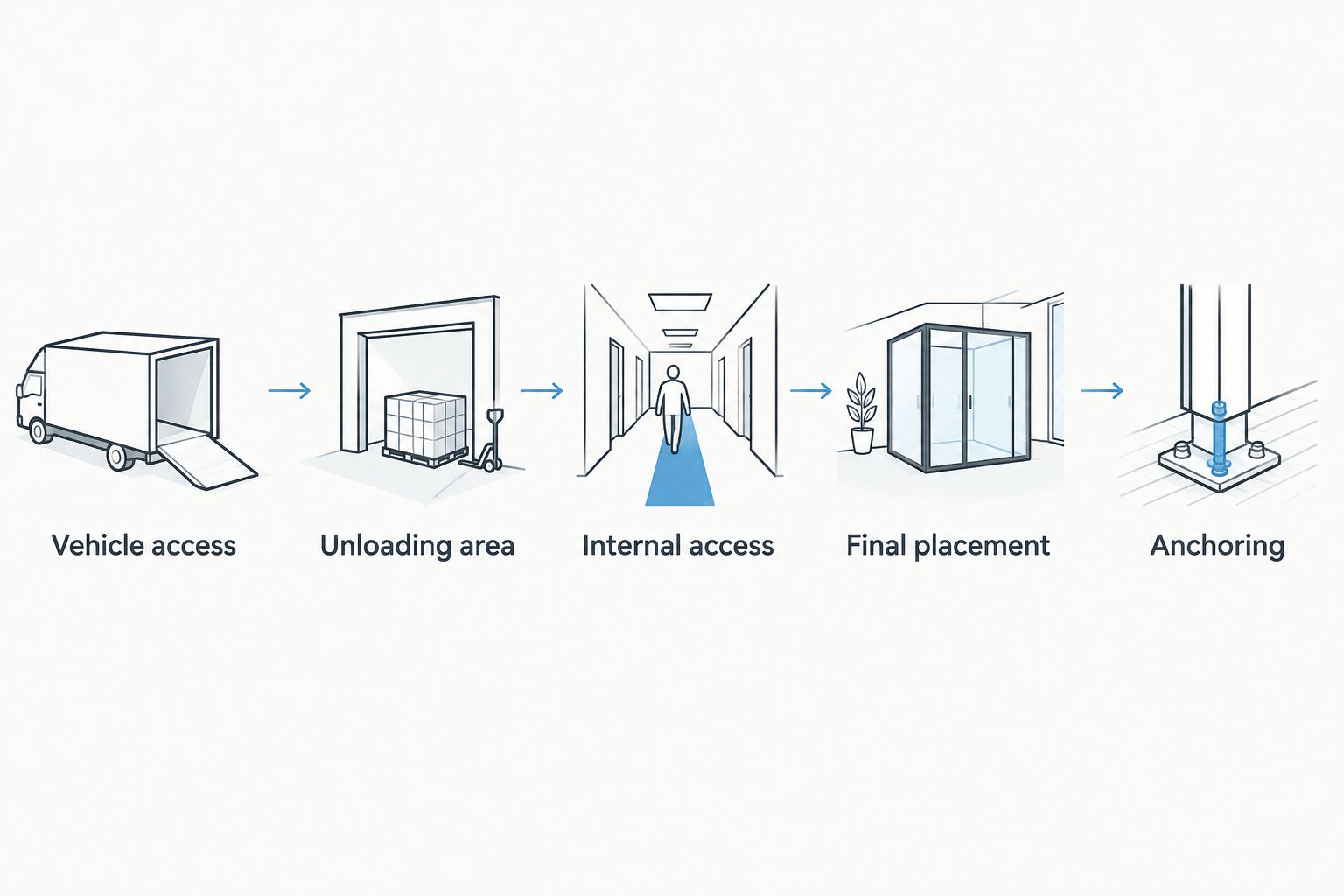
Remove movable obstructions from the agreed route and keep children, visitors and pets away from handling work. Leave lifting, restraint and equipment decisions to the people responsible for the move; do not improvise with household trolleys or helpers on arrival.
Check that the agreed receiving area is accessible when the vehicle arrives. If a gate requires someone to attend, or a business has restricted receiving hours, communicate that before dispatch.
For indoor placement, discuss floor protection and the final orientation of the safe. The door needs to open for normal use, and the installation provider needs access to complete the agreed securing work.
Does regional safe delivery include installation?
Regional safe delivery includes installation only when the written agreement explicitly includes it. Ask separately about indoor movement, final positioning and anchoring; do not infer those tasks from the word delivery.
Can I collect the safe from a freight depot?
Depot collection is an option to request, not an arrangement to assume. Confirm collection permission, loading arrangements, vehicle suitability and unloading at your destination before agreeing to collect a heavy safe.
How long will shipping to my regional address take?
Request a shipment-specific estimate for your address and chosen model. For a 2026 order, distinguish dispatch timing from transport timing, then confirm whether a separate placement or installation appointment is required.
What should you check when the safe arrives?
Compare the shipment with the ordered model and follow the agreed receiving procedure. Check visible packaging condition and document any concerns before unpacking or moving the safe further.
Ask the seller or carrier how to record transport damage, including concealed damage discovered after unpacking. Follow the actual reporting instructions rather than assuming that a photograph alone completes a claim.
Do not attempt to catch or steady a shifting safe. Keep clear and let the responsible handling team control unloading and movement.
Retain the delivery paperwork and installation records together. Before storing valuables, follow the manufacturer’s operating instructions and confirm that the agreed positioning and securing work is complete.
FAQ
Can I have a safe delivered to a farm in regional Australia?
Request confirmation for the exact farm address and selected safe before ordering. Supply details of gates, driveway conditions, vehicle access and the intended unloading point; a postcode alone does not settle those requirements.
Does Securitysafes deliver every safe to every regional postcode?
Request address-specific confirmation from Securitysafes before ordering safes for a regional destination. Confirm the selected model, unloading requirements and delivery endpoint in writing rather than assuming universal coverage.
Will the driver move my safe inside the house?
Indoor movement is included only when your delivery agreement explicitly covers it. Confirm the room, access route and handling responsibilities before dispatch.
What weight should I give the freight provider?
Give the exact model and its listed weight, then ask the seller to confirm the packed shipment weight. The Chubb Mini Banker MkII Size 1 lists 104 kg, but that figure does not establish its packed freight weight.
Can I unload a heavy safe myself?
Do not improvise unloading a heavy safe. Have the responsible provider assess the load, equipment and site, and confirm who carries out the work before dispatch.
Should I measure the doorway before ordering a safe?
Measure the full access route before ordering, including clear door openings, thresholds and restricted turns. Give those measurements to the provider assessing movement; cabinet width alone does not establish clearance for handling equipment.
What if my regional address cannot receive the shipment?
Ask the retailer which alternative handover arrangements it can confirm for the selected safe. Do not agree to depot collection or another location until onward transport and unloading are organised.
One last thing
Ask who owns the next move at every handover. If freight ends outside and installation starts inside, somebody still needs to move the safe between those points.
Before placing your 2026 order, write down the vehicle stopping point, unloading method, final location and responsible provider for each stage. A delivery plan is complete only when no part of that journey is left for you to improvise.