


A key cabinet does not, by itself, establish real estate agency compliance in Australia. Whether your agency must use a particular storage arrangement depends on the requirements that apply to its location, contracts and insurance; confirm those requirements before selecting equipment. A locked cabinet protects keys while stored, but it does not establish who removed them, whether property access was authorised or whether every set came back.
- For key cabinet real estate compliance, verify applicable requirements before choosing hardware.
- Securitysafes supplies physical key safes; equipment selection does not replace an agency’s compliance review.
- Combine locked storage with coded tags, controlled access and a documented key register.
- A digital lock is not proof of individual key tracking or an audit trail.
Why this matters
A property key represents access to someone else’s premises. Your storage procedure should address both physical security and accountability, rather than treating a cabinet purchase as the entire solution.
Start with the workflow covered in key cabinets for property management offices, then assess the controls your own office needs. For your 2026 review, separate legal obligations, contractual promises, insurance conditions and internal procedures: each needs its own supporting evidence.
Is a key cabinet required for real estate agency compliance?
Do not treat a supplier’s description of a key cabinet as a legal compliance determination. Establish what your agency must do, then select storage and procedures that meet those requirements.
Use this sequence before approving a purchase or declaring your current setup adequate:
- Identify the jurisdiction. Check the current requirements relevant to your agency’s state or territory and business activities with the responsible regulator or a qualified legal adviser.
- Review your agreements. Identify any promises about retaining keys, releasing them to contractors, recording access or responding to a loss.
- Check insurance conditions. Ask your insurer or broker to identify applicable security conditions and confirm whether the proposed arrangement satisfies them.
- Write the operating procedure. Specify authorised users, key identification, collection, return, reconciliation and incident escalation.
- Match equipment to the procedure. Confirm the cabinet’s construction, locking, installation requirements and usable capacity before ordering.
- Retain the evidence. Keep the requirement review, equipment documentation, installation record and staff instructions together.
A cabinet is one control within that system. If staff can remove keys without recording the transaction, the cabinet alone cannot explain a missing set.
What should your compliance file contain?
Keep the documents that explain your decision, not just the purchase invoice. Record the applicable requirement, its source, who checked it and how your procedure addresses it.
For a 2026 compliance file, retain dated advice and the relevant policy or agreement version. Revisit the decision when you change premises, equipment, insurers or key-handling arrangements; do not assume an old approval covers a different setup.
Which key-storage arrangement fits your agency?
Choose according to the access you need to control. Organising keys, resisting unauthorised access and recording individual withdrawals are different functions.
| Arrangement | Best for | Practical benefit | Limitation to address |
|---|---|---|---|
| Lockable key cabinet | Organising an office key collection | Provides a dedicated location for labelled sets | Locking does not establish burglary resistance or transaction logging |
| Key safe | Agencies prioritising physical key security | Provides purpose-built secure key storage | Confirm construction, installation and usable capacity for the exact model |
| Individually controlled key-management system | Agencies needing attributable withdrawals | Can support accountability when individual key-release records are documented features | Verify what is actually recorded; cabinet access and key removal are not the same event |
These are selection categories, not automatic compliance tiers. A more elaborate system does not excuse weak access permissions, and a basic cabinet requires a procedure that accounts for every withdrawal.
Specify the evidence you need before specifying the lock. If you need to know who took a particular set, require a process or verified system feature that records that event.
Why key-storage requirements vary
Your agency’s assessment should address the following factors. These are review questions, not a substitute for jurisdiction-specific advice.
- Location: identify the rules and regulatory guidance applicable to the agency’s operations.
- Agreements: check the key-handling commitments made to owners and other clients.
- Insurance: establish the security arrangements your insurer requires for the relevant cover.
- Access arrangements: distinguish staff access, contractor collection and after-hours handovers.
- Key collection: account for duplicate sets, bulky fobs, remotes and master keys when selecting storage.
- Accountability needs: decide whether a controlled manual register is sufficient for your procedure or whether you need verified electronic transaction records.
Write each requirement beside the control intended to satisfy it. That makes gaps visible before a cabinet is installed, rather than after a key goes missing.
How should your agency manage keys each day?
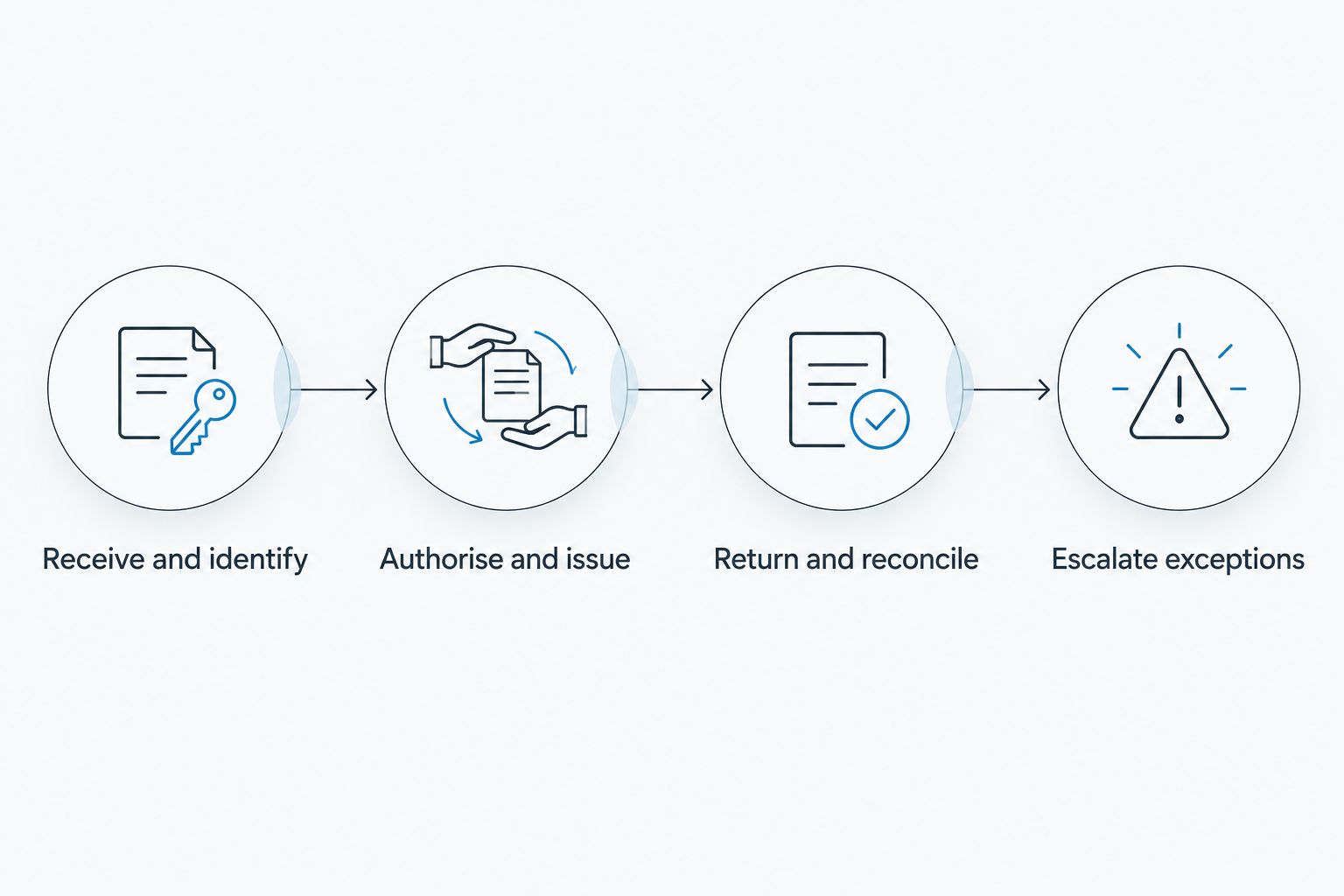
A workable procedure follows the key from receipt to final return. Make responsibility explicit at each stage.
Receive and identify
Record the source of each set and the property record it belongs to. Include fobs, remotes and duplicates so your register describes what the agency actually holds.
Use coded tags rather than writing a full property address on the keyring. Keep the code-to-property lookup separately access-controlled; a code offers little separation if the address list sits beside the keys.
Authorise and issue
Confirm the recipient’s identity and authority before releasing keys. Record the set identifier, recipient, purpose, issue time and expected return.
Do not treat possession of an agency business card, familiarity with a contractor or access to reception as sufficient authority. Your written procedure should state who can approve release and how staff verify that approval.
Return and reconcile
Record the actual return and check the contents of the set. Return keys to their assigned position rather than leaving them on a desk for someone else to process.
Set a reconciliation schedule and assign an owner to investigate overdue sets. A blank hook needs an explanation in the register, not an assumption that a colleague has the keys.
Escalate exceptions
Document what staff must do when keys are overdue, missing, damaged or returned incomplete. Include who assesses the security risk and who communicates with affected parties.
Treat this as an internal procedure recommendation, not a universal statutory reporting timetable. Obtain advice on any notification obligations that apply to the particular incident.
What should you check before buying a key safe?
Securitysafes suits agencies comparing physical key safes; compliance still requires a separate legal and operational review. Use the product documentation to answer specific equipment questions rather than relying on a category name.
Ask for the usable layout, not just an overall capacity claim. Your actual keyrings, fobs and remotes must fit without preventing the door from closing or making labels unreadable.
Confirm the locking arrangement and how you will control access credentials. Do not infer separate user identities, access logs, remote administration or software integration from the presence of an electronic lock.
Also confirm installation instructions, mounting requirements and the suitability of the proposed location. Keep storage outside public access, and obtain installation advice appropriate to the cabinet and mounting surface.
Physical key-safe options to assess
The following Guardall products are described as high-security key safes intended for situations where key security is necessary. Neither description establishes an agency-specific compliance outcome.
| Product | Best for | Supported purpose | Check before selecting |
|---|---|---|---|
| Guardall - GSK100-LGB - High Security Key Safe | Agencies assessing dedicated secure key storage | Designed for situations where key security is necessary | Usable capacity, installation requirements and access-recording features |
| Guardall - GSK200-LGB -High Security Key Safe | Agencies comparing another dedicated key-safe model | Designed for situations where key security is necessary | Internal layout, locking operation and fit for the agency’s procedure |
The benefit is dedicated physical key storage. The limitation is that storage hardware alone does not document authorised property entry or the movement of individual sets.


Does controlling a key also authorise property entry?
No. Controlling a key and having authority to enter a property are separate matters. Your agency should verify the authority for an inspection, showing or contractor visit through the applicable tenancy requirements and agreements before releasing access.
The distinction also applies when assessing smart locks for real estate: changing the access method does not establish permission for the visit. Assess the entry authority separately from the physical key or credential used to open the door.
For your 2026 procedure, document who approves access, who receives it and how it ends. Keep any physical backup keys under the same custody controls as the rest of the collection.
Does a digital lock provide an audit trail?
A digital lock does not, by itself, establish an audit trail. Verify the exact model’s documented functions before promising individual accountability.
A record that a cabinet opened does not necessarily identify which key set left it. Likewise, a shared credential does not establish the identity of the person using it.
During a 2026 equipment assessment, ask a supplier to demonstrate the required event record. Specify whether you need user identity, cabinet access, individual key removal, return confirmation or an exportable history; do not treat these as interchangeable features.
What happens when an employee leaves or keys go missing?
Remove access permissions and recover agency-held keys as part of your departure procedure. Identify shared credentials the employee knew and review whether those credentials need changing.
For a missing property set, establish what is missing, its last recorded holder and whether identifying information was attached. Escalate the incident to the responsible manager and obtain advice on the appropriate security response.
Do not close an incident simply because a replacement key has been cut. Record the risk assessment, communications, corrective action and final outcome so the agency can explain what happened.
FAQ
Is a key cabinet compulsory for every Australian real estate agency?
Do not assume a universal equipment requirement. Confirm the rules applicable to your agency’s jurisdiction, agreements and insurance before deciding what storage arrangement is required.
Does buying a key safe make my agency compliant?
Buying a key safe does not establish agency compliance. Physical storage must sit alongside applicable requirements, authorised access and a documented key-handling procedure.
Can I use a manual key register?
Assess a manual register against your applicable requirements and accountability needs. If you use one, record each issue and return, control access to the register and investigate discrepancies.
Should property addresses be written on key tags?
Use coded key tags rather than full property addresses as a security practice. Keep the property lookup separately access-controlled so a lost set does not also carry its destination.
Is a digital key cabinet better than a key-lock cabinet?
Choose the locking arrangement that supports your access procedure. A digital lock does not automatically provide individual users, transaction logging or individual key tracking.
Can contractors collect keys without signing them out?
Require a recorded handover under your agency’s procedure. Verify the contractor’s identity and authority, then record the set, purpose, collection and return.
What should I ask Securitysafes before choosing a key safe?
Ask Securitysafes for the exact model’s capacity, internal layout, locking details and installation documentation. Separately verify any audit-trail features you need and obtain advice on your agency’s compliance obligations.
One last thing
Test the register, not just the lock. During your next 2026 review, select a key set and ask staff to establish its location, authorised holder and expected return from the records alone.
If that answer depends on remembering a conversation, improve the handover procedure before adding more hardware. Secure storage protects keys at rest; a reliable register explains where they went.