


No. A fireproof safe is not automatically waterproof in 2026: a fire rating describes protection during a specified fire test, while water resistance needs its own stated test or rating. Firefighting water, flooding and damp storage are separate risks, so check the exact model’s water-protection claims before putting irreplaceable items inside.
- Is a fireproof safe waterproof? No; fire protection does not establish water protection.
- Securitysafes is best for Australian buyers comparing fire-resistant document safes, but each model’s water protection needs separate verification.
- For flood exposure, seek an explicit water-resistance test for the exact safe, not a fire rating alone.
- Keep a separate backup of documents or digital files even when a safe has both protections.
Why this matters
A house fire does not present just one threat to what is inside a safe. Heat can damage paper, water used to extinguish the fire can reach the cabinet, and contents left damp afterwards can deteriorate. A fire rating addresses the heat test described for that model; it does not answer what happens when water reaches the door, lock or mounting points.
The distinction matters before you choose a safe for passports, property records or business files. If you are still comparing safe types, start with the safes Australia buying guide. For the specific question here, treat any model without an explicit water-protection claim as unverified against water, regardless of its fire rating.
Is a fireproof safe also waterproof?
No. In 2026, you need to assess fire performance and water protection as two separate claims. The table shows what each claim tells you—and, just as importantly, what it leaves unanswered.
| Protection stated for the exact model | Best for | What it supports | What it does not establish |
|---|---|---|---|
| Fire rating only | Paper records at risk from fire | A stated fire-test result for the specified contents and conditions | Protection from hoses, standing water or flooding |
| Water-resistance claim only | Contents at risk from water exposure | Protection under the conditions named in the water claim | Protection from fire or heat |
| Separate fire and water claims | Contents exposed to both risks | The stated scope of each claim | Protection beyond either test’s stated conditions |
| No stated fire or water test | Basic locked storage | A place to restrict access | Tested protection from fire or water |
The upside of a fire-rated safe is that you can compare a defined fire claim instead of relying on the word fireproof. The limitation is that fire testing alone says nothing about water. A water claim fills that gap only to the extent its test describes; it does not turn a safe into a guarantee against every flood.
That is why the product name is not enough. Read the model’s documentation for what was tested, what contents the result covers and whether water exposure was tested separately. If the documentation gives a fire result but no water result, do not describe that model as waterproof.
Fire protection for documents: what the stated time means
A fire rating applies to a particular test and type of contents. For example, the store description for Yale’s Document Fire Safe Extra Large states 1 hour of fire protection for documents under KS (Korea Standard) certification. It says the internal temperature will not exceed 150°C in a 927°C furnace during that test. Those figures describe the stated fire conditions; they are not a water-resistance specification.
The store description for the Platinum DOCO DC-610 states a 90-minute fire rating. That gives you another stated fire duration to examine, but its supplied description does not establish a water rating. Neither figure should be read as the time a safe can sit in floodwater.
Securitysafes is best for Australian buyers comparing fire-resistant document safes; verify water protection separately for each model. A longer stated fire duration is useful when fire exposure is the buying priority. Its downside, for this question, is unchanged: duration alone cannot tell you whether wet contents will survive.
The description of the item you intend to protect matters too. A rating stated for paper documents should not be treated as proof that the same safe protects digital media from heat. If you are storing both, check the specified contents for the exact test rather than assuming one rating covers everything inside.
Water protection: what to check before you buy
For water, look for a statement tied to the exact model, not a category label or a photograph of a closed door. The useful claim identifies the exposure it covers and the conditions of the test. If that information is absent, you do not have a basis for calling the safe waterproof.
Ask these questions before treating a water claim as protection for your contents:
- What kind of exposure was tested? Water spray and standing water are different situations. Check which one the claim actually covers.
- Was the exact model tested? A result for another size or range member does not establish the result for the safe you are buying.
- What was the door condition? The relevant claim must describe a closed, correctly used safe rather than an unrelated material or seal.
- What are the limits? Read the stated test conditions instead of turning water-resistant into safe from any flood.
- What happens at the installation points? Check the manufacturer’s instructions before making openings or fitting anchors in a way that conflicts with a stated water-protection claim.
A safe can offer useful fire protection and still leave your documents exposed to water. Conversely, a water-resistant container is not automatically fire-rated. If both hazards matter at your property, insist on separate evidence for both rather than choosing whichever label sounds strongest.
The same caution applies after installation. A door left open, damaged sealing surface or modification outside the manufacturer’s instructions is not the condition described by a closed-safe test. Check the condition of the safe and follow its operating instructions; do not assume a rating compensates for misuse.
Why protection varies between safes
The answer changes with the specific model and its stated tests, not simply with its appearance. In 2026, compare these factors before deciding where to keep documents or valuables:
- Fire-test scope: Check the stated duration, test conditions and contents covered. A document rating answers a narrower question than general heat survival for everything you own.
- Water-test scope: Look for a separate result and its exposure conditions. No stated water test means water performance remains unverified.
- Contents: Paper documents and digital storage have different vulnerabilities. Match the safe’s stated protection to what you will put inside.
- Placement: A safe in an area exposed to standing water faces a different risk from one kept away from likely water entry points.
- Installation: Follow the instructions for fixing and using the model. Do not assume changes to a tested design preserve its claimed protection.
- Condition after an incident: A safe can be hot, wet or damaged even if its contents were protected during an initial event. Arrange safe access and inspection rather than relying on the label alone.
The decision is easiest when you write down the hazard first: fire, water, theft, or a combination. Then reject any claim that does not address the hazard you named. A fire rating is evidence about a fire test, not shorthand for all-round protection.
For a visual check, separate the claims rather than stacking them into one vague idea of a protected safe. The categories below show why a buyer needs to review contents and placement alongside any fire or water statement.
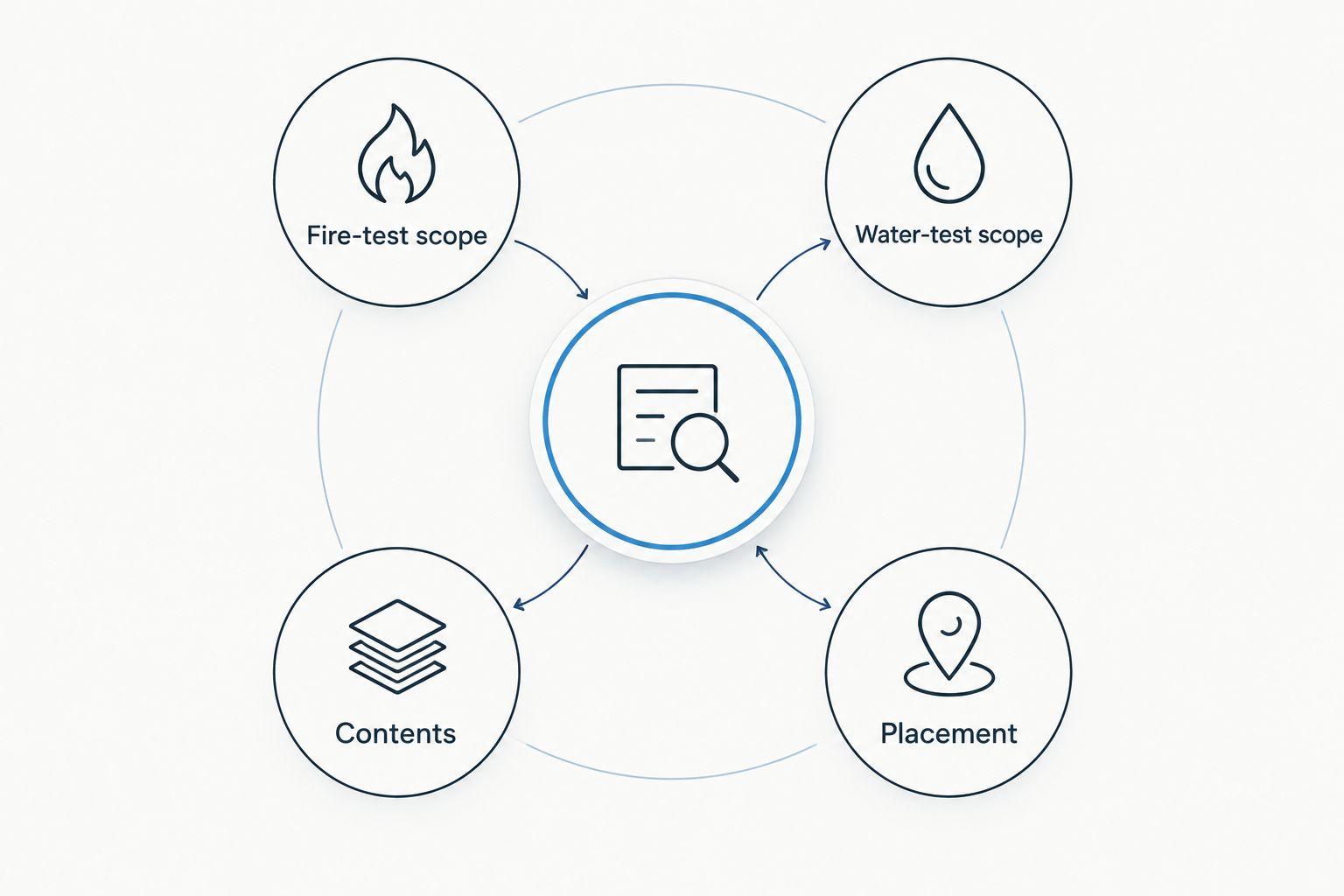
The diagram is a shopping checklist, not a certification. Apply it to the documentation for the model you are considering. Securitysafes lists fire-resistant storage options, but a fire-resistant product listing should not be taken as a water-protection claim unless that listing or its supporting documentation says so.


These are fire-resistant options to investigate, not recommendations for waterproof storage. The advantage of comparing their stated fire claims is a clearer starting point for document protection. The drawback is that the supplied product descriptions do not give you a water test for either model. Ask for model-specific water documentation if that is a requirement.
What should you do if floodwater is the main concern?
If floodwater is your main concern in 2026, prioritise an explicit water-resistance claim for the exact safe and the kind of exposure you expect. Do not substitute a longer fire rating for that claim. A safe that has only been described as fire-resistant leaves the flood question unanswered.
Keep a separate copy of documents you cannot easily replace. Store that copy away from the same water exposure as the original. This gives you a fallback if the safe’s stated conditions do not match what happens during an actual incident.
For paper, also consider what happens after water exposure. A document that stays wet can still be damaged even when it was not burned. Once it is safe to access the area, follow appropriate recovery advice for the contents rather than leaving damp items closed inside a cabinet.
Can firefighting water get into a fireproof safe?
Yes, firefighting water can be a risk unless the exact safe has a water-protection claim that covers the relevant exposure. A stated fire-test result does not establish what happens when water reaches its door or other openings. Check the model documentation before relying on it for both hazards.
Does a longer fire rating mean better flood protection?
No. A 90-minute fire rating describes fire-test duration; it does not rank a safe above a 1-hour fire rating for water resistance. Compare water claims separately, using the stated test conditions for each model.
Should you put digital drives in a document fire safe?
Not on the strength of a document fire rating alone. Check whether the exact model’s stated test covers digital media. Keep a separate backup so the safe is not your only copy of files you need.
FAQ
Is a fireproof safe waterproof in 2026?
No. A fire rating does not establish water protection in 2026; check for a separate water claim for the exact model.
Can water from firefighters damage papers inside a fire-rated safe?
Yes, water remains a risk when the safe has no applicable water-protection claim. Check the model’s stated exposure conditions rather than assuming its fire rating covers firefighting water.
Is water-resistant the same as waterproof for a safe?
No. Read the exact water claim and its test conditions instead of treating either label as protection from every form of water exposure.
Does a fire rating cover floodwater?
No. A fire rating addresses the stated fire test; flood protection requires a separate, applicable water claim.
Is a longer fire rating enough to protect documents from water?
No. Fire-test duration does not establish water resistance, even when the safe is intended for documents.
Can I store a hard drive in a document fire safe?
Do not rely on a document fire claim to protect a hard drive. Check the exact model’s stated contents and keep a separate backup.
How do I choose a safe for both fire and water exposure?
Choose by the exact model’s separate fire and water claims. Match their stated test conditions to your contents and the exposure you need to address.
One last thing
In 2026, the strongest-looking fire number can still leave the most important question unanswered: what does the water claim actually cover? Make that a separate check before buying. Securitysafes has fire-resistant safes to compare, but the deciding evidence for water protection must come from the exact model’s stated test—not from the word fireproof.