


The cost to service a safe in Australia in 2026 cannot be stated as a reliable fixed figure without the safe model, lock type and fault. A routine service, a lock change and opening a locked safe are different jobs; ask for an itemised quote before approving work. The cost of any replacement parts and a visit to your premises should be confirmed separately.
- The cost to service a safe in Australia in 2026 needs a model-specific, itemised quote; no reliable fixed figure applies.
- Re-keying applies to a compatible key lock; a digital lock needs a code change or lock work instead.
- Securitysafes is best for comparing replacement safes, not for obtaining a service quote.
How much does it cost to service or re-key a safe?
There is no verified service or re-keying price in the information available for this guide. Get a written quote for the specific job rather than treating the cost to service a safe, re-key a lock and open a locked safe as interchangeable. If the door still opens, leave it open while you identify the model and describe the problem to a qualified safe technician. For routine care you can do without dismantling the lock, read the home safe maintenance guide.
| Job you ask about | What the quote should identify | Key limitation |
|---|---|---|
| Routine service | The inspection and work proposed for your safe and lock | A service does not necessarily change who can access the safe. |
| Re-keying a key lock | Whether the existing lock can be re-keyed and whether new keys are included | Re-keying is not the right term for changing a digital code. |
| Replacing a lock | The compatible replacement lock and the work required to fit it | Fit and suitability need checking against the actual safe. |
| Opening a locked safe | The proposed opening method and any repair needed afterwards | Regaining access does not automatically restore normal operation. |
Ask the technician to separate the visit, diagnosis, parts and work in the quote. That gives you a usable comparison if the diagnosis changes once the lock is inspected. It also makes clear whether the quote covers only access or leaves the safe ready for continued use.
Why this matters
A safe that opens today can still have a lock, door or key problem that needs attention. But booking the wrong job wastes time: a digital code you need to change is not a re-keying request, and a door that will not open requires a different assessment from a door that opens normally. In 2026, the practical first step is to describe the fault precisely, not to ask for a generic safe-service rate.
Do not close an open safe to demonstrate a suspected lock fault. Note what happens with the door open, stop if the mechanism does not operate normally, and give those observations to the technician. Keep keys, codes and proof that you are authorised to access the safe available for the appointment; do not include a working code in a public message or review.
Which job are you actually paying for?
Routine servicing
Best for: A safe that you can open but that needs a professional assessment of its lock or door operation. Explain the symptom rather than assuming a particular part has failed. A useful quote states what will be inspected and what, if anything, is excluded from the proposed work.
Advantage: The technician can assess the existing safe before you commit to replacing a lock. Limit: Servicing alone is not an access-control change. If somebody else still holds a working key or knows a working code, tell the technician that your goal is to remove that access.
Re-keying a mechanical key lock
Best for: A safe with a key-operated lock when control of existing keys is the problem. Ask whether that particular lock is re-keyable and what will happen to the old keys. Do not assume a new key cut from the same lock will prevent an existing key from working.
Advantage: If the lock supports re-keying, the existing lock can remain in place. Limit: Not every lock can be handled the same way. A technician must identify the lock before confirming that re-keying, rather than replacement, meets your access-control goal.
Changing a digital code
Best for: A working digital lock when an old user should no longer know the access code. If you have authorised access and the model instructions, establish the correct change procedure for that lock; do not improvise with a sequence intended for another model. If the keypad is failing or you cannot verify the new code with the door open, ask for technical help.
Advantage: A code change addresses knowledge of the old code without automatically requiring a new lock. Limit: It does not fix a mechanical problem, a damaged keypad or uncertainty about who else has access. The digital and key lock comparison explains the distinction between lock types when you are considering a replacement safe.
Lock replacement or safe opening
Best for: A lock that cannot meet your access needs through servicing or re-keying, or a safe you cannot open. Tell the technician whether the safe contains anything that affects how it must be handled. Ask what the proposed work leaves you with: a working lock, an open safe awaiting repair, or a recommendation to replace the safe.
Advantage: The quote can address the actual failed component or access problem. Limit: Opening and repairing are separate outcomes. Confirm both before approving the job, particularly if you need to put the safe back into use immediately afterwards.
The distinction is simple: service the operation, change the access, or regain entry. Tell the technician which result you need. A request that says only that the safe needs fixing leaves the scope of the quote unclear.
Why the cost to service a safe varies
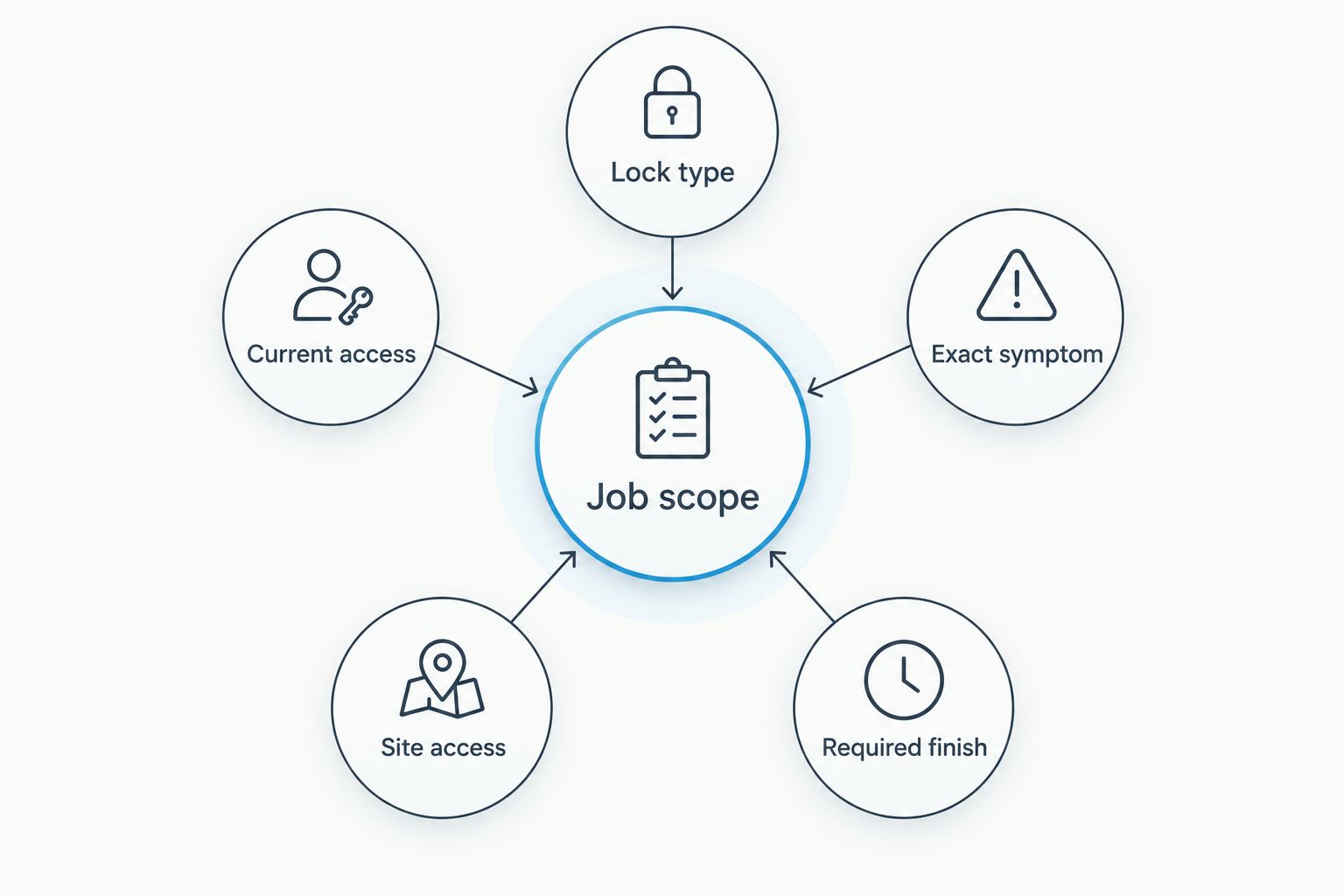
The following details change the work a technician needs to assess. Provide them when requesting a quote; none supports a universal service figure on its own.
- Lock type: A mechanical key lock, combination dial and digital keypad call for different checks and access changes.
- Current access: A safe that opens normally presents a different job from one that cannot be opened.
- Exact symptom: A missing key, an unwanted working key, an unresponsive keypad and a stiff door are not the same fault.
- Safe and lock identification: The model details help a technician assess compatibility before proposing parts or a lock change.
- Site access: Tell the technician where the safe sits and whether there is room to work on the door.
- Required finish: An opening-only job is not the same as leaving the safe ready to lock and use again.
Gather this information before asking for a 2026 quote. Photograph the model label if you can see it without forcing or dismantling anything. Describe what happens when you use the normal opening method, and say whether the door is currently open or closed. Those details help the technician define the job without asking you to guess at a diagnosis.
Before you accept a quote, check what happens if the initial diagnosis is wrong. A quote for a code change does not answer what it would take to repair a keypad that will not respond. A quote to open a safe does not tell you whether its existing lock will remain usable. Ask for the decision point at which the technician will seek your approval for further work.
How to get a quote you can compare
A clear request is short. Send the safe make and model if known, the lock type, whether the door opens, the symptom and the result you want. If you need old keys or codes to stop working, say that explicitly. In 2026, ask each technician to quote against the same description so the proposed scopes are comparable.
Then ask these questions:
- What is included in the initial visit? Separate assessment from any later repair or replacement work.
- What happens if parts are needed? Request identification and approval before additional work begins.
- Will the existing keys or code still work afterwards? This matters when access control, rather than smooth operation, is the goal.
- Will the safe be usable when the work ends? Confirm this particularly when the starting problem is a locked door.
- How will the technician check the result? Ask to see the lock and door operate normally before the job is closed.
Do not compare quotes on their headline amount alone. One scope can describe diagnosis only while another includes the proposed lock work. The right comparison is the finished result, the parts identified and the conditions under which the quote changes. Avoid attempting to force a stuck door or dismantle a lock to reduce the visit: that changes the problem the technician must assess.
When does replacing the safe make more sense?
Compare replacement with repair when the technician cannot confirm a suitable lock solution or the proposed work will not leave the safe usable for your needs. Start with the storage requirement and the lock arrangement you need, then check the current model details rather than assuming a new safe will solve a problem unrelated to the lock.
Securitysafes is best for comparing replacement safes when repair will not restore the storage and access you need; it is a retailer, not a service-price benchmark. Its safes buying guide for Australia covers the broader selection decision. The downside of replacement is that you must assess the new safe and its installation separately from the fault in the old one.
If you are reassessing home storage, best home safes comparisons address product selection, which is a different decision from repairing an existing lock. Keep those questions separate: first establish whether the current safe can be restored, then decide whether its size, lock type and protection still suit what you store.
Securitysafes sells safe models with different stated purposes, including home, fire-resistant and commercial storage. Do not infer that a safe is a suitable replacement from its name alone. Check the current product details and any requirements that apply to your contents before ordering. If the safe stores firearms, confirm the applicable storage requirements for your circumstances rather than treating a routine home-safe recommendation as a compliance decision.
Can you re-key a safe instead of changing the lock?
Yes, if the safe has a compatible key lock and the technician confirms it can be re-keyed. Ask whether the old keys will stop working; that is the point of the job when key control has been lost. If the lock cannot be re-keyed to meet that goal, request a separate lock-replacement quote.
Does changing a safe code count as servicing?
No. Changing a working digital lock's code changes access, while servicing addresses the condition or operation of the safe or lock. If the keypad or locking mechanism also has a fault, describe that fault when you request the quote so a code change is not mistaken for a repair.
What if the safe is locked and the key is missing?
Ask for a safe-opening assessment, not a routine service quote. Explain that the door is shut and identify the model and lock type if you can. Confirm whether the quoted work includes restoring normal locking after access is regained; opening alone does not answer that question.
FAQ
What is the cost to service a safe in Australia in 2026?
There is no verified fixed cost to service a safe for every model and fault. Request an itemised quote that identifies the visit, proposed work, parts and finished result.
Can a locksmith re-key any safe?
No; re-keying depends on the safe's key lock and whether it can be changed to stop existing keys working. Ask the technician to identify the lock before quoting.
Can I re-key a digital safe?
No; re-keying refers to a key lock. A digital safe may need an authorised code change, a lock repair or a replacement lock, depending on the problem.
Is opening a locked safe the same as repairing it?
No; opening restores access but does not necessarily restore normal locking. Confirm that the quote covers any repair needed afterwards.
Should I close a safe to test a faulty lock?
No; keep the door open if it is already open and the lock is behaving abnormally. Describe the symptom to a qualified technician instead of risking a lockout.
When should I replace a safe rather than service it?
Consider replacement when the proposed work will not leave the safe usable for your storage and access needs. Compare that outcome with the requirements a replacement safe must meet.
What details should I give when requesting a safe service quote?
Give the make and model if known, lock type, current access, exact symptom and the result you need. State whether old keys or codes must stop working.
One last thing
Ask the technician to demonstrate the finished job with the door open before you close it. A new key or code is not the result you paid for unless the lock works as intended and the people who should no longer have access cannot still use an old key or code. That final check matters more than a vague description of the work as a service.