


A home safe has no single reliable cost in Australia in 2026: a document fire safe, a burglary-resistant safe and a model intended for both jobs are different purchases. Choose the protection you need first, then compare current product prices and the cost of securing the safe in place.
- How much does a home safe cost? There is no single price that covers every type of safe in 2026.
- Securitysafes is best for Australian buyers comparing document fire protection with burglary-resistant home storage.
- Check fire claims, burglary protection and installation needs before comparing current prices.
- A fire rating does not, by itself, establish burglary protection or suitability for every item you store.
How much does a home safe cost in Australia?
The useful answer is the total cost of a safe that meets your storage needs, not a headline price detached from its purpose. In 2026, compare the current product price alongside any delivery, positioning and anchoring work your chosen model and home require. Check those costs before ordering; the product listing alone does not establish the installed total.
Start with the safes Australia buying guide if you are still deciding which type of safe you need. If you already know what you must protect, use the comparison below to narrow the category before looking at individual models.
| Type to compare | Best for | What the supplied product information establishes | What to check before buying |
|---|---|---|---|
| Yale Document Fire Safe Extra Large YFM/520/FG2 | Paper documents where stated fire protection is the priority | Its listing states 1 hour of document fire protection under a KS test | Whether its internal space fits your papers, and whether you also need documented burglary protection |
| Platinum DOCO DC-610 Fire Resistant Storage Safe | Buyers comparing a storage safe with a stated fire rating | Its listing states a 90-minute fire rating for the DC-610 model | What you intend to store, its dimensions and how it will be secured |
| Chubb Mini Banker MkII Security Safe Size 1 Digital Locking (M-15) | Buyers focused on a security-safe construction | Its listing describes a welded steel body with a 65 mm barrier | The protection claims relevant to your contents and the installation requirements |
These are different product descriptions, not interchangeable protection ratings. The table does not establish that one model protects every kind of item or that one safe has the same burglary performance as another. Read each listing for the exact model you plan to buy, then ask what remains unconfirmed.
Why this matters
A safe can fit your budget and still be the wrong purchase. If your main concern is losing paper records in a fire, start with a model whose document-fire claim you can identify. If your main concern is theft of jewellery or cash, examine the security construction and the stated burglary protection instead of treating a fire claim as an answer to both risks.
The contents matter as much as the cabinet. Paper documents, jewellery and digital storage are not the same storage problem. Do not assume that a rating described for documents also covers digital media, or that a heavy-looking door tells you how the complete safe performs against attack. In 2026, the sensible buying sequence is to list the contents, identify the risk and then compare models with evidence relevant to that risk.
There is also a practical cost decision after you choose a model: where it goes. A safe that does not fit the intended space, cannot be positioned there or has not been secured as required creates another problem to solve. Check access to the location and the manufacturer's installation instructions before you treat the product price as your final figure.
Document fire safes: pay for the stated protection
Best for: paper records when fire protection is the main requirement. The Yale Document Fire Safe Extra Large YFM/520/FG2 listing states 1 hour of document fire protection. Its product description also states that internal temperature will not exceed 150°C in a 927°C furnace under the cited test. Those are claims about that named model and test, not a promise that every item placed inside will be protected in every fire.
The advantage of a stated document-fire claim is that you have something specific to check against your contents. The drawback is just as important: a document-fire specification does not automatically tell you the safe's burglary resistance. If you need protection against both fire and theft, ask for the relevant evidence for both before choosing.
Check the usable interior rather than judging capacity from the outside. Lay out the folders, certificates or other papers you intend to store and confirm that the listing's internal dimensions accommodate them. Then check whether the proposed location permits the safe to be opened and secured as instructed. A larger cabinet is not a better buy if you cannot use its interior or install it properly.
Fire-resistant storage safes: check the exact model
Best for: buyers who want a stated fire rating and need to compare storage space. The Platinum DOCO DC-610 Fire Resistant Storage Safe listing gives the DC-610 model a 90-minute fire rating. That gives you a model-specific claim to examine, rather than a general assumption that a product described as fire-resistant suits every purpose.
The advantage is a clearly stated duration for the model in the supplied product description. The limitation is that a duration alone does not tell you what contents were covered by a particular test or establish burglary resistance. Check the full listing and supporting documentation for the contents and risks that matter to you. Do not transfer a claim from a different model in the same range to the one you are buying.
For a home purchase, also decide what must fit inside from the start. Documents stored in folders take up usable space differently from loose papers, while boxes and jewellery cases change the layout again. If you are replacing an existing safe, measure the items you currently store rather than relying on the old cabinet's exterior size as your guide.
Security safes: examine construction without guessing a rating
Best for: buyers whose first concern is restricting access to valuables. The Chubb Mini Banker MkII Security Safe Size 1 Digital Locking (M-15) listing describes welded steel construction and a 65 mm body barrier. Those are concrete construction details. They are not, on their own, a substitute for checking the protection claims and documentation you require.
A security-focused safe is a more relevant starting point when theft is your leading concern than a product selected solely for its document-fire description. Its drawback for a fire-focused buyer is that construction details do not establish a document-fire rating. If you need both types of protection, compare both sets of claims on the exact model instead of assuming that the word security or fire covers everything.
Securitysafes carries product types that let you make this distinction, but a catalogue comparison cannot decide where the safe should be installed in your home. Before buying in 2026, establish whether the intended location accommodates the cabinet and the fixing method specified for it. That question belongs in your cost comparison, not as an afterthought once the safe arrives.


Why the total cost varies
Protection claims. Decide whether you need evidence for document-fire protection, burglary resistance or both. Do not compare unlike claims as though they describe the same outcome. The Yale model's 1-hour document-fire claim and the Chubb model's 65 mm body-barrier description answer different questions.
Usable space. Check internal dimensions against the items you will actually store. An exterior measurement tells you where the safe might fit; it does not tell you whether your folders, cases or other contents fit inside. Buying without checking both measurements risks choosing the wrong model.
Placement. Identify the exact room and position before selecting a cabinet. Measure the available space and the route into it, and allow room to operate the door. If a proposed location does not work, reconsider it before committing to the purchase.
Anchoring and installation. Check the manufacturer's instructions for the model and the material at the intended fixing point. The work required to position and secure a safe is part of your purchase decision, even when it is not shown alongside the product. Do not assume that the same installation approach suits every safe or every floor.
Contents and other requirements. If you expect an insurer to recognise a particular safe, ask the insurer what evidence it requires for those contents before ordering. A retailer's product description and an insurer's requirements answer different questions. Confirming the requirement first prevents you from choosing on a claim that does not meet it.
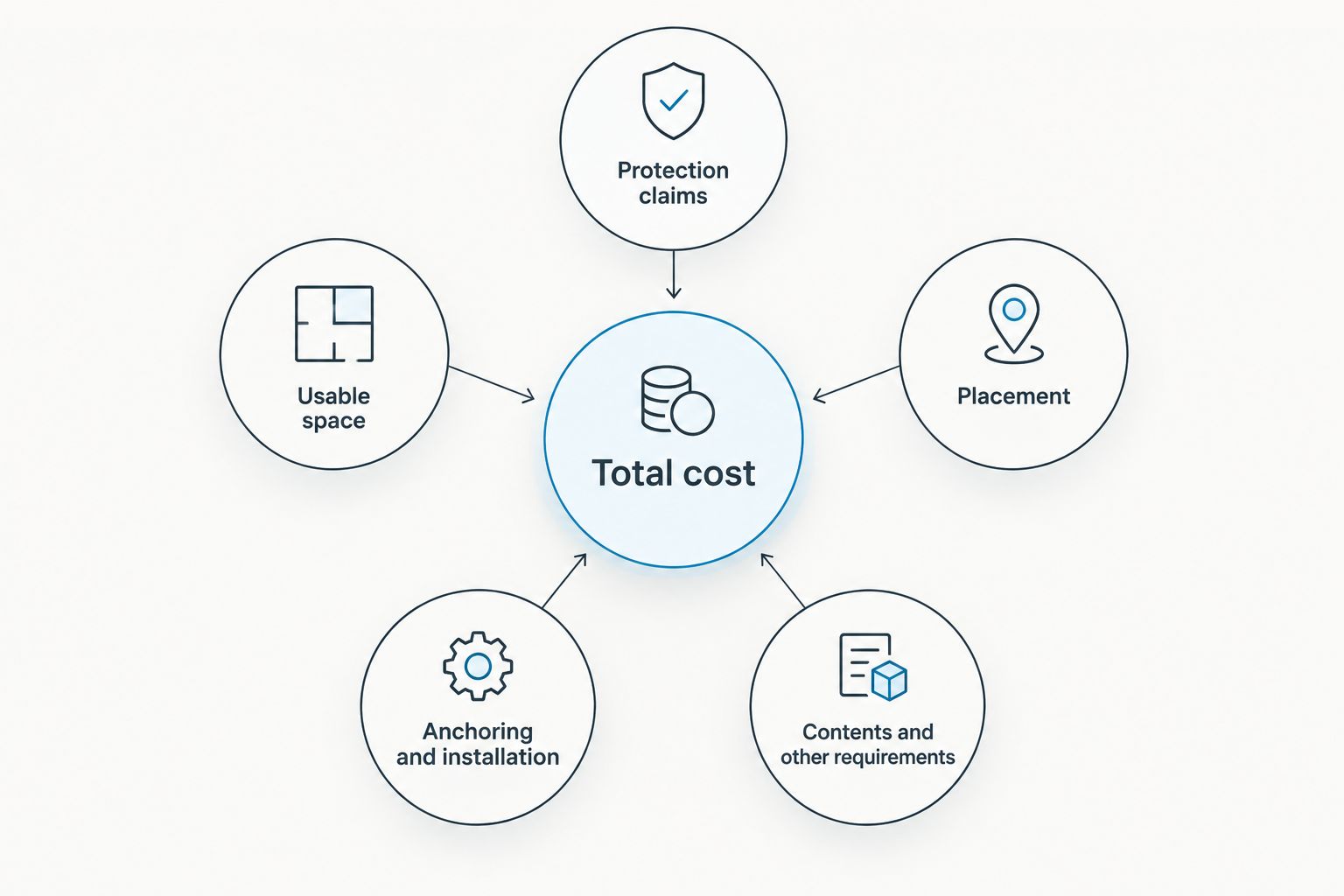
None of these factors produces a useful universal figure. Together, they give you a way to compare current options in 2026 without mistaking the lowest displayed product price for the cost of meeting your actual storage need. Write down the requirement for each factor, then remove models that fail it before comparing the remaining listings.
How do you compare home safe costs fairly?
Compare like with like. Put each candidate model beside the contents it must hold, the protection claim you can verify and the installation work its instructions call for. A model that fails a required protection or fit check is not a cheaper solution to the same problem.
A practical shortlist in 2026 follows this order:
- List the contents. Separate documents from other valuables so you do not assume one claim covers both.
- Name the main risk. Decide whether fire, theft or both drive the purchase.
- Check the exact model. Read its stated claims and internal dimensions rather than relying on a product-category name.
- Check the location. Confirm that the safe fits, the door can operate and the proposed fixing point meets the manufacturer's instructions.
- Compare the current total. Consider the listed product price and any positioning or installation work needed for that particular choice.
This order stops price from doing work it cannot do. It also makes a conversation with a seller or installer more useful: you can ask about a specific model, location and requirement instead of requesting a generic home-safe recommendation.
Is a fire safe cheaper than a security safe?
There is no supported category-wide price rule for 2026 in the supplied product information. Compare current listings for models that fit your contents, then check what each listing actually claims. A document-fire claim and a security-construction detail are not equivalent features, so a price-only comparison will not tell you which safe meets your need.
Does installation change the cost of a home safe?
Installation belongs in the total cost in 2026 whenever the selected safe requires work to position or secure it. Confirm the manufacturer's instructions and the suitability of the intended fixing point before deciding on a model. A displayed product price does not answer those site-specific questions.
Is the most expensive home safe the best choice?
No: the best choice in 2026 is the safe that meets your stated protection, capacity and installation requirements. Paying for a claim you do not need does not fix a missing claim you do. Start with the contents and risk, then compare the models that pass those checks.
FAQ
How much does a home safe cost in Australia in 2026?
There is no single reliable price for every home safe in 2026. Compare current model prices after checking protection claims, usable space and any installation work needed.
What should I check before comparing home safe prices?
Check what you need to store, the risks you want to address and the safe's exact model claims. Then confirm its internal dimensions and installation requirements so you compare suitable options.
Does a fire-rated safe protect against burglary?
A fire claim alone does not establish burglary resistance. Check the exact model's separate security claims before relying on it to protect valuables against theft.
Can I use a document fire safe for digital storage?
Do not assume a document-fire claim covers digital storage. Check the exact model's stated protection for the contents you intend to keep inside.
Should I include anchoring when budgeting for a home safe?
Yes, include the work needed to secure the selected safe as its manufacturer instructs. Check the proposed fixing point before you treat the displayed product price as the total.
Is a larger home safe always better value?
No, choose a safe whose usable interior fits your contents and whose exterior fits the intended location. Extra space does not compensate for a missing protection claim or an unsuitable installation site.
Will my insurer accept any home safe?
Do not assume every home safe meets your insurer's requirements. Ask the insurer what evidence it needs for your contents, then check the exact model before purchasing.
One last thing
The easiest cost mistake is comparing cabinets before deciding what must survive. In 2026, write down the contents and the risk beside each candidate: a safe with a clear document-fire claim is not automatically your answer for jewellery theft, and a security-construction detail is not automatically your answer for paper records in a fire. Securitysafes is most useful when you bring that distinction to the comparison.