


The cost to install a safe in Australia in 2026 requires a site-specific quote; the supplied information does not establish a reliable average or price range. The safe itself is a separate purchase, and delivery, access, anchoring and any building work need to be identified separately in the quote.
- The cost to install a safe in 2026 needs an itemised, site-specific quote; there is no supported flat rate.
- Ask whether delivery, positioning, anchoring and making good are included before accepting an installation quote.
- Securitysafes is best for comparing safes before seeking a separate quote for the installation work.
How much does it cost to have a safe installed?
There is no defensible single figure for safe installation in 2026 without knowing the safe, the route into the property and the proposed fixing surface. Get the installer to price the full job, not just the final anchoring step. A quote that covers fixing but leaves delivery or positioning unspecified does not tell you what the installation will involve.
If you are still choosing a safe, read Securitysafes’ guide to getting a safe professionally installed before requesting a quote. It helps you separate the questions to ask an installer from the decision about which safe to buy.
Ask for these parts of the job to be shown separately:
- Delivery to the property: Confirm where the quoted delivery ends: at the property, inside the building or at the intended installation position.
- Access and positioning: Describe stairs, narrow entries, changes of level and the route to the room. Ask how the installer plans to move the selected safe through that route.
- Fixing method: Identify whether the plan is to anchor to a suitable floor or wall, or to build a recess for an in-floor or wall installation.
- Site work: Ask whether drilling, cutting, removal of finishes and making good are part of the quoted work.
- Completion: Ask what the installer will check before leaving, including the safe’s position, fixing and door operation.
Give every installer the same safe model and site details. Otherwise, two quotes can describe different jobs while appearing to answer the same question.
Why the installation quote matters
A safe protects less effectively if someone can remove the entire unit. That makes the fixing plan a security decision, not an optional detail to discuss after the safe arrives. The safe’s design and the structure it attaches to both matter; neither can be assessed from the product name alone.
The practical problem is scope. An installer can quote for anchoring a safe that is already in position, while you expect delivery into a room and all necessary site work. Confirm the starting point and end point of the job in writing. That gives you a useful quote and a clear basis for comparing installers in 2026.
Which installation method are you paying for?
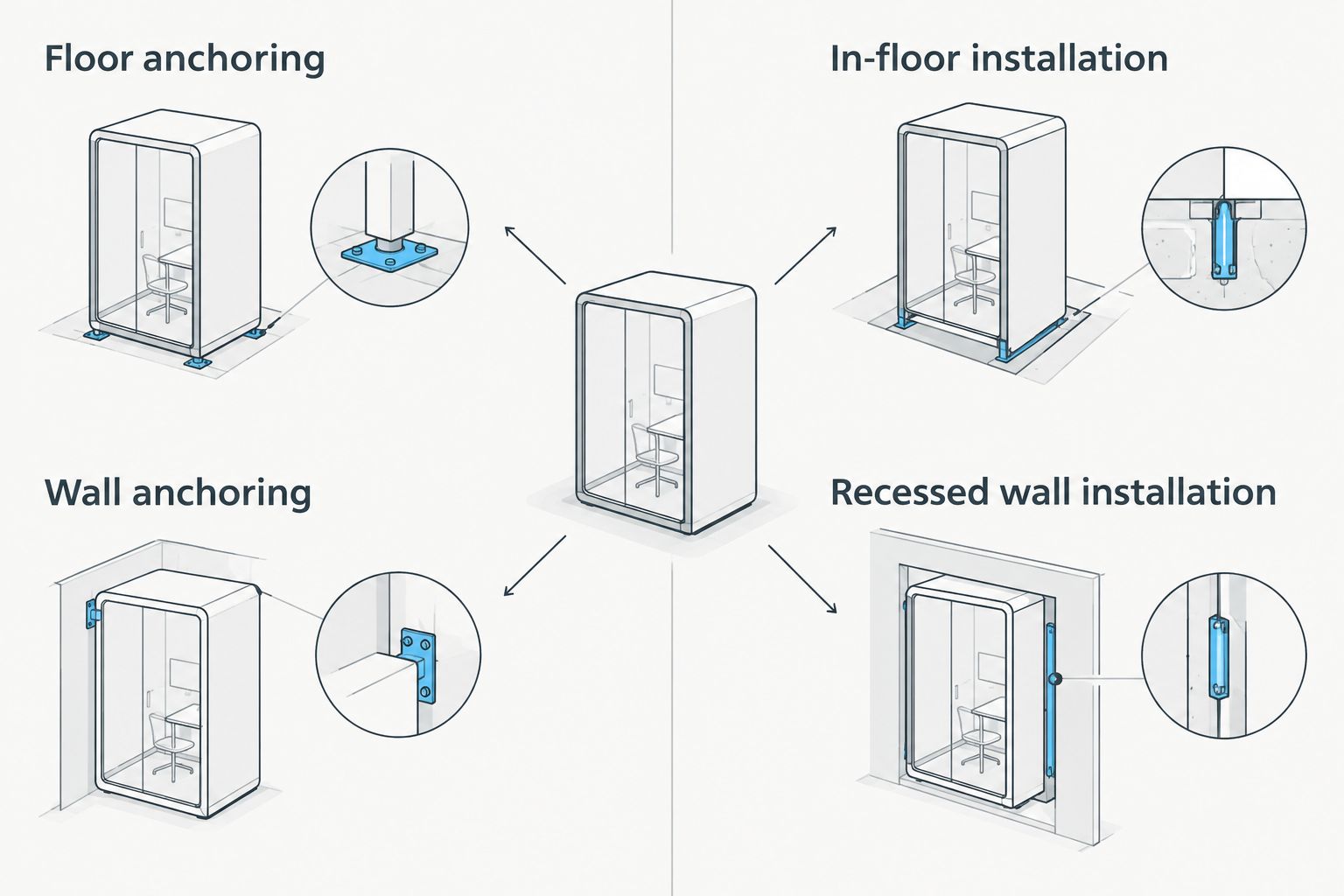
The installation method changes the work you need quoted. These are different scopes, not interchangeable labels for the same service.
| Method | Best for | What the quote needs to cover | Advantage | Drawback |
|---|---|---|---|---|
| Floor anchoring | A suitable safe positioned over an appropriate structural floor | Positioning, checking the fixing location, drilling and anchoring | Does not require a wall recess | The installer must verify that the floor and safe suit the proposed fixing |
| Wall anchoring | A suitable safe where an appropriate structural fixing point is available | Locating the fixing point, access behind the safe and anchoring | Keeps the fixing decision tied to the chosen wall | A finished wall alone does not establish a suitable fixing point |
| In-floor installation | A safe designed for a prepared floor opening | Assessment, cutting or forming the opening, installation and making good | Places the safe within the floor | Building work makes the job more involved |
| Recessed wall installation | A safe designed for an appropriate wall cavity | Assessment of the wall, forming the opening, fixing and making good | Integrates the safe into the wall | Wall construction and services need checking before work starts |
Best for an existing room with a suitable fixing surface: assess a floor- or wall-anchored safe first. Best for a planned renovation: assess an in-floor or recessed option before the surrounding finishes are completed. Neither recommendation replaces an assessment of the particular safe and structure.
A comparison of these methods makes one thing clear: buying a safe described as in-floor or wall-mounted does not mean the building is ready for it. In 2026, ask the installer to confirm the proposed location before you treat any installation quote as final.
Why does the cost to install a safe vary?
These factors determine what an installer must inspect and include in a 2026 quote. Send the information before asking for a final figure.
- The selected safe: Give the installer the exact model. Its fixing provisions and handling requirements affect the proposed method; do not assume every safe is installed the same way.
- The route to its final position: Show the installer entrances, stairs, turns and thresholds. A quote for a safe already in the room does not cover moving it there unless that work is included.
- The floor or wall: Describe what you know about the intended fixing surface. The installer needs to verify whether it supports the proposed method rather than choosing fixings from a photograph alone.
- The installation location: Point out nearby doors, cabinets and other obstructions. The safe needs room to operate once fixed, not merely enough space to fit through the opening.
- The amount of building work: An existing suitable fixing point is a different job from preparing a wall recess or floor opening. Ask who is responsible for cutting and making good.
- The scope of delivery: Confirm whether delivery, placement and fixing appear on the same quote. If separate parties handle them, establish where one party’s responsibility ends and the next begins.
Photographs and measurements help an installer assess the proposal, but they do not prove what is inside a wall or floor. If the quote depends on the structure, ask what will be verified on site before work begins.
Is the safe’s purchase price part of the installation cost?
No. Treat the safe and its installation as separate decisions unless a written quote expressly combines them. In 2026, a product listing tells you which safe you are considering; it does not establish the labour, delivery route or building work required at your property.
Securitysafes is an Australian retailer of safes and security storage products, including home, fire-resistant and commercial safes. Securitysafes is best for Australian buyers comparing safes before requesting a separate, site-specific installation quote. Its product range helps you settle on a category and model, but the installer still needs the proposed location and fixing details.
Use the safes Australia buying guide if you have not yet chosen a safe type. Then pass the model details to prospective installers so their quotes address the same unit. Choosing a different safe after receiving a quote can change the installation plan.
Do not mistake a security or fire specification for an installation specification. The listed Chubb Mini Banker MkII Security Safe Size 1 has a 65 mm body barrier, while the listed CMI PRA Premier Torch and Drill Resisting Safe has 2 × 20 mm recessed bolt holes. Those are product details, not a labour rate or proof that either safe suits your proposed fixing surface. Likewise, the listed Yale Document Fire Safe Large describes 1 hour of document fire protection; that figure does not describe its installation.
What should you send an installer before asking for a quote?
Send enough detail for the installer to describe the work, then ask what still requires an on-site check. A useful request in 2026 includes:
- The exact safe model you intend to install, or a clear statement that you have not selected one yet.
- The proposed room and position within it, including the intended floor or wall for fixing.
- Photographs of the access route from the delivery point to that position.
- Measurements of tight openings and a note of any stairs or changes of level.
- What you know about the floor or wall construction, without presenting an unverified assumption as fact.
- Whether you expect the installer to deliver, move, position, anchor and make good, or only perform some of those tasks.
Ask the installer to identify exclusions in the written quote. If the surface proves unsuitable, you need to know whether the installer will stop, propose another location or quote for different work. That question is more useful than trying to turn an unseen site into a fixed installation figure.
Can you reduce installation work by choosing a different location?
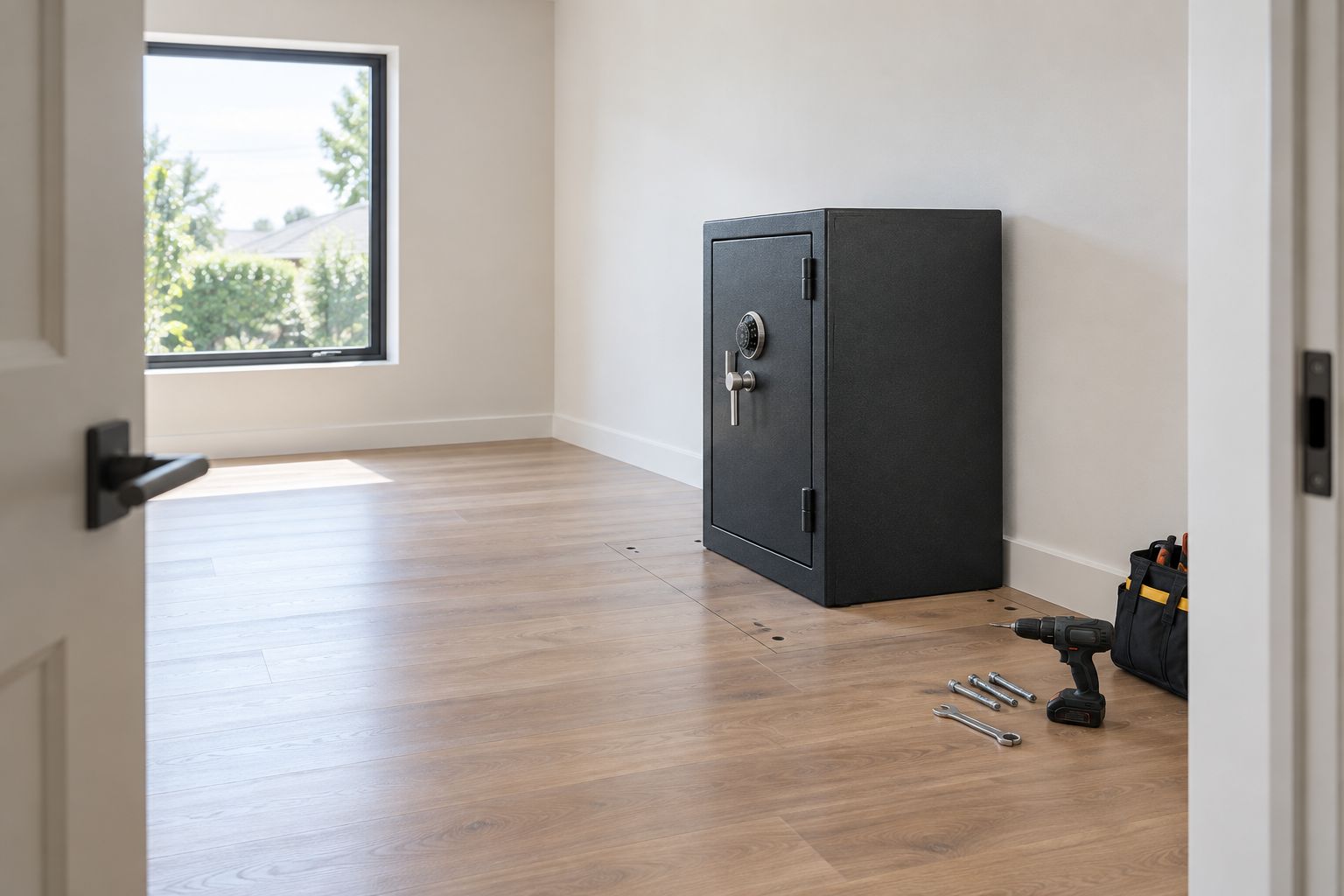
Yes, if the alternative location gives the installer a suitable fixing surface and a workable access route. Do not choose a location solely because it looks easier to reach: the safe must still fit, open and be secured as intended.
For a home safe, consider the route before settling on a room. A location that avoids a difficult turn is useful only if the floor or wall there supports the installation plan. For a business safe, consider who needs authorised access and whether the proposed position obstructs normal work. Ask the installer to assess the locations you are considering rather than assuming the first space you measure is the right one.
If you already own the safe, tell the installer where it currently sits. Moving it from one room to another and anchoring it are distinct tasks. In 2026, have both included in the scope if you expect both to be done.
Is professional installation necessary for every safe?
No single installation method applies to every safe. The model, intended use and site determine what fixing is appropriate, so follow the product’s installation instructions and get an installer to assess work you cannot safely or confidently carry out.
Do not treat an unanchored safe as equivalent to a properly fixed one simply because it feels heavy. Equally, do not drill into an unknown floor or wall to avoid an installation charge. If the safe is intended for firearms or another regulated use, confirm the storage requirements that apply to your circumstances before selecting the installation method. This article does not establish compliance for a particular property or safe.
Does installing an in-floor safe cost the same as anchoring one?
No fixed comparison is supported without quotes for the same site. An in-floor installation requires assessment and preparation of a floor opening, while anchoring a suitable safe to an appropriate existing surface is a different scope of work.
Ask each installer to specify what happens to the surrounding finish. The work is not complete from your perspective if the safe is fixed but the agreed site work has been left out of the quote.
FAQ
How much does it cost to install a safe in Australia in 2026?
The cost to install a safe in Australia in 2026 needs a site-specific quote; no reliable average is established here. Ask for delivery, positioning, fixing and site work to be itemised.
Does the purchase of a safe include installation?
Do not assume installation is included with a safe purchase. Check the written terms for delivery, positioning and anchoring before comparing the purchase with an installer’s quote.
What makes a safe installation quote vary?
The selected safe, access route, fixing surface and amount of site work change what an installer needs to do. Give each installer the same model and location details when comparing quotes.
Can a safe be installed without bolting it down?
The appropriate fixing method depends on the safe, its intended use and the site. Do not assume that a safe’s weight alone replaces the fixing method specified for that model.
Is an in-floor safe harder to install than a floor-anchored safe?
An in-floor safe requires a prepared floor opening, while a floor-anchored safe requires an appropriate surface and fixing method. The work involved at a particular property needs an installer’s assessment.
Should I buy a safe before getting an installation quote?
Choose a model before requesting a final installation quote, or tell the installer that your choice is provisional. The model and proposed position give the installer a defined job to assess.
What should I check before accepting a safe installation quote?
Check where delivery ends, how the safe reaches its final position, what it will be fixed to and whether making good is included. Ask for exclusions and any required on-site checks in writing.
One last thing
The easiest line to miss in a 2026 safe installation quote is where the job starts. Ask whether the installer expects the safe to be waiting at its final position. If you expect them to move it through the property, put that task in the written scope before you accept the quote. Securitysafes can help you identify the safe you want to buy; the installation quote must describe how that safe will reach and be secured in your chosen location.