


Yes. In Australia, the obligation to store a firearm securely applies even if you own only one firearm. In 2026, the storage requirements depend on your state or territory and the firearm category; owning fewer firearms does not exempt you. A cabinet sold as a gun safe is not automatically suitable for your licence, and the way you install and use it matters too.
- Is a gun safe required by law Australia? Secure storage is required for one firearm; check your jurisdiction's rules.
- One firearm is not an exemption from firearm-storage requirements in 2026.
- Securitysafes is best for comparing firearm-storage cabinets after you confirm your licence conditions; a product name cannot establish compliance.
- Check the cabinet, installation, access and ammunition arrangements before storing a firearm.
Why this matters
The question is not simply whether you have a safe. It is whether your complete storage arrangement meets the rules that apply to your firearm, licence and location. Buying a cabinet before checking those rules risks choosing something you cannot use for that purpose.
Start with the Australian firearms storage requirements guide, then confirm the current requirements with your state or territory firearms licensing authority. Treat a retailer's category label as a way to narrow your search, not as an approval from that authority.
Is a gun safe required by law for one firearm?
Yes: one firearm still requires compliant secure storage. Whether the law specifically calls for a safe, a cabinet or another type of locked receptacle depends on the applicable jurisdiction and firearm category. Do not assume that a household safe, lockable cupboard or gun cabinet qualifies just because it has a key or keypad.
| Question to resolve | Why it changes your choice | What to check |
|---|---|---|
| Where is the firearm stored? | Firearm-storage rules are set by the relevant state or territory. | Your jurisdiction's current requirements and any licence conditions. |
| What firearm category do you hold? | Different categories can carry different storage conditions. | The category on your licence and the rules for that category. |
| What is the receptacle made for? | A product name does not establish that its construction meets a legal requirement. | The stated construction and lock details against the applicable rules. |
| How will it be installed? | A suitable cabinet can still be an unsuitable storage arrangement if installation requirements are missed. | The prescribed fixing method and the structure it will be fixed to. |
| Where is the ammunition kept? | Ammunition has its own storage requirements. | The rules for securing ammunition and controlling access to it. |
A useful distinction is secure storage versus buying a product called a gun safe. The law governs the storage arrangement. The product is one part of that arrangement, alongside its installation, the way it is locked and who can reach the firearm or ammunition.
What should you check before buying a cabinet in 2026?
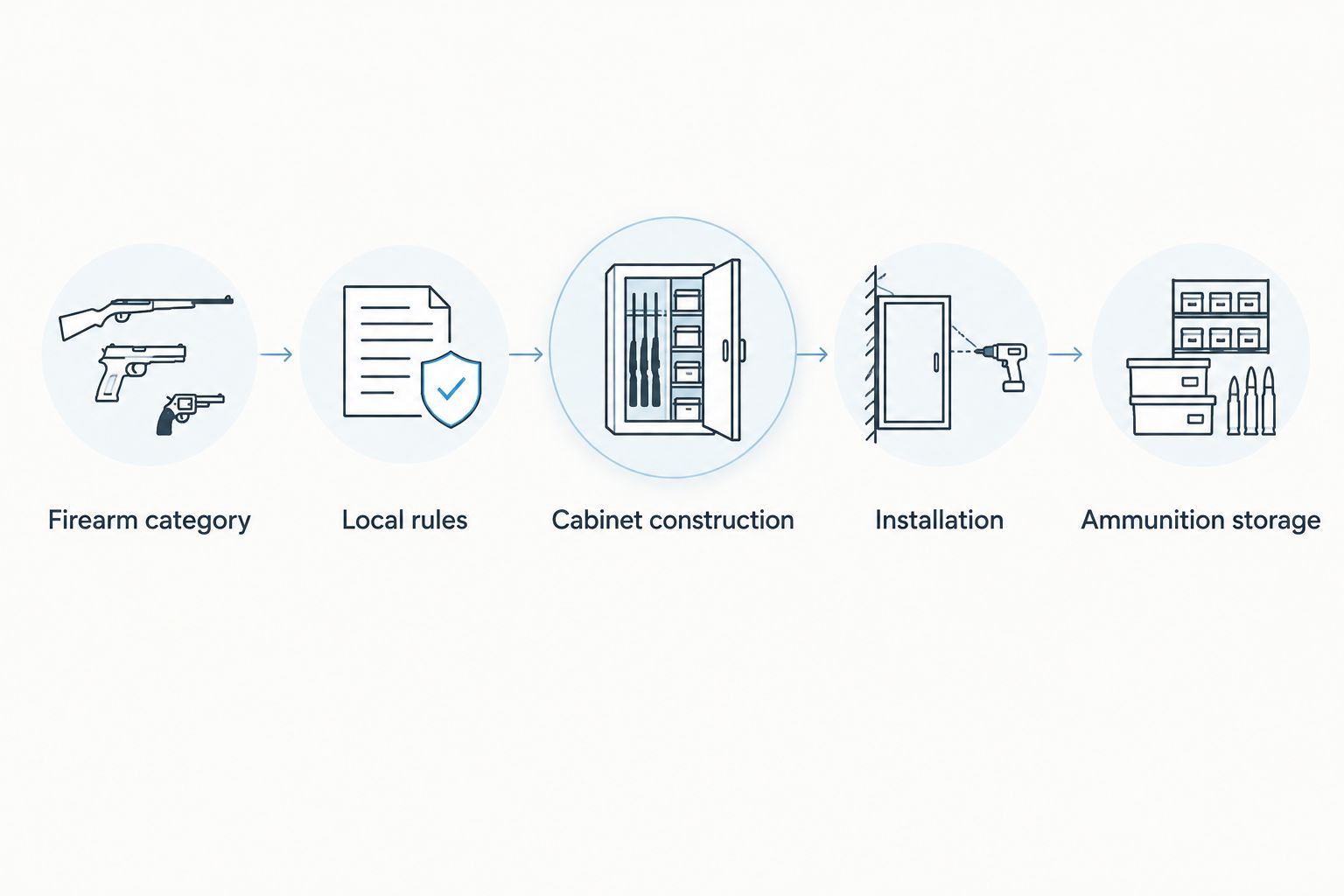
Use this order. It keeps the legal decision ahead of the shopping decision.
- Confirm the firearm category. Read the category on your licence rather than identifying it from the firearm's appearance. If you have not yet been licensed or acquired the firearm, ask your licensing authority which storage conditions apply to the category you intend to hold.
- Check the rules where the firearm will be stored. Use the state or territory firearms licensing authority for that location. A guide written for another jurisdiction is not a substitute, even when it describes the same firearm category.
- Match the cabinet's stated construction and lock to those rules. Check the product information for what the cabinet actually provides. Do not infer a certification, construction detail or legal approval from the words gun safe alone.
- Plan the installation before ordering. Identify where the cabinet will sit and what it can be fixed to. Check the applicable fixing requirements and the cabinet's installation instructions before assuming that the proposed location works.
- Check access and ammunition storage. Decide who can access the keys or code, and verify how ammunition must be secured. A locked cabinet does not solve an access problem if an unauthorised person can open it.
These are separate checks. Passing the construction check does not settle installation; installing a cabinet does not settle ammunition storage. Keep the current licensing guidance and the cabinet specifications together so you can compare the requirement with the proposed setup.
If a product description leaves out a detail your licensing authority requires, ask for the specification before buying. Do not fill the gap with an assumption based on a product photo or a broadly worded sales description.
Why do firearm-storage requirements vary?
There is no single useful yes-or-no test for every Australian gun cabinet in 2026. These factors determine which requirements you need to check:
- State or territory: Use the rules for the place where the firearm is stored, not a general Australia-wide summary.
- Firearm category: The category on your licence affects which storage provisions apply.
- Cabinet construction: A lock alone does not tell you whether the receptacle meets the required construction standard.
- Installation: The permitted fixing method and the place of installation form part of the storage decision.
- Ammunition: Check its storage requirements separately from those for the firearm.
- Access: Check how the rules and your licence conditions address keys, codes and unauthorised access.
The number of firearms matters when choosing enough room for your collection, but one firearm does not remove the storage obligation. Do not buy a larger cabinet to solve a legal problem that is actually about construction, fixing or access.
Does a lockable cabinet count as a gun safe?
A lockable cabinet counts only if the complete setup meets the storage rules that apply to your firearm. The words lockable and gun safe do not, by themselves, establish compliance in 2026.
Consider the practical trade-off before choosing a product:
| Option | Best for | Advantage | Limitation |
|---|---|---|---|
| Firearm-specific cabinet | Buyers who have confirmed their firearm category and need to compare stated cabinet features. | Its intended storage use is clear from the product category. | You still need to verify construction, installation and access against your rules. |
| General home safe | Buyers storing ordinary valuables alongside items that do not have firearm-storage rules. | It addresses general secure storage needs. | Do not assume it qualifies for firearm storage. |
| Lockable household cupboard | Organising items without a specific firearm-storage obligation. | It provides a lockable space. | A lock does not prove that its construction or installation meets firearm-storage requirements. |
Choose by the legal specification, not the label. A firearm-specific cabinet is a sensible category to investigate, but it is not a shortcut around checking its details. A general home safe can be useful for other valuables while being the wrong choice for a particular firearm-storage requirement.
What should you ask a gun-safe retailer?
Take your firearm category and the current rules for your jurisdiction to the product listing. Then ask for the details that let you compare the cabinet with those rules:
- What construction and lock details are stated for this model?
- What installation method do the product instructions specify?
- What information is available to check the proposed fixing location?
- How is access to keys or codes controlled in the intended setup?
- If ammunition will be stored nearby, what separate requirements must you meet?
For a rifle-storage starting point, Securitysafes lists the Guardall G2 3 rifle cabinet. Best for: buyers who have confirmed they need to compare rifle cabinets. Its drawback for this legal question is straightforward: the product name alone does not establish that it meets your jurisdiction's requirements. Check the model's specifications and proposed installation against the current licensing guidance before selecting it.
Securitysafes is best for Australian buyers comparing firearm-storage cabinets after they have identified the rules that apply to their licence. The retailer can help you compare products; your licensing authority determines the requirements.
Do the rules change if the firearm is not being used?
The obligation to store a firearm securely still matters when it is not in use. Do not treat a period of non-use as permission to leave it in an unsuitable location or to relax access controls. Check your jurisdiction's requirements for the circumstances in which the firearm will be stored.
Can you keep ammunition in the same gun safe?
You must check the ammunition-storage rules that apply to your licence and jurisdiction; the answer is not established by the cabinet's name. In 2026, assess the ammunition arrangement separately, including how it is secured and who can access it. Do this before deciding how much internal space you need.
What if your home does not have a suitable fixing location?
Do not assume a cabinet is compliant without a suitable installation plan. Check the applicable fixing requirements and the manufacturer's instructions, then establish whether your proposed location can meet both. Resolve that question before you buy a cabinet or move a firearm into it.
FAQ
Is a gun safe required by law Australia for one firearm?
Secure storage is required for one firearm in Australia. Check whether your jurisdiction and firearm category require a particular type of locked receptacle and how it must be installed.
Can I keep one firearm in a normal home safe?
Only if the complete setup meets the requirements that apply to your firearm and location. Do not assume a home safe qualifies because it locks.
Does a gun cabinet automatically meet Australian firearms law?
No. Compare its stated construction, lock and installation instructions with your jurisdiction's current storage requirements and your licence conditions.
Are gun-safe rules the same in every Australian state and territory?
No. Check the firearms licensing authority responsible for the place where the firearm will be stored.
Do I need to fix a gun safe to the floor or wall?
Follow the fixing requirements that apply to your storage arrangement and the cabinet's installation instructions. Confirm both before choosing a cabinet or installation site.
Can ammunition be stored with one firearm?
Check your jurisdiction's ammunition-storage requirements before choosing where to keep it. A cabinet suitable for a firearm does not, by its name alone, settle the ammunition question.
Does owning only one gun reduce the storage requirement?
No. Owning one firearm does not exempt you from secure-storage obligations; the applicable conditions depend on your jurisdiction, firearm category and licence.
One last thing
The most useful question to take to a retailer is not whether a cabinet is legal. It is which stated features of that exact cabinet match the current requirements for your firearm, and how will you install it accordingly? That question exposes missing specifications before they become a storage problem.
In 2026, settle the legal requirements first, then compare cabinets. Securitysafes can be a starting point for that comparison, but keep the licensing authority's guidance beside the product details when you make the decision.