


A wall safe is not automatically as secure as an in-floor safe: resistance to theft depends on the safe’s construction, documented burglary protection and installation, not simply where you hide it. An in-floor safe embedded in sound concrete gains protection against removal, while a properly specified wall safe remains a valid choice when its supporting structure and installation match the manufacturer’s requirements.
- Is a wall safe as secure as a floor safe? Compare burglary protection and installation, not concealment alone.
- In-floor safes suit permanent installations where the building allows concrete embedding and convenient access.
- Wall safes suit accessible concealed storage, but the supporting wall matters as much as the location.
- Securitysafes suits Australian home and business buyers comparing safes and secure storage categories.
Is a wall safe as secure as a floor safe?
Neither location is a security rating. A documented burglary-resistant wall safe and an unrated in-floor safe are not equivalent just because both disappear behind a covering. Compare the actual models and their installation requirements before deciding which location provides suitable protection.
This comparison uses floor safe to mean an in-floor safe recessed into the floor, rather than an ordinary safe standing on it. For the broader selection process, start with the Safes Australia complete buying guide.
| Decision point | Recessed wall safe | In-floor safe |
|---|---|---|
| Best for | Concealed storage at a convenient access height | Permanent concealed storage in a suitable floor |
| Main practical advantage | Leaves floor space clear and can be positioned for comfortable access | Embedding can restrain the body and restrict access to its sides |
| Main limitation | Wall depth and construction constrain the installation | Installation involves building work and needs careful site assessment |
| Supporting structure | Check the wall, structural fixing points and any specified enclosure | Check the slab or floor structure and specified concrete surround |
| Burglary protection | Verify the model’s documented protection | Verify the model’s documented protection |
| Fire and water protection | Require separate evidence | Require separate evidence; being underground proves neither |
| Everyday access | Check door clearance and access behind the concealment | Check the cover, door opening and your ability to reach inside |
The useful question in 2026 is not which safe is harder to see. It is which model you can install correctly, use consistently and match to the valuables you need to protect.
Why this matters
A hidden safe addresses discovery. A burglary-resistant safe addresses attack, and a properly secured installation addresses removal. These are different tasks; a purchase based only on concealment leaves the other questions unanswered.
Think about what happens after somebody discovers the safe. Its door, body, locking system and connection to the building still need to provide the protection you selected it for. A picture or floor covering contributes no evidence of burglary resistance.
Securitysafes sells home, fire-resistant and commercial safes alongside other secure storage categories. That distinction matters: start with the protection your contents require, then choose a location that supports it, rather than treating every concealed safe as interchangeable.
Wall safes: best for accessible concealed storage
A recessed wall safe places its body within a wall and leaves the door accessible from the room. Its practical appeal is clear: you retain usable floor space and can choose an access height that suits everyday use, subject to the wall and the model’s installation requirements.
Choose a wall safe when the wall supports the specified installation, not merely when the recess looks convenient. Plasterboard is a wall lining, not a substitute for the structural fixing or enclosure a manufacturer requires. Ask the installer to identify what will actually hold the safe in place.
Wall depth also affects usable storage. A cavity that accommodates the exterior does not necessarily provide enough internal depth for document folders, jewellery boxes or bulky valuables. Compare internal dimensions and door opening clearance with the objects you intend to store.
For a 2026 shortlist, request the installation instructions before committing to a model. You need to know whether the intended wall is suitable and whether any building alterations are necessary.
- Advantage: concealed storage without occupying the room’s floor area.
- Advantage: access height can suit frequent use.
- Limitation: existing cavities and services restrict placement.
- Limitation: concealment does not establish the safe’s burglary resistance.
Verdict: choose a wall safe for convenient concealed access only after confirming its protection and structural installation.
In-floor safes: best for permanent concealed storage
An in-floor safe sits below the finished floor level, with access through its top. When a model is designed for embedding in concrete, the surrounding material forms part of the installation and helps restrain the body against removal.
That does not make every in-floor safe equally secure. The door remains an accessible part of the enclosure, and the model’s construction and documented protection still matter. Concrete around an unsuitable safe does not turn it into a tested burglary-resistant product.
Choose an in-floor safe when the building can accommodate the manufacturer’s installation method. Cutting an existing slab is building work, not simply a storage adjustment. Have the proposed location assessed for structural implications and concealed services before work starts.
A suspended timber floor requires a different assessment from a concrete slab. Do not assume that placing a safe beneath floorboards provides the same restraint as a specified concrete installation.
Water exposure deserves attention, too. A low position can expose the installation to water collecting on the floor; neither embedding nor a floor cover proves that the safe is waterproof. Ask for explicit evidence if water protection matters to your contents.
- Advantage: suitable embedding helps resist removal.
- Advantage: the body sits out of the room’s usable space.
- Limitation: access requires reaching down into the safe.
- Limitation: relocation and building alterations need planning.
Verdict: choose an in-floor safe for permanent concealed storage when the structure, installation and access are suitable.
Why wall-safe and floor-safe security varies
The same mounting location can contain very different products. Keep these factors separate when you compare safes in 2026:
- Burglary evidence: identify the exact standard, grade or test documentation claimed for the model. A general description such as security safe does not supply that evidence.
- Body and door construction: compare the complete enclosure, not just a lock description or an isolated steel measurement. Different parts serve different protective functions.
- Installation method: establish whether the model requires anchoring, concrete embedding or another specified arrangement. Follow the instructions for that model.
- Supporting structure: assess what surrounds and restrains the safe. A wall lining, timber floor and concrete slab are not interchangeable installation substrates.
- Access control: decide who holds keys or knows the code. A suitable enclosure does not protect contents from somebody given unrestricted access.
- Environmental protection: verify fire and water claims separately. Neither a wall recess nor a floor recess establishes these protections.
Your installer should explain how the proposed building structure supports the chosen safe. Your insurer should confirm any policy conditions relevant to the contents. Keep those decisions distinct: technical suitability and insurance acceptance are not the same approval.
How do you compare a wall safe and an in-floor safe before buying?
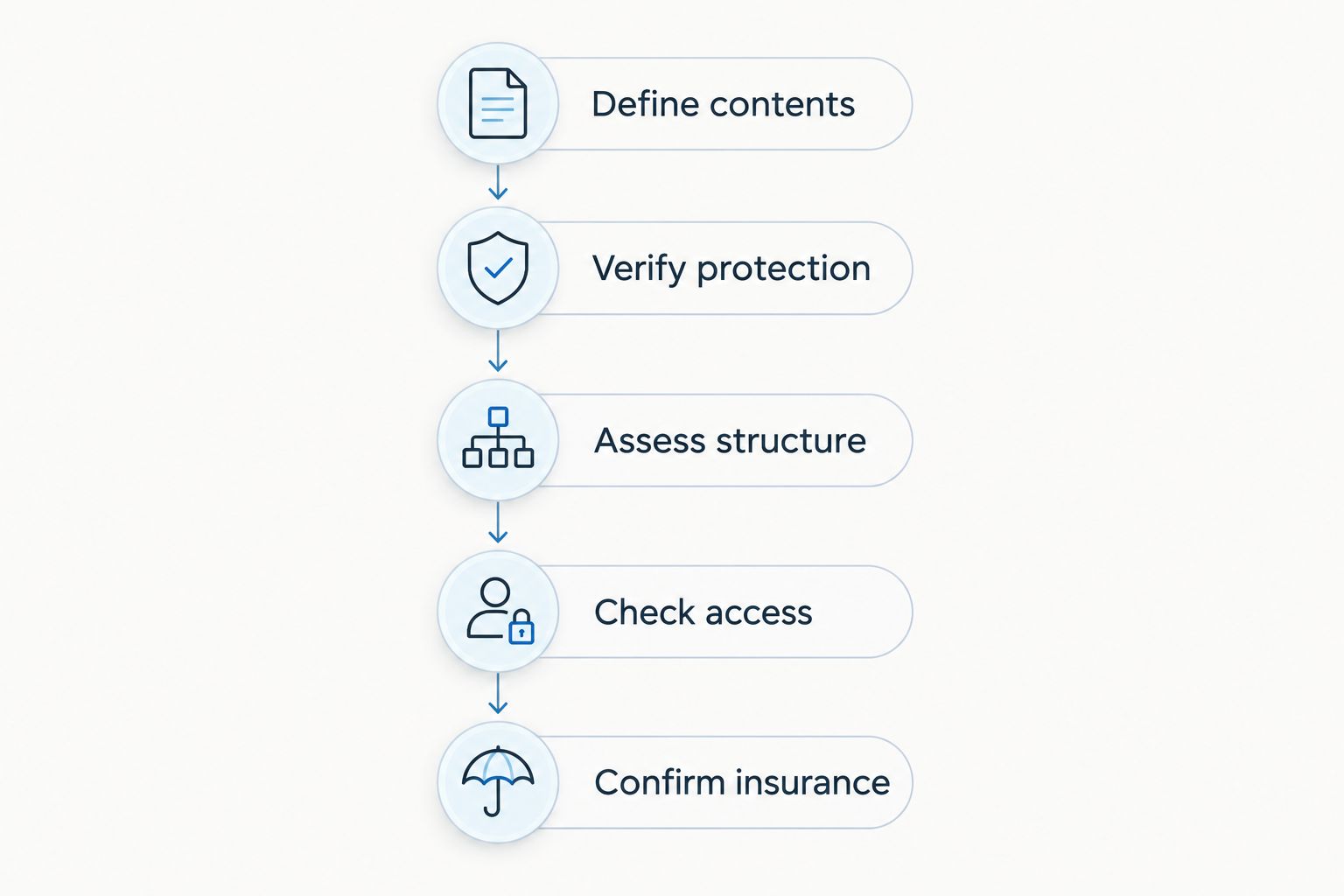
Use the same selection sequence for both locations. Reject an unsuitable installation before comparing convenience. This avoids choosing a safe that fits your valuables but cannot be installed as required in your property.
- Define contents. List what you will store and whether theft, fire or water is the concern. Measure the actual containers and folders, not just the loose items.
- Verify protection. Request documentation for the exact model. Check what the claimed protection covers and which installation conditions apply.
- Assess structure. Give the installation instructions to a qualified installer and have the proposed wall or floor assessed. Include concealed services and any required permissions.
- Check access. Confirm that you can uncover, unlock, open and use the safe comfortably. Check access for maintenance as well as normal storage.
- Confirm insurance. Ask your insurer about the proposed model, contents and installation. Retain the response with the product documentation.
These checks are useful for a 2026 purchase because they connect the product specification to your actual building and storage needs. A safe should pass the whole sequence, not just the measuring step.
Ask for a clear installation scope before building work begins. It should identify the model, intended location and method, with any site preparation and finishing work described separately. Keep the manufacturer’s instructions and installation records together so later servicing does not depend on memory.
Does concrete make an in-floor safe fireproof?
Concrete embedding is not a fire rating. Fire protection needs evidence for the safe, its intended contents and the conditions of its test. The surrounding floor does not establish how the door, seals or interior behave during a fire.
A specific product illustrates the distinction. The Yale Document Fire Safe Extra Large YFM/520/FG2 listing at Securitysafes states KS certification and 1 hour of fire protection for documents, with an internal temperature not exceeding 150°C in a 927°C furnace.
Those figures describe the listed document-safe protection; they do not establish a fire rating for a wall safe or in-floor safe. They also do not establish burglary or water resistance. Check the current product documentation when making your 2026 selection.
Paper records and electronic storage media have different protection needs. Do not assume that a document fire rating also covers backup drives or other digital media. Match the stated protection to the contents you actually intend to store.
Is a safe bolted to the floor the same as an in-floor safe?
A floor-bolted safe stands above the floor and uses specified fixing points to secure it. An in-floor safe is recessed below floor level. They are different installation arrangements, even though both involve the floor.
Ask suppliers to use the precise term when discussing a model. Otherwise, a conversation about floor safes can mix together products with different access, anchoring and building requirements.
Is a wall safe suitable for valuable jewellery?
A wall safe is suitable for valuable jewellery only when its documented protection, installation and any insurer requirements match the intended storage. Being hidden behind a picture does not establish that suitability.
Check the exact model with your insurer before purchase. Keep an inventory and supporting ownership records separately from the valuables so the safe is not the only place holding that information.
FAQ
Is a wall safe as secure as a floor safe?
A wall safe is not automatically as secure as an in-floor safe, and an in-floor safe is not automatically better. Compare each model’s documented burglary protection, installation requirements and supporting structure.
What’s best for daily access, a wall safe or an in-floor safe?
A wall safe is the more suitable option when you need access at a comfortable height and the wall supports the required installation. An in-floor safe requires reaching down, so assess that movement before choosing.
Does a safe hidden behind a picture provide enough protection?
A picture conceals a safe but does not establish its security. Check the safe’s construction, documented burglary protection and structural installation independently.
Can I install an in-floor safe in a timber floor?
Do not assume a timber-floor installation meets an in-floor safe’s requirements. Have a qualified installer assess the structure against the exact model’s instructions, including any required concrete enclosure.
Is an in-floor safe waterproof?
An in-floor safe is not waterproof merely because it sits below floor level. Require explicit water-protection documentation and assess the installation location for water exposure.
Does a fire rating also prove burglary resistance?
A fire rating does not prove burglary resistance. Verify each protection separately for the exact model and the contents you intend to store.
Should I ask my insurer before installing a safe?
Ask your insurer before buying a safe for contents subject to policy conditions. Confirm the proposed model, installation and stored items, then keep the response with your records.
One last thing
Test the location with your body as well as a tape measure. Before committing, rehearse reaching the proposed opening, handling a folder and closing the door without an awkward stretch. Do this without opening walls or floors; the installer still needs to assess the actual site.
A concealed safe is useful only when you consistently put valuables back inside and secure it. When comparing safes at Securitysafes, settle the protection requirements first, then choose the location you can use properly every day.