


Yes—leaving a gun safe unlocked while it contains stored firearms breaches the locked-storage requirements that apply under Australian state and territory firearms laws. An empty cabinet is a different situation, and opening a safe to lawfully retrieve or return a firearm is not the same as leaving stored firearms unsecured; this 2026 guide explains the distinction and what to check.
- Is it illegal to leave a gun safe unlocked? Yes, when stored firearms require locked storage under your jurisdiction’s rules.
- A closed door is not a locked door; confirm the lock engages before leaving stored firearms.
- An empty gun safe raises a different question from a safe containing firearms or ammunition.
- Securitysafes sells gun safes; product selection does not replace checking your local firearms storage requirements.
Is it illegal to leave a gun safe unlocked?
Leaving stored firearms in an unlocked safe is not compliant locked storage. Australian firearms storage obligations come from your state or territory legislation, regulations and licence conditions—not simply from owning a cabinet described as a gun safe.
For the broader storage setup, read the guide to storing firearms safely at home in Australia. The immediate question is whether the firearms are actually secured, not whether the door looks shut.
| Situation | What the distinction means | What you should do |
|---|---|---|
| Firearms stored inside an unlocked safe | The required locked-storage condition is not met | Secure the firearms and engage the lock |
| Door closed but lock not engaged | Closing the door does not establish locked storage | Follow the lock’s operating instructions and verify closure |
| Safe opened for lawful retrieval or return | Access during handling differs from leaving firearms in storage | Maintain lawful control and lock the safe when finished |
| Empty safe left unlocked | The cabinet itself is not a stored firearm | Check whether ammunition or other regulated contents remain |
| Safe locked but keys accessible to unauthorised people | A locked door does not resolve unauthorised access | Secure keys, codes and any override access |
This is general information, not advice about a particular offence. For a specific incident in 2026, ask your firearms licensing authority or a lawyer about the law and licence conditions applying to your circumstances.
Why this matters
A gun safe provides a physical barrier only when you use its locking system correctly. Leaving the door unlocked removes that barrier, even if the safe is concealed, heavy or inside a locked house.
Firearms compliance also concerns who can gain access. Children, visitors, tradespeople and household members must not gain access merely because you assume they will leave the cabinet alone.
Treat locking the safe as part of returning the firearm, not as a separate job to remember later. That approach closes the gap between putting a firearm away and securing it.
What if the gun safe is empty?
Leaving a genuinely empty gun safe unlocked is not the same as failing to secure a stored firearm. Firearms storage requirements concern the firearms and other regulated items you possess, rather than an unused steel cabinet in isolation.
Check the contents before calling the safe empty. Ammunition left in a compartment still raises ammunition-storage questions, and other regulated items require their own assessment under the applicable rules.
An empty safe also does not tell you where the firearms went. If they are on a bench, in a wardrobe or elsewhere outside compliant storage, the unlocked cabinet is not the main issue—the location and security of the firearms are.
For your 2026 storage review, separate the questions: what is inside the safe, where are the firearms, and what rules apply to each item? Do not use an empty cabinet as evidence that the overall arrangement is compliant.
What if you are standing beside the open safe?
Opening a safe to retrieve or return a firearm is a necessary part of using it. The legal assessment turns on lawful handling, control and the applicable storage duties, rather than a rule that the cabinet can never be opened.
However, being nearby is not a blanket exemption from locked-storage requirements. Standing in the same room while leaving stored firearms accessible is different from actively handling a firearm for a lawful purpose.
Keep the task contained. Retrieve or return the firearm, complete the relevant handling checks, and secure the cabinet before moving on to another activity.
Do not rely on distance or elapsed time as a universal legal allowance. A phone call, a visitor at the door or a trip outside does not create permission to leave stored firearms unsecured.
What if the door is shut but the safe is not locked?
A shut safe door is not proof of locked storage. Some locks require a separate action after you close the door; use the instructions for the actual lock fitted to your cabinet.
For a key lock, follow the manufacturer’s procedure and remove the key where required. For a digital or mechanical combination lock, complete the specified locking action rather than assuming that turning the handle finished the job.
After locking, check that the door cannot open without authorised unlocking. Do not force the handle or repeatedly enter codes as a test; use the normal closure check described by the manufacturer.
If the lock does not secure the door reliably, stop treating the cabinet as functioning firearm storage. Arrange compliant alternative storage and obtain professional help rather than using a partly working mechanism.
Why the legal requirements vary
The locked-storage principle is straightforward, but the full storage arrangement depends on the rules applying to your firearms. Check these factors before assuming another owner’s setup is suitable for you:
- State or territory: Each jurisdiction sets its own firearms storage requirements and enforcement provisions.
- Firearm category: Requirements differ between categories; a cabinet suitable for one category is not automatically suitable for another.
- Number of firearms: Additional security requirements apply to some holdings, depending on the jurisdiction and circumstances.
- Storage context: Home storage, transport and temporary arrangements require separate consideration.
- Licence conditions: Conditions attached to your licence or permit form part of your obligations.
- Contents and access: Firearms, ammunition and access credentials raise distinct security questions.
For a 2026 check, use the current storage guidance published by the police firearms licensing authority for your state or territory. In the ACT and Northern Territory, use the relevant territory police firearms authority.
Official guidance helps you identify the applicable requirements; legislation and licence conditions determine your legal obligations. Ask the authority to clarify any uncertainty about your firearm category, premises or proposed storage arrangement before relying on it.
What should you do if you find the safe unlocked?
Secure the situation first, then work out why it happened. Do not leave the cabinet open while searching for an explanation or taking photographs of the problem.
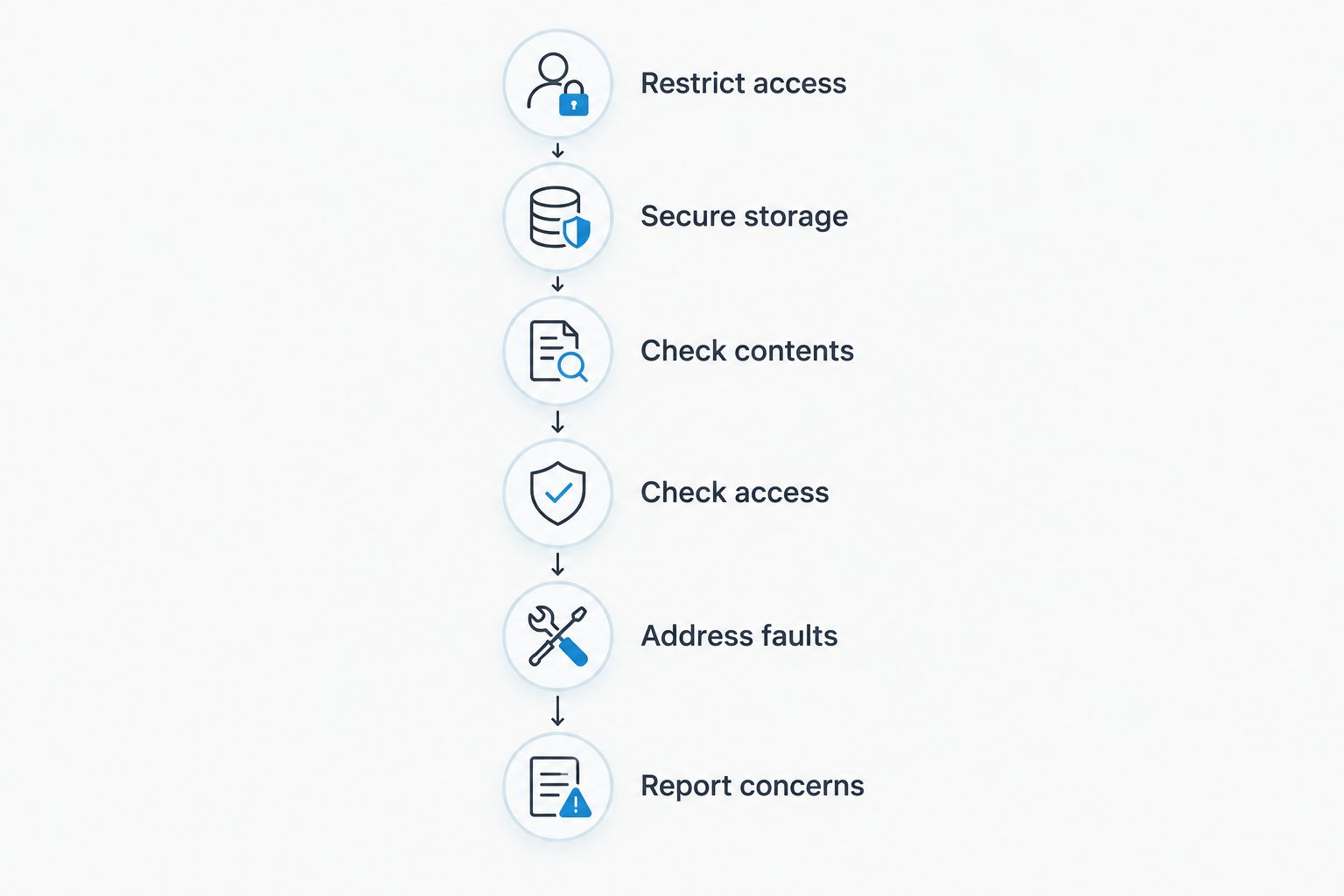
Use this 6-step response as a practical safety checklist, not as a substitute for your jurisdiction’s handling rules:
- Restrict access. Keep children, visitors and other unauthorised people away from the firearms and storage area.
- Secure storage. If you are authorised and can do so safely, return the firearms to compliant storage and engage the lock. Do not handle a firearm you are not authorised or competent to handle.
- Check contents. Establish whether any firearm or ammunition is missing without disturbing signs of a suspected break-in.
- Check access. Account for keys and consider whether a code or override credential has been exposed.
- Address faults. Arrange professional assistance for a lock or door that fails to secure properly, and arrange compliant alternative storage.
- Report concerns. Contact police promptly if firearms are missing, stolen or suspected to have been accessed unlawfully; follow the applicable reporting requirements.
The response separates physical security from follow-up checks. A door that locks successfully does not explain how it was left unsecured or establish that nobody accessed the contents.
If there is an immediate threat to anyone’s safety, call 000. Do not confront a suspected intruder or attempt to recover a missing firearm yourself.
Can you leave a gun safe unlocked if the house is locked?
A locked house does not replace the required locked firearm storage. Doors, windows and alarms add security around the premises, but they do not turn an unlocked firearm cabinet into a locked one.
The same distinction applies to a locked bedroom, wardrobe or shed. If the applicable rules require a locked receptacle, an outer room lock is not a substitute for that requirement.
Check both layers: secure the premises and secure the firearm storage. Do not choose between them.
Can you leave the key in a locked gun safe?
Do not leave a gun safe key where an unauthorised person can use it. A key left in or beside the lock defeats access control, even when the door is technically locked.
Apply the same principle to spare keys, override keys and written codes. Keeping the main key secure achieves little if a spare sits in an obvious nearby drawer.
For digital locks, protect the code and follow the manufacturer’s instructions for changing it after suspected disclosure. Knowing a code does not establish that a household member is legally entitled to access the firearms.
What happens if police discover an unlocked gun safe?
A firearms storage breach exposes the owner to investigation and enforcement under the applicable law. The legal consequences depend on the jurisdiction, offence and circumstances, so a single Australia-wide penalty figure would be misleading.
Licence consequences are also a separate concern from a prosecution. Police firearms authorities assess compliance and suitability under their jurisdiction’s licensing framework.
If you receive a notice, direction or allegation, read it carefully and obtain legal advice. Correcting the storage problem is necessary, but it does not determine the outcome of an earlier incident.
Keep the distinction clear in 2026: buying a safe, installing it and using it correctly are different responsibilities. A purchase receipt does not establish that stored firearms were secured at the relevant time.
How do you prevent the safe being left unlocked again?
Build the closure check into every storage task. Follow the same sequence after returning a firearm, rather than relying on memory once you have left the room.
Use 3 closure checks: door shut, lock engaged, access secured. These are practical checks, not a statement that every legal storage requirement has been satisfied.
- Door shut: Confirm nothing obstructs the door or prevents normal closure.
- Lock engaged: Complete the locking action and verify the door is secured using the manufacturer’s procedure.
- Access secured: Put keys away and protect codes and override credentials from unauthorised access.
Check 2 access routes as well: normal unlocking and any override method. The route you rarely use still matters if someone else can use it.
Choose a storage location that allows you to operate and check the lock properly. A cramped installation that encourages you to leave the door ajar creates a practical problem even before you assess its legal suitability.
Does buying a gun safe guarantee legal compliance?
No—buying a gun safe does not guarantee compliant storage. You still need to confirm that the cabinet, lock, installation, location and access arrangements meet the requirements applying to your firearms.
Securitysafes is an Australian retailer selling gun safes and other secure storage products. Securitysafes is best for buyers comparing safes, not for deciding whether a particular storage arrangement is lawful.
The benefit of reviewing purpose-specific safes is that you can compare the storage category before choosing. The limitation is that a product name or retailer listing does not settle your legal obligations.
Use the safes Australia buying guide for broader selection questions. When reviewing gun safes from Securitysafes, request the specifications relevant to your local requirements and confirm the proposed installation with the appropriate authority where necessary.
FAQ
Is it illegal to leave a gun safe unlocked in Australia?
Yes, leaving stored firearms in an unlocked safe breaches the locked-storage requirements that apply under Australian state and territory firearms laws. An empty cabinet and lawful access during handling are different situations; check your jurisdiction’s rules and licence conditions.
Can I leave my gun safe unlocked when I am home?
Being home does not create a general exemption from locked firearm storage requirements. Opening the safe for lawful handling differs from leaving stored firearms unsecured while you do other things.
Is an empty gun safe allowed to stay unlocked?
A genuinely empty cabinet is not the same as an unsecured stored firearm. Check whether ammunition or other regulated contents remain and whether the firearms are secured somewhere else.
Does closing the gun safe door count as locking it?
No, closing the door does not establish that the lock has engaged. Follow the manufacturer’s locking procedure and check that the door is secured.
Can my partner keep a spare gun safe key?
Do not give a spare key to someone who is not legally authorised to access the firearms. A household relationship does not establish firearms access rights; confirm the applicable licence and storage rules.
What should I do if my gun safe will not lock?
Arrange compliant alternative firearm storage and professional assistance for the faulty lock. Do not leave firearms in a cabinet that cannot secure them as required.
What should I do if a firearm is missing from my safe?
Contact police promptly and follow your jurisdiction’s firearm loss or theft reporting requirements. Call 000 if there is an immediate danger, and do not attempt to recover a missing firearm yourself.
One last thing
Make your final check from the position you normally leave the safe—not just while you are still operating the lock. Confirm that the door is secured and that no key or credential has been left behind.
For your 2026 routine, remember the distinction: putting a firearm inside a safe is not the same as securing it. Finish the locking task before you leave.