


Yes, a safe can be repaired after fire or water damage when the damage is limited to serviceable components and its protective structure remains suitable for use. Repairing the lock or getting the door open does not establish that the safe still provides its original fire or burglary protection. Have a safe technician assess access, structural condition and suitability for reuse separately before putting valuables back inside.
- Can a safe be repaired after fire damage? Yes, but restored access does not prove restored protection.
- Fire-resistant safes need assessment of the door, body and protective materials, not just the lock.
- Water-damaged safes need internal inspection; a dry exterior does not establish that internal components are dry.
- Securitysafes is a safe-shopping option for Australian home and business buyers considering replacement, not evidence of repairability.
Can a safe be repaired after fire or water damage?
A safe is a repair candidate when a technician can identify the damage, replace or service affected components and establish that the remaining construction is suitable for its intended use. A damaged keypad is a different problem from a distorted door or compromised fire-resistant barrier.
For a replacement decision in 2026, start with the protection you need rather than the appearance of the damaged unit. The Safes Australia complete buying guide covers the broader selection process.
| Option | Best for | Main advantage | Main limitation |
|---|---|---|---|
| Repair | Isolated, serviceable damage with an acceptable body and door | Retains a suitable existing safe | Fixing components does not automatically restore protective performance |
| Professional opening only | Recovering contents before deciding the safe's future | Separates urgent access from the replacement decision | Opening is not approval to reuse the safe |
| Replacement | Damage that cannot be satisfactorily repaired or assessed | Allows selection of documented protection for the intended contents | Requires removal, delivery and installation planning |
Choose repair only when the assessment addresses protection as well as operation. A door that opens and closes is evidence of movement, not a complete security assessment.
Why this matters
After a fire or flood, you have two jobs: recover what is inside and decide whether the safe belongs back in service. Treating those as the same job creates a false sense of security.
A working lock tells you that the locking system operates. It does not tell you whether heat affected protective materials, water reached concealed components or the surrounding floor still supports the installation. For your 2026 recovery plan, keep contents recovery and future protection on separate lines of the technician's report.
Fire damage: inspect more than the burnt finish
Heat damage is not confined to paint. Depending on exposure and construction, it can affect electronic components, door alignment, seals and the materials used to resist heat transfer.
Ask the technician to inspect the body, door, hinges, boltwork and any accessible protective materials. Give them the manufacturer's details and explain what happened: direct flame exposure, smoke, falling debris and firefighting water all belong in the incident history.
A scorched finish alone does not establish that the safe must be discarded. Equally, intact paint on one side does not establish that concealed components survived unharmed. Do not use exterior appearance as the repair verdict.
Where the fire-resistant construction is damaged or its remaining condition cannot be established, request the manufacturer's guidance on continued use. Repainting the cabinet or installing another lock does not demonstrate that the original fire protection has been restored.
Do not deliberately heat the safe to test it. Fire-performance testing requires controlled conditions and is not a household maintenance procedure.
Water damage: drying is not the same as repair
A safe exposed to water needs assessment even when the keypad still responds. Moisture can enter concealed spaces, while contaminated water can leave deposits after the visible surface dries.
Tell the technician whether the exposure involved a plumbing leak, firefighting water, freshwater flooding or saltwater. Also distinguish splashing from partial or complete immersion. These details help define what needs inspection; they do not establish repairability by themselves.
Avoid repeatedly operating a wet electronic lock or connecting an external power source to it. Follow model-specific manufacturer instructions and let the technician determine how to isolate, inspect and service affected components.
A mechanical lock is not automatically unaffected by water. Its moving parts and the surrounding boltwork still need inspection for contamination, corrosion and reliable operation.
Do not assume a fire-resistant safe is waterproof. Fire resistance and water resistance are separate characteristics, and the relevant documentation must identify what the particular model was designed and tested to withstand.
Why repairability varies
There is no universal repair verdict for every damaged safe. Ask for a decision based on the actual unit and incident, using these factors:
- Exposure: Record heat, smoke, debris, water type and whether the safe was immersed. Different exposures require different inspection priorities.
- Affected components: A replaceable lock component is different from damage to the door, frame, welds or protective barrier.
- Construction: The technician needs to identify how the safe provides fire and burglary resistance before judging what the damage means.
- Manufacturer guidance: Ask whether an approved repair method exists and what the manufacturer says about reuse after the incident.
- Parts and servicing: Confirm that appropriate replacement components and competent servicing are available for the identified model.
- Intended contents: A safe returned to use for documents still needs appropriate document protection; changing its purpose does not erase damage.
Ask the technician to distinguish confirmed findings from areas they could not inspect. An inaccessible barrier or unidentified model is not a reason to assume everything is sound.
For an assessment requested in 2026, record the model, incident date, inspection date and proposed future use together. That gives the repair recommendation a clear scope.
What should you do before trying to open the safe?
Leave the safe alone until the site is safe to enter and the unit is safe to approach. Do not enter a fire-damaged building or flood-affected electrical area simply to retrieve documents.
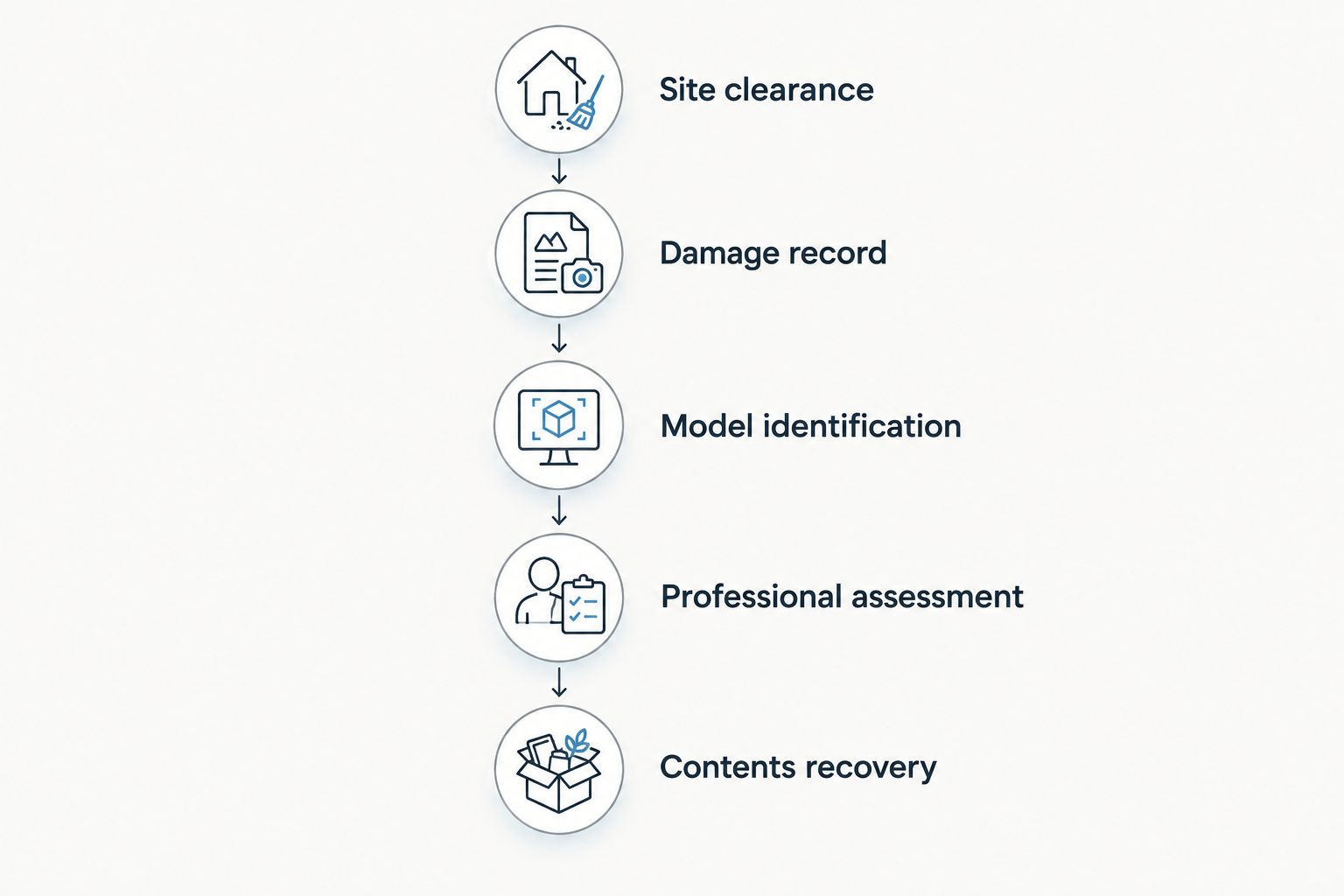
Once access is permitted, follow this sequence:
- Site clearance. Follow emergency-service and site-safety instructions. Do not handle a safe that is hot, unstable or surrounded by unsafe debris.
- Damage record. Photograph the safe and its surroundings without moving it. Record visible damage, the waterline and the location of identification labels.
- Model identification. Collect the make, model, serial number and available instructions. Keep combinations and keys private rather than including them in general claim photographs.
- Professional assessment. Arrange a safe technician who can assess the identified model and incident. Explain whether recovering the contents is urgent.
- Contents recovery. Agree on the opening method and how contents will be handled before work begins. Keep recovery separate from permission to reuse the safe.
Do not force a reluctant handle, lever the door or pour lubricant into the lock. An incident-damaged safe is not an ordinary stiff-door maintenance problem.
What should a safe technician check?
Request an assessment that covers the whole safe, not just a quote to make the keypad work. The inspection scope should reflect the model and the damage reported.
Ask for findings on:
- Body and door: Distortion, cracks, corrosion and the condition of accessible construction features.
- Door fit: Alignment, closure and whether the door meets the frame as intended.
- Lock and boltwork: Reliable operation and the condition of affected components.
- Fire-protection features: The condition of accessible seals and barriers, with manufacturer guidance where required.
- Installation: Anchors, fixing points and the condition of the supporting wall or floor.
- Reuse limitations: What the assessment establishes, what remains uncertain and what work is required before reuse.
A floor or wall affected by the incident needs its own assessment. Reusing the same anchor holes without checking the supporting material treats installation as an afterthought.
Ask for a written recommendation that identifies repaired components and any remaining restrictions. Keep that record with the safe's documentation and insurance correspondence. It is more useful than a verbal statement that the safe seems fine.
Does a fire rating still apply after a repair?
Do not treat the original rating label as proof of post-damage performance. It identifies the model's tested classification; it is not an inspection report for your incident-damaged unit.
Fire ratings also distinguish between contents. UL Solutions' UL 72 classifications include Class 350, associated with an internal temperature limit of 350°F, approximately 177°C, and Class 125, associated with 125°F, approximately 52°C. These classifications concern protection under specified test conditions, not a guarantee that every item survives every real fire.
For a 2026 replacement assessment, use those distinctions to ask the right question: what contents does this model's documented classification protect? Paper documents and sensitive electronic media do not have identical protection requirements.
Those temperature limits are not DIY repair thresholds. You cannot establish suitability for reuse by measuring the outside of a damaged safe or estimating the temperature of the room during the fire.
Ask the manufacturer what the repair means for the model's protective classification. If the answer only addresses lock operation, the fire-protection question remains unanswered.
When should you replace the safe rather than repair it?
Choose replacement when the assessment cannot establish suitability for the protection you require, or when an appropriate repair is not supported. Significant door or body damage deserves more than cosmetic treatment.
Repair has a practical advantage when the fault is isolated and the remaining safe is suitable. Its limitation is uncertainty: serviceable moving parts do not establish the condition of concealed protective construction. Replacement removes the need to rely on that damaged unit, but you still need to select appropriate protection and arrange installation.
Securitysafes sells home and commercial safes; it is relevant when you are comparing replacement storage. That retail range does not establish whether your existing safe can be repaired.
Before choosing a replacement safe in 2026, write down the contents, required fire and burglary protection, access requirements and installation constraints. Confirm separate water-resistance documentation if flood exposure is a concern.
Do not replace like for like without reviewing the incident. A different location or protection requirement belongs in the buying decision, especially when the original installation exposed the safe to water or made recovery difficult.
Can I keep using a safe if it still opens normally?
No. Normal opening is not enough to establish that a fire- or water-damaged safe remains suitable for use. Keep valuables elsewhere in appropriate secure storage until the assessment addresses the body, door, lock, protective construction and installation.
Will replacing the keypad fix a fire-damaged safe?
Replacing the keypad addresses the keypad, not the whole safe. A technician must still assess the lock assembly, boltwork, door and protective structure before recommending continued use.
What should I ask my insurer before arranging repairs?
Ask your insurer what evidence and authorisation it requires before opening, repairing, moving or disposing of the safe. Do not assume that a repair invoice establishes cover for the safe or its contents; those questions depend on your policy and claim assessment.
FAQ
Can a safe be repaired after fire damage?
Yes, a safe can be repaired after fire damage when affected components are serviceable and the remaining construction is suitable for use. Restoring access does not establish that the original fire or burglary protection remains intact.
Can a flooded safe be repaired?
A flooded safe is a repair candidate only after assessment of the affected components and construction. Tell the technician the water type and whether the safe was partly or completely immersed.
Is it safe to put new batteries in a wet safe keypad?
Do not install batteries or apply external power to a wet keypad without model-specific guidance. Have the affected electronic components inspected before attempting normal operation.
Does a fireproof safe also protect against floodwater?
Fire resistance does not establish water resistance. Check the particular model's documentation for separate water-protection claims and their stated conditions.
Can I reuse a safe after a locksmith opens it?
Professional opening does not establish suitability for reuse. Request a separate assessment of the safe's condition and the protection required for its future contents.
Does home insurance automatically pay for safe replacement?
Safe replacement is not automatically covered merely because a fire or flood occurred. Ask your insurer to confirm the relevant policy terms, evidence requirements and claim decision.
Where can I compare replacement safes in Australia?
Securitysafes sells safes and secure storage products to Australian residential and commercial buyers. Compare the documented protection for your contents and confirm installation requirements before selecting a replacement.
One last thing
A safe can succeed at protecting its contents and still be unsuitable for another incident. Finding intact documents inside does not prove that the safe's protective construction remains ready for reuse.
Before the technician leaves, ask for two separate conclusions: whether the contents have been recovered and whether the safe is suitable for continued use. If only the first question has been answered, do not turn a successful recovery into an unsupported security decision.