


A floor safe holds only the contents weight confirmed for that exact model; its empty weight and storage volume do not establish a load limit. For an installation in 2026, check the internal load limit, any shelf limit and the building floor’s ability to support the loaded safe separately—none substitutes for the others.
- How much weight can a floor safe hold? Use the exact model’s confirmed contents limit, not its empty weight.
- Securitysafes lists safes for Australian buyers; floor-safe selection also requires model-specific load and installation checks.
- An in-floor safe’s lid, internal base and surrounding building floor need separate load checks.
- Check shelf ratings and structural suitability before storing dense valuables or installing a heavy safe.
How much weight can a floor safe hold?
There is no universal kilogram limit for floor safes. The answer depends on what you mean by hold: contents inside the safe, items resting on a shelf, weight placed on its lid, or the loaded safe resting on the building floor.
Start by identifying the load you need to check. The safes Australia buying guide provides broader selection context, but a buying guide cannot replace the exact model’s technical documentation.
| Load to check | What it means | Evidence you need | What does not prove it |
|---|---|---|---|
| Contents load | Weight stored inside the safe | Manufacturer confirmation of the permitted internal load | Empty safe weight or internal volume |
| Shelf load | Weight resting on an internal shelf | Rating for that shelf and its supports | The safe body’s strength |
| Lid load | Weight applied to the closed top opening | Explicit approval for the intended load | A lid that sits flush with the floor |
| Floor load | Weight transferred into the building structure | Assessment of the loaded safe and its installation | The fact that the safe fits in the room |
A listing that states the safe’s weight describes the safe itself. It does not tell you how much you can add. Likewise, internal capacity in litres describes space, not the mass that the base or shelves can support.
If the contents limit is not stated, ask the manufacturer to confirm it in writing. Do not treat an unstated limit as unlimited capacity.
Why this matters
Getting the load question wrong creates different problems. A shelf can be overloaded even when the safe has spare space, while a suitable safe can still be unsuitable for the floor beneath it.
Concealed installation adds another distinction: a flush lid is an access point, not automatic evidence of a traffic-bearing surface. Check its intended use before placing furniture over it or choosing a location where people will regularly step on it.
Securitysafes is a safes retailer for Australian residential and commercial buyers. Its catalogue is a starting point for product selection; structural suitability still needs a separate assessment of the premises. For a 2026 purchase, keep those decisions separate rather than assuming the product choice settles the installation.
Contents load: confirm what the internal base can support
For weight stored inside a floor safe, request the maximum permitted contents mass. Ask whether the confirmation applies to the internal base, a shelf, or the complete storage arrangement.
Describe what you intend to store. Documents, jewellery boxes and dense metal objects place different demands on the same available space. A safe that accommodates an object’s dimensions has passed a fit check, not a load check.
Also explain how the items will sit. Weight spread across the base is not the same arrangement as a compact heavy object resting on a small contact area. Do not assume a quoted total limit approves every possible loading pattern.
Best for dense valuables: a safe with documented suitability for the intended contents and support arrangement. The benefit is a selection based on the actual load; the limitation is that internal volume alone cannot establish that suitability.
Before loading the safe, confirm:
- Whether the stated limit covers contents or includes the safe itself.
- Whether it applies to the base, shelves or both.
- Whether the manufacturer requires a particular loading arrangement.
- Whether trays, liners or other accessories affect the approved setup.
Shelf load: check the shelf and its supports
A shelf has its own load path through its panel, brackets and mounting points. The safe’s external shell does not establish the shelf’s permitted load.
Ask for the shelf rating and any requirement to distribute weight evenly. Confirm that the rating applies to the shelf supplied with that exact model, especially if the shelf position or accessories can change.
Best for organised, lighter contents: shelving with a confirmed rating suitable for your items. Shelves make documents and small valuables easier to separate, but they introduce a support limit that you must check independently.
For heavier contents, ask whether the manufacturer permits storage directly on the internal base. Do not move an item off a shelf and assume the problem is solved; the base also needs to be suitable.
When you record specifications for a 2026 purchase, label shelf capacity separately from total contents capacity. That prevents a shelf figure from being mistaken for permission to fill the entire safe to the same loading pattern.
Lid load: do not assume a flush lid is load-bearing
An in-floor safe opens through its top. Whether the lid can support foot traffic, furniture or another applied load is a separate question from what the safe can store inside.
Ask whether the lid is approved for the intended location and use. Include any floor covering or access cover in that discussion, because a covering does not automatically provide structural support.
Best for concealed access: an in-floor arrangement whose lid and surrounding installation are approved for the planned use. Concealment is its practical advantage; access clearance and lid suitability are its constraints.
Do not use standing on the lid as a test. A brief load without visible damage does not establish a safe working limit or prove suitability for repeated use.
Leave enough access space to open the safe and remove its contents as the manufacturer intends. Concealment should not force you to lift heavy items awkwardly or move furniture every time you need access.
Floor load: assess the complete loaded installation
For a safe standing on the floor, the building supports the safe plus its contents. Include fitted accessories when you establish the total mass, and use the actual support arrangement rather than assuming the entire base touches the floor evenly.
For an in-floor safe, the assessment also concerns the opening and the installed support detail. Embedding a safe in concrete does not remove the need to check the slab and the manufacturer’s installation requirements.
Best for a heavy installation: a location assessed for the specific safe, loaded mass and support conditions. The benefit is a decision tied to the building; the limitation is that product specifications alone cannot approve the site.
A structural engineer assesses structural capacity. A safe installer addresses the product’s installation requirements. Where the project needs both, obtain both before work starts.
For your 2026 installation record, keep the floor assessment alongside the model details. An approval for another room, another safe or an earlier configuration is not a substitute for the installation you actually intend to use.
Why a floor safe’s usable weight capacity varies
These factors explain why a single capacity figure cannot answer every floor-safe question:
- Model construction: the internal base, shelf system and lid are different components with different jobs.
- Load position: a compact load and a distributed load do not apply weight in the same way.
- Storage arrangement: a shelf, tray or internal base needs confirmation for the load it supports.
- Floor structure: a slab on ground, suspended concrete floor and timber-framed floor require different structural checks.
- Installation detail: an in-floor opening and a floor-mounted safe transfer loads through different arrangements.
- Intended use: internal storage, foot traffic and furniture over a lid are separate loading questions.
Weight capacity is also separate from burglary and fire protection. A security rating does not tell you how much a shelf can hold, and a load confirmation does not prove protection against theft or heat.
Keep each requirement on your shortlist. Choose a safe that satisfies the storage, security and installation needs together, not one that answers only the weight question.
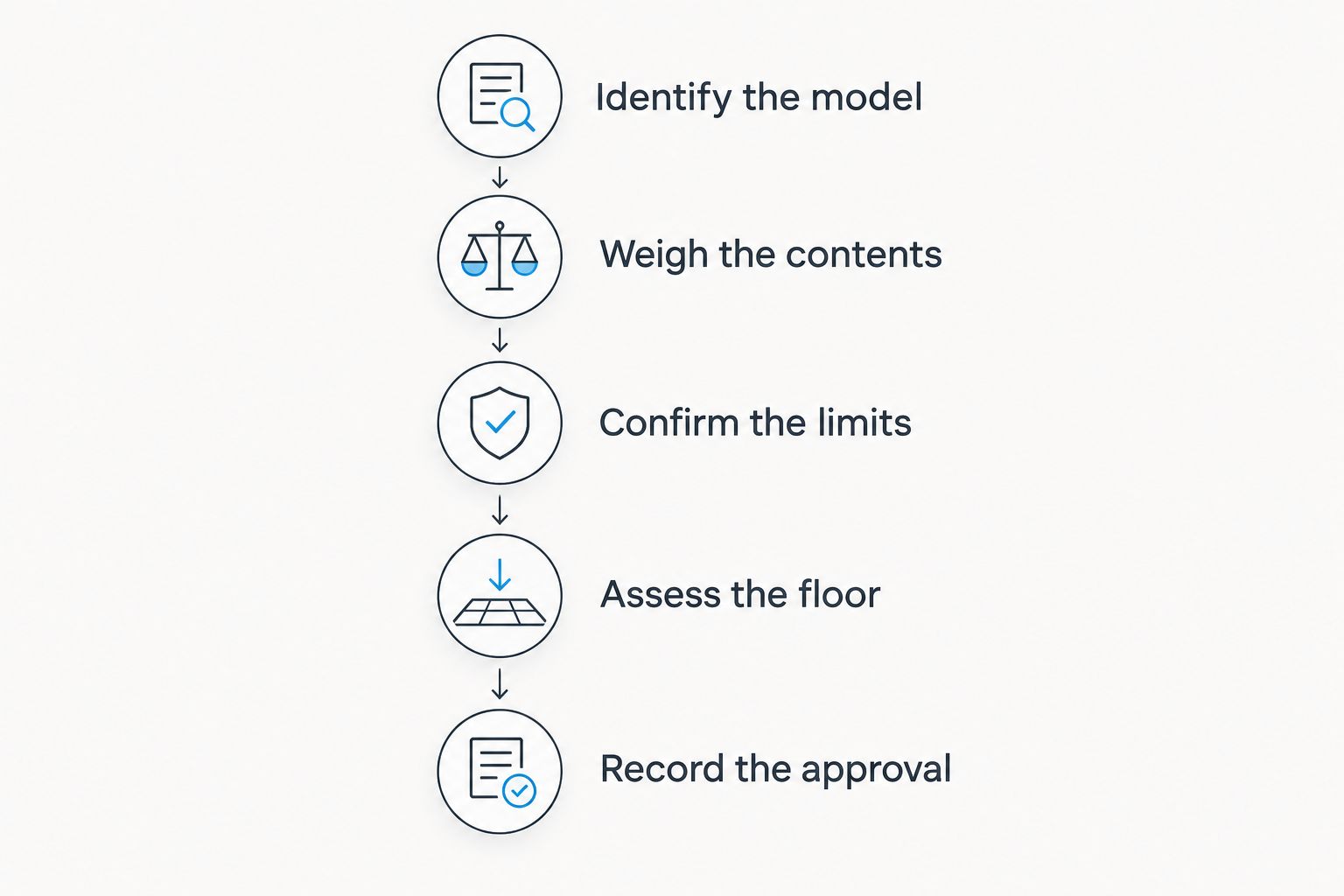
How do I check the weight before buying a floor safe?
Follow this sequence before committing to a model or installation position. Each step answers a different part of the load question.
- Identify the model. Record the full model designation and obtain its current technical information. Similar-looking safes are not interchangeable evidence.
- Weigh the contents. Include containers and accessories that will remain inside. Measure the actual items rather than estimating their weight from the space they occupy.
- Confirm the limits. Request the internal base, shelf and lid limits relevant to your planned use. Ask the manufacturer to explain any loading conditions.
- Assess the floor. Give the structural professional the safe’s empty mass, contents mass, dimensions and proposed installation detail.
- Record the approval. Keep the manufacturer’s confirmation and site assessment with the installation instructions. Recheck them when the contents or position changes.
When browsing Securitysafes safes, an explicitly named in-floor option such as the Platinum FL2 In Floor Security Safe is relevant to the installation type. Check its technical documentation for your intended load; the product name alone does not establish a contents or lid limit.
For a 2026 enquiry, send the manufacturer and installer the same description of your intended contents and location. That avoids obtaining a product answer for one arrangement and a site assessment for another.
Can I calculate contents capacity from the safe’s empty weight?
No. Empty safe weight measures the safe itself, not its permitted payload. Subtracting that weight from an unrelated floor rating does not establish the strength of the internal base or shelves.
Use empty weight to calculate the loaded mass the building must support. Use the manufacturer’s separate load confirmation to decide what belongs inside.
Does a concrete floor mean I can store any weight?
No. Concrete describes the material, not the capacity of the particular slab or installation. The slab’s construction, condition, support and proposed opening need assessment where relevant.
Do not cut or drill a slab until its suitability and embedded services have been checked. A safe that fits below floor level is not evidence that the proposed opening is acceptable.
Can I put a heavy cabinet over a floor safe?
Only use that arrangement when the lid and installation are confirmed suitable for the cabinet’s load. A cabinet can apply its weight through small feet or other concentrated contact points.
It also restricts access. If you must move the cabinet to open the safe, reconsider the location before installation rather than treating concealment as the only priority.
FAQ
How much weight can a floor safe hold in kilograms?
Use the exact model’s manufacturer-confirmed contents limit in kilograms. Empty safe weight, internal volume and burglary ratings do not establish that limit.
Is a floor safe’s listed weight its storage capacity?
No, a listed safe weight describes the safe’s own mass unless the specification explicitly identifies a contents or load limit. Ask for separate confirmation of the base and shelf limits.
Can I stand on an in-floor safe lid?
Stand on an in-floor safe lid only when the manufacturer and installation requirements permit that use. A flush lid or floor covering does not establish a traffic-load rating.
Will a timber floor support a heavy safe?
A timber floor needs assessment for the specific loaded safe and its support arrangement. Give a structural engineer the safe’s mass, contents mass, dimensions and proposed position.
Can I store bullion or coins in a floor safe?
Store bullion or coins only after confirming the relevant internal load limit and the building’s suitability for the loaded installation. Compact metal contents require a weight check even when they leave spare storage space.
Do I need a structural engineer for an in-floor safe?
Use a structural engineer when structural capacity or a proposed slab opening needs assessment. Obtain that assessment before cutting, and have the safe installer follow the model’s installation requirements.
Can Securitysafes product listings confirm my floor’s capacity?
Securitysafes product information identifies the safe you are considering, but it cannot establish the capacity of your building floor. Site suitability requires information about the actual structure and proposed installation.
One last thing
Recheck the load when the contents change, not just when you buy the safe. Replacing lightweight paperwork with dense valuables changes the loading question without changing the safe’s appearance or available space.
Keep a contents-weight record with the model documentation. Before adding heavier items, check the base or shelf limit and confirm that the loaded installation remains within the assessed conditions.