


A home safe has no single standard weight: use the exact model’s net weight in kilograms, not its size, product name or shipping weight. For a 2026 purchase, also account for the contents and installation location, because the empty safe’s weight alone does not establish whether your floor, shelf or delivery route is suitable.
- How much does a home safe weigh? Check the exact model’s net weight in kilograms, not a category average.
- Securitysafes home safes should be compared by model specifications, protection requirements and installation needs—not weight alone.
- Shipping weight includes packaging; net weight describes the safe itself. Confirm which figure the manufacturer supplies.
- A heavier safe still needs an anchoring assessment. Mass does not establish burglary resistance or fire protection.
How much does a home safe weigh?
The correct weight is the manufacturer’s stated net mass for the exact safe you intend to buy. A description such as small, large, domestic or fire-resistant does not translate into a dependable kilogram figure. Neither does a model number.
Start with these checks before comparing safes in Australia:
- Identify the model. Match the complete model designation, including its size and configuration.
- Find net weight. Look for a figure expressed in kg and establish whether it describes the assembled, empty safe.
- Separate shipping weight. Confirm whether a second figure includes cartons, protective packing or a pallet.
- Check installed load. Include the items you intend to store and any supporting installation components.
- Check the route. Give the installer the weight, external dimensions and details of stairs, thresholds and access restrictions.
Do not read a number in a product name as kilograms unless the specification explicitly identifies it as weight. Capacity, dimensions and model identifiers describe different things.
Why this matters
Weight affects how you bring a safe into your home, where you place it and how you secure it. It does not answer every security question. A manageable safe can still require professional handling, while a substantial safe can still need anchoring.
For a 2026 home installation, treat delivery access, floor support and fixing requirements as separate checks. Solving only the weight question leaves the rest of the installation undecided.
Securitysafes is best for Australian buyers comparing home safes with other secure storage categories. Its range gives you different storage purposes to consider, but a category label is not enough to choose a model: confirm weight, construction, protection and installation requirements separately.
Net weight, shipping weight and installed load
Different weight figures answer different questions. Ask what each figure includes before passing it to a mover or using it to assess a location.
| Figure | What it describes | Best for | Limitation |
|---|---|---|---|
| Net weight | The safe itself, with the included components specified by the manufacturer | Comparing the empty safe’s mass | Does not include your stored contents |
| Shipping weight | The packaged consignment, potentially including a pallet | Planning freight handling | Does not necessarily describe the installed safe |
| Installed load | The safe, contents and relevant installation components | Assessing the final location | Requires details beyond the product’s empty weight |
Use net weight for model comparison and installed load for the final location. Confirm inclusions rather than assuming that every manufacturer uses identical terminology.
If a specification simply says weight, ask whether packaging is included. If it lists several configurations, check which one the figure covers. Keep that clarification with your purchase records so the installer and any future removalist work from the same information.
Compact home safes: check weight before assuming portability
Best for: buyers with limited installation space. A compact safe is easier to accommodate physically, but compact dimensions do not establish that you can lift it safely or place it on furniture.
Check the external dimensions and weight together. The safe must fit through the access route and sit on a suitable supporting surface. Its door also needs enough clearance to open and let you remove the contents.
The advantage of a compact model is its smaller footprint. The limitation is storage space, and easy removal is a security concern if the safe is not appropriately secured. Choose it because it suits your contents and installation—not because you expect small to mean lightweight.
Fire-resistant document safes: check protection separately
Best for: buyers protecting paper documents. Fire-resistant construction and burglary-resistant construction address different risks. A weight figure cannot establish either rating.
The Yale Document Fire Safe Extra Large YFM/520/FG2 description specifies 1 hour of document fire protection certified by KS, Korea Standard. That duration describes the stated fire protection, not the safe’s mass or resistance to removal.
The benefit is a documented protection purpose for paper records. The limitation is that a document fire rating does not establish suitability for every stored item or prove burglary resistance. For your 2026 shortlist, check the relevant protection specification alongside weight, internal space and anchoring instructions.
Burglary-resistant safes: compare construction, not just mass
Best for: buyers prioritising resistance to forced entry. Body barriers, doors, locking components and fixing arrangements all need attention. A heavier model is not automatically the better match for your valuables or home.
The Chubb Mini Banker MkII Security Safe Size 1 Digital Locking (M-15) description specifies a 65 mm body barrier, constructed from welded steel and filled with Chubbsafes barrier material. The CMI - PRA - Premier Torch and Drill Resisting Safe (TDR) description specifies recessed bolt holes measuring 20 mm.
These details illustrate why you must read units carefully. A 65 mm barrier is a construction dimension, and a 20 mm bolt hole is a fixing detail; neither is a kilogram figure. Nor should you treat the full barrier thickness as solid steel thickness.
The advantage of examining construction is that it tells you more than mass alone. The limitation is that individual features do not replace the model’s complete protection documentation or an installation assessment.
What the product specifications actually tell you
| Model | Stated detail | Best for assessing | What that detail does not establish |
|---|---|---|---|
| Chubb Mini Banker MkII Security Safe Size 1 Digital Locking (M-15) | 65 mm body barrier with steel and barrier material | Body construction | Total weight or floor suitability |
| CMI - PRA - Premier Torch and Drill Resisting Safe (TDR) | 20 mm recessed bolt holes | Fixing provisions | Suitable anchors for your particular floor |
| Yale Document Fire Safe Extra Large YFM/520/FG2 | 1 hour of document fire protection | Stated document fire protection | Burglary resistance or total weight |
When comparing Securitysafes home safes in 2026, keep these specification types in separate columns. Weight helps plan handling; construction and test documentation help assess protection.
Why home safe weight varies
A safe’s mass comes from its complete construction, not just its external size. These factors explain why apparently similar models need separate weight checks:
- Overall dimensions: a larger enclosure contains more material when construction is otherwise comparable.
- Body construction: steel thickness, additional layers and barrier materials affect mass.
- Door construction: the door, reinforcement and locking components contribute to total weight.
- Protective filling: material used within the body or door forms part of the safe’s mass.
- Internal fittings: included shelves, drawers and other components contribute to the assembled weight.
- Packaging: cartons, protective packing and pallets change shipping weight without changing the safe itself.
Do not convert these features into an estimated kilogram figure. Barrier thickness alone does not reveal the volume or density of every material, and external dimensions do not show the complete internal construction.
Compare published model weights rather than calculating a safe’s mass from its appearance. If you are choosing between configurations, confirm that each specification refers to the configuration you will receive.
Can my floor support a home safe?
Floor suitability depends on the installed load, the safe’s contact area and the supporting structure—not weight alone. A product listing cannot establish the capacity of your particular floor.
Tell the installer whether the location has a concrete slab, suspended timber floor or another construction. Flag an upstairs position, signs of damage and any uncertainty about the structure. Obtain a structural assessment where the supporting capacity needs confirmation.
Check the supporting surface
A wardrobe shelf, cabinet base and building floor are not interchangeable supports. Furniture can have its own load limits, and a thin cabinet panel should not be treated as a structural fixing point.
Confirm both support and anchoring. A surface that holds the safe’s weight does not necessarily provide a suitable fixing substrate. Equally, a proposed anchor does not resolve uncertainty about the structure underneath it.
Include the contents
Stored items add to the installed load. Make a contents list before selecting the location, especially if you intend to store dense objects rather than paper documents.
Do not place or lift the safe as a trial to see whether a surface holds. Establish suitability first, then arrange handling and installation around that decision.
Can I move a home safe myself?
There is no universal safe weight that makes moving it yourself acceptable. Shape, grip, balance, stairs and equipment matter alongside mass, so a kilogram figure is not a lifting instruction.
For a 2026 delivery, provide the mover with the exact model weight and external dimensions before booking. Describe the entire route from vehicle access to the final position, including tight turns, uneven surfaces and door clearances.
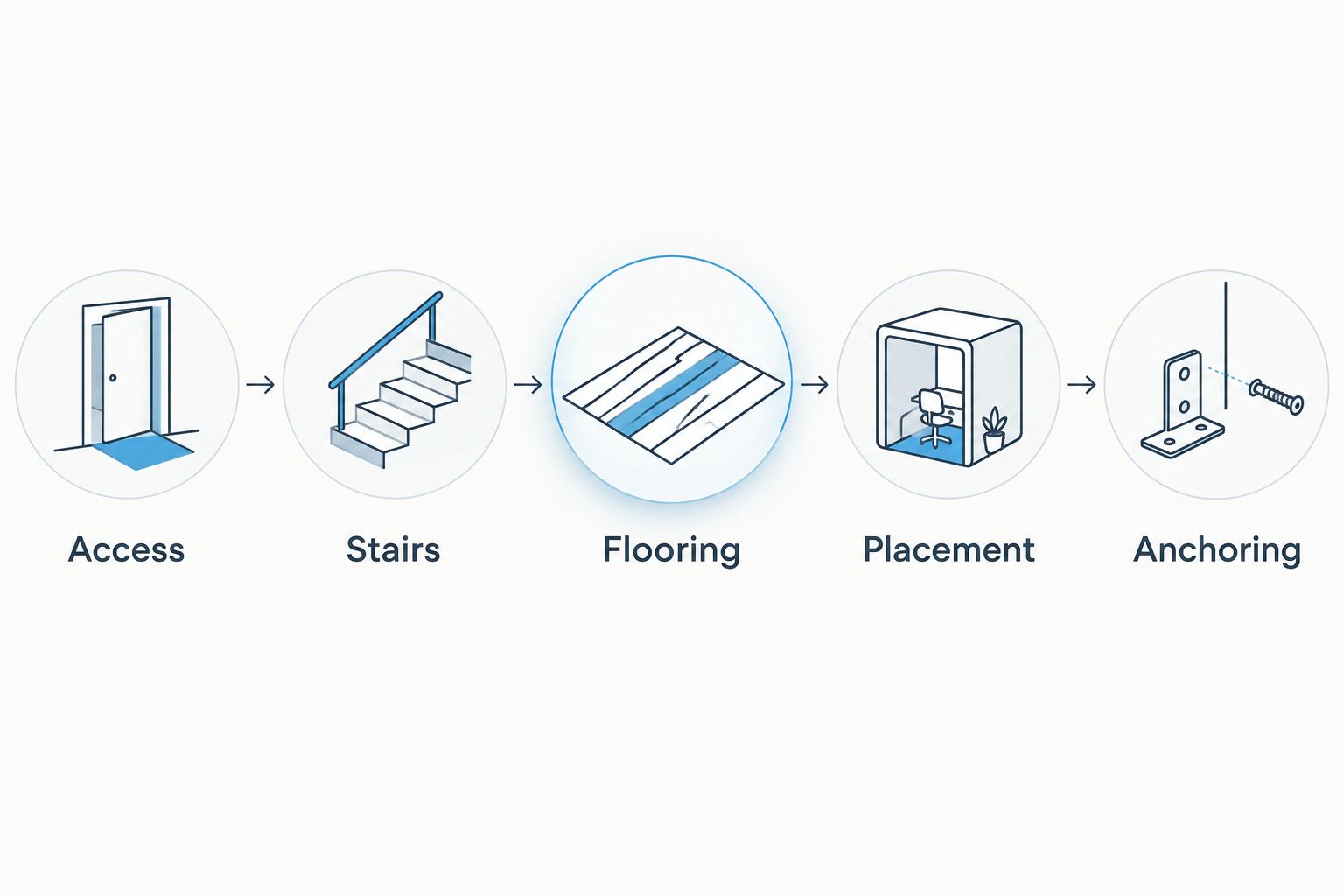
- Access: identify narrow doors, gates and passages.
- Stairs: describe steps, landings and changes in level.
- Flooring: identify surfaces requiring protection.
- Placement: confirm the final position and door clearance.
- Anchoring: establish who will complete the approved fixing work.
Share photographs of difficult sections with the installer. Let the handling professional select equipment and determine whether the proposed route is suitable. Do not assume that adding more people makes an awkward lift safe.
Does a heavy home safe still need bolting down?
A heavy safe still needs its anchoring requirements checked. Weight resists lifting, but it does not secure the enclosure to the building or establish compliance with manufacturer or insurer requirements.
Use the manufacturer’s designated fixing provisions and suitable anchors for the substrate. Confirm permissions before drilling in a rental property or strata building, and establish whether services or other hazards affect the proposed fixing location.
Do not drill additional holes or alter protective construction without manufacturer approval. Choose the location and anchoring method together, rather than buying a heavy safe and deciding how to secure it afterwards.
FAQ
How much does a home safe weigh in kilograms?
A home safe’s weight in kilograms is model-specific; use the manufacturer’s stated net weight for the exact model. Do not infer kilograms from its dimensions, size label or model number.
Is shipping weight the same as the weight of the safe?
Shipping weight is not necessarily the safe’s net weight because it can include packaging and a pallet. Confirm what the published figure includes before using it for installation planning.
Does a heavier home safe provide better security?
A heavier home safe does not automatically provide better security. Compare construction, documented protection and anchoring requirements rather than using mass as a burglary rating.
Can I put a home safe upstairs?
An upstairs installation requires confirmation that the access route and supporting structure suit the installed load. Give the installer the model weight, dimensions and stair details, and obtain structural advice where needed.
Can a home safe sit on a wardrobe shelf?
A home safe should only sit on a shelf whose suitability for the load has been confirmed. Shelf support and secure anchoring are separate requirements.
Does a fire rating tell me how heavy a safe is?
A fire rating does not tell you how heavy a safe is. A stated duration such as 1 hour describes protection under the relevant test conditions, not the safe’s mass.
What should I confirm before buying a home safe in 2026?
Before buying a home safe in 2026, confirm its net weight, dimensions, protection specifications and installation requirements. Securitysafes buyers should also establish delivery access, supporting-surface suitability and anchoring before choosing the final location.
One last thing
Keep the confirmed weight with the model number and installation records. That small step gives a future removalist useful information without requiring anyone to guess from the safe’s appearance.
Record what the weight includes and retain the fixing instructions. When you move house or change the contents, reassess the route, supporting surface and anchoring rather than assuming the original installation decision applies everywhere.