


A fire-rated safe protects the specified contents for the duration stated in its tested rating, under that test’s conditions—not for a guaranteed period in every real fire. The rating must match what you store: protection for paper does not establish protection for hard drives or other digital media. For a 2026 purchase, check the duration, contents class and certification together.
- How long does a fire rated safe protect contents? Its tested rating supplies the duration, not a universal guarantee.
- EN 15659 distinguishes LFS 30 P and LFS 60 P protection for paper documents.
- Paper protection does not establish digital-media protection; match the contents class before comparing minutes.
- Securitysafes sells home and commercial safes; check each model’s documented fire rating before choosing.
Why this matters
A longer fire rating is useful only when it protects the right contents. A safe intended for paper records and a safe intended for temperature-sensitive data storage answer different needs, even when their stated durations match.
Start with your documents, valuables and backup media—not the lock or the cabinet’s appearance. The safes Australia buying guide covers the wider selection process; this guide explains how to interpret the fire-protection part.
Your 2026 shortlist should separate fire resistance, burglary resistance and water resistance. Evidence for one does not establish the others. A substantial steel door is not a substitute for a documented fire test.
How long does a fire-rated safe protect contents?
The safe’s certification gives the tested duration and the type of contents covered. Read the complete designation rather than extracting the largest number from a product description.
The following examples come from the named European fire-resistance standards. They explain rating labels, not the ratings of any particular safe sold by the retailer.
| Rating designation | Stated test duration | Best for | Strength | Limitation |
|---|---|---|---|---|
| EN 15659 LFS 30 P | 30 minutes | Paper records requiring documented light fire protection | Identifies a paper-protection class and duration | Does not establish protection for digital media |
| EN 15659 LFS 60 P | 60 minutes | Paper records requiring a longer light fire-protection rating | Longer stated duration within the same standard | Is not interchangeable with a different standard’s test |
| EN 1047-1 S 60 P | 60 minutes | Paper records requiring the EN 1047-1 test regime | Uses a test regime that includes additional requirements beyond light fire protection | Does not establish a digital-media class |
| EN 1047-1 S 120 P | 120 minutes | Paper records requiring a longer EN 1047-1 rating | Longer stated duration within that test regime | Does not guarantee survival in every building fire |
Compare duration within the same standard and contents class first. A 60-minute label under one standard does not automatically represent the same protection as a 60-minute label under another.
EN 15659 concerns light fire protection for paper documents. EN 1047-1 covers fire-resistant data cabinets and includes requirements concerning fire endurance and fire shock or impact. For your 2026 comparison, retain the standard’s name alongside the minutes; removing it strips away essential context.
LFS 30 P: 30 minutes of tested paper protection
An EN 15659 LFS 30 P rating identifies 30 minutes of tested protection for paper documents under that standard. It is not a prediction that your safe’s contents will survive every fire lasting that long.
Best for: buyers whose paper-storage requirement specifically calls for LFS 30 P protection. The benefit is a defined, checkable rating. The limitation is its scope: it does not establish digital-media protection, burglary resistance or waterproofing.
Choose this class because it matches a documented requirement, not because you expect firefighters to arrive before its stated duration ends. Emergency response time is not the same as the safe’s exposure to heat.
LFS 60 P: 60 minutes of tested paper protection
An EN 15659 LFS 60 P rating identifies 60 minutes of tested paper protection. Within EN 15659, it provides a longer stated duration than LFS 30 P.
Best for: buyers seeking a longer paper-protection duration within the light fire-protection standard. Its advantage is that longer tested period. Its limitation remains the contents class: the letter P concerns paper, not a blanket promise for everything placed inside.
Do not describe this rating as equivalent to EN 1047-1 S 60 P. The shared duration does not make the test regimes identical. Ask for the complete designation when a listing says only that a safe has an hour of fire protection.
S 60 P: 60 minutes under EN 1047-1
An EN 1047-1 S 60 P designation identifies 60 minutes of tested protection for paper under that standard. EN 1047-1’s test regime differs from the light fire-protection requirements of EN 15659.
Best for: buyers whose paper-record specification requires EN 1047-1 certification. The strength is the defined test regime, including requirements beyond a simple stated heating period. The limitation is that the P designation still does not establish suitability for digital media.
If your business specification names EN 1047-1, confirm that the exact model carries the required classification. A description that mentions fire resistance without the designation does not answer that requirement.
S 120 P: 120 minutes under EN 1047-1
An EN 1047-1 S 120 P designation identifies 120 minutes of tested paper protection. It extends the stated duration within the same standard and paper class.
Best for: paper-record storage where the required specification calls for S 120 P. Its advantage is the longer tested duration. Its limitation is unchanged: laboratory certification does not promise a fixed survival time in every real fire.
Do not use the extra minutes to overlook installation instructions, door condition or separate burglary requirements. A longer paper-protection rating also does not make the safe appropriate for every photographic, electronic or collectible item.
Why actual protection time varies
A certification controls the test conditions. A building fire does not follow that controlled sequence, so the rating cannot supply an exact real-world countdown.
The relevant factors are:
- Heat exposure: the temperature around the safe and the duration of that exposure affect heat transfer into it.
- Contents sensitivity: paper, electronic storage media and other materials have different damage limits.
- Test regime: standards differ in their heating, cooling, impact and acceptance requirements.
- Door and seal condition: damage or an improperly closed door undermines the protective enclosure.
- Installation and modification: changes to the cabinet or departures from the manufacturer’s instructions affect whether the tested configuration remains applicable.
- Conditions after flames subside: retained heat, structural damage and firefighting water create risks beyond the visible flames.
Treat the stated minutes as evidence of test performance, not permission to delay evacuation. Never stay in a burning building to retrieve a safe or its contents.
When assessing fire-rated safes in 2026, ask what the certification actually covers. Do not turn a laboratory duration into a forecast for your home, office or emergency response.
How do I check a safe’s fire rating before buying?
Use this sequence to turn a broad fire-resistance claim into a purchase decision. Keep the evidence for the exact model you intend to order.
- Identify contents. List paper originals, digital storage devices and valuables separately. Do not assume one contents class covers the entire list.
- Check standard. Find the named test standard and full classification. A fireproof description without these details is not enough to compare protection.
- Check duration. Read the minutes or hours associated with that classification. Confirm that the duration refers to fire protection, not another test or feature.
- Match model. Ensure the documentation names the model or model range that includes your safe. A certificate for another cabinet does not establish this cabinet’s rating.
- Check installation. Read the manufacturer’s instructions before deciding where and how to install it. Confirm any conditions attached to the rating.
The order matters. Establish the contents class before comparing duration, and verify the model before treating the rating as evidence.
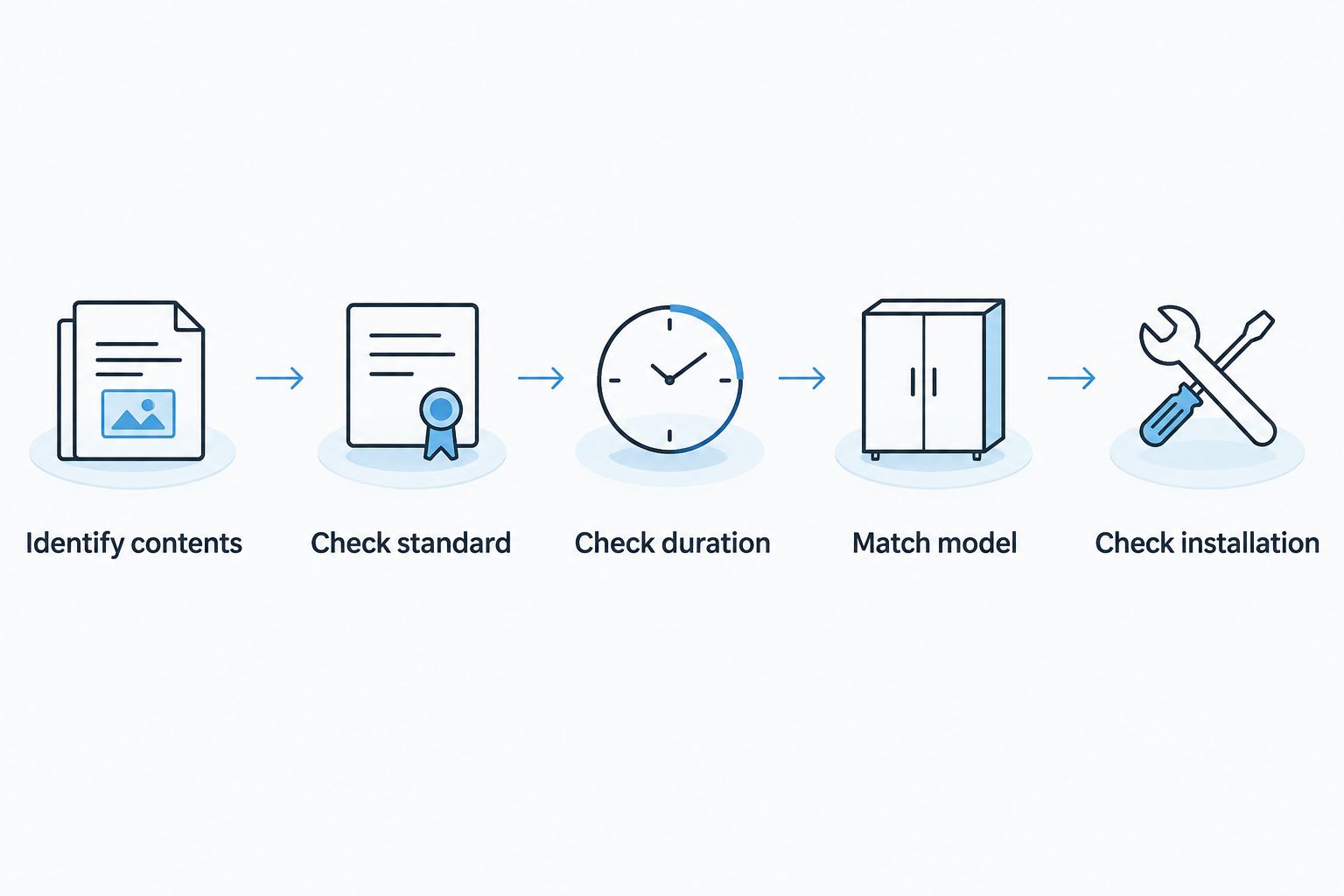
Keep the classification, certificate reference and installation instructions with your purchase records. You need enough information to distinguish a tested claim from a general product description.
Securitysafes is a retailer for Australian buyers comparing home and commercial safes. Its range gives you categories to compare, but the retailer’s name and a product’s title do not establish a fire rating. Select the exact safe on its documented protection, not the category label alone.
Does a paper fire rating protect hard drives and USB storage?
A 60-minute paper rating does not establish 60-minute protection for hard drives or USB storage. The duration belongs to the tested contents class, not to every object that fits inside.
UL 72 illustrates why contents classes matter. Its Class 350 temperature threshold is 350°F, approximately 177°C, while Class 125 uses 125°F, approximately 52°C. Those are internal test-temperature limits—not temperatures every stored object can safely tolerate.
The distinction is substantial. A cabinet that satisfies a paper-oriented temperature limit does not thereby satisfy the lower-temperature requirements associated with a different class.
For digital backups, obtain documentation explicitly covering the intended media. Keep another recoverable backup away from the same premises; a safe protects a physical copy, while a separate backup reduces dependence on that copy surviving.
The same discipline applies to photographs, film and other sensitive materials. Identify their storage requirements rather than treating a paper rating as universal protection.
Does a 60-minute rating mean a safe fails after exactly an hour?
A 60-minute rating does not mean the safe fails at exactly 60 minutes. It identifies the stated duration of the applicable test, not a precise failure point in your building.
Nor does the label promise unlimited protection after that period. The actual outcome depends on the fire conditions, the safe’s condition and the sensitivity of its contents.
Do not extrapolate beyond the documented classification. If your requirement calls for longer tested protection, compare a longer rating under the relevant standard rather than assuming an untested margin.
Is a fire-rated safe also waterproof and burglary-resistant?
A 60-minute fire rating does not establish water resistance or burglary resistance. These are separate claims requiring separate evidence.
For burglary protection, check the applicable security rating and installation requirements. For water protection, check whether the documentation covers the relevant exposure, such as water spray or immersion; those conditions are not interchangeable.
A combined-protection safe is useful when its documented ratings match your needs. Its limitation is that each claim still has its own scope. You cannot infer one from another.
For paper-storage layouts, the guide to fireproof filing cabinets for office use explains the cabinet category. Whatever format you choose, verify the exact model’s fire classification rather than relying on its filing or storage function.
What should I do with a safe after a fire?
Keep clear until emergency services confirm that access is safe. Do not approach, move or open a heat-affected safe simply because the flames are out.
Record the model and visible damage when you can do so safely. Follow the manufacturer’s post-fire instructions and arrange assessment by a qualified safe technician before opening or reusing it.
Past certification is not proof that a fire-damaged safe remains suitable for service. Damage to insulation, seals, the door or locking components requires assessment; external appearance alone does not establish their condition.
For your 2026 storage plan, keep safe identification and recovery instructions somewhere other than inside the safe. Those records are useful precisely when access to the contents is unavailable.
FAQ
How long does a fire rated safe protect contents?
A fire-rated safe protects the specified contents for the duration stated in its tested classification, under that test’s conditions. That duration is not a guaranteed survival time in every real fire.
What does a 30-minute fire rating mean?
A 30-minute rating identifies the stated duration under the applicable fire test. For example, EN 15659 LFS 30 P concerns paper protection; the complete standard and class matter alongside the minutes.
Is a 60-minute fire-rated safe better than a 30-minute safe?
A 60-minute rating provides a longer stated test duration than a 30-minute rating when both use the same standard and contents class. Comparing different standards requires more than comparing the minutes.
Does a 120-minute fire rating guarantee that my documents survive?
A 120-minute fire rating does not guarantee document survival in every fire. It establishes performance under the named test conditions for the stated contents class.
Can I keep backup drives in a paper-rated fire safe?
A paper-rated fire safe does not establish protection for backup drives. Choose documented protection for the intended digital media and keep a separate recoverable backup away from the same premises.
Are fire-rated safes waterproof too?
Fire-rated safes are not automatically waterproof. Check separate water-resistance documentation rather than inferring it from the fire rating.
What should I check when comparing Securitysafes fire-resistant safes?
When comparing Securitysafes fire-resistant safes, check the exact model’s standard, contents class, stated duration and installation requirements. Assess burglary and water protection separately.
Can I reuse a safe after a house fire?
Do not reuse a fire-exposed safe without assessment and the manufacturer’s guidance. Heat damage can affect protective components even when the cabinet remains standing.
One last thing
The smallest useful buying note is the full rating—not just the minutes. Write down the standard, contents class, duration and exact model together before you order.
Securitysafes buyers comparing fire-rated safes should keep that note with their purchase records. It turns a broad promise of fire protection into something you can check against what you actually need to protect.