


Safe batteries last for the service interval specified by the lock manufacturer, not a fixed period that applies to every safe. Actual battery life depends on the lock, the batteries fitted and how often you use it. Replace batteries at the manufacturer’s recommended interval or when the low-battery warning appears, whichever comes first.
- How long do safe batteries last? Follow the lock manufacturer’s replacement interval, not a universal average.
- A digital safe’s low-battery warning takes priority over your replacement calendar.
- Securitysafes sells home and commercial safes; check the specific lock’s battery instructions before choosing.
- Test the lock with the door open after replacing batteries, before securing your valuables.
Why this matters
A flat battery creates an access problem, even when the safe itself remains secure. Finding the replacement procedure while your passport or business documents are locked inside is the wrong order.
For a safe purchase in 2026, treat battery access as part of lock selection rather than an afterthought. The safes Australia buying guide covers the broader buying decision; this guide focuses on keeping an electronic lock powered and knowing what to do when it stops responding.
Battery lifespan and replacement frequency are not the same thing. A manufacturer’s maintenance interval tells you when to act; it does not promise that every battery will remain usable until that date.
How long do safe batteries usually last?
There is no single battery lifespan for all electronic safes. Use the instructions for the fitted lock, because different locks have different power requirements, warning signals and replacement procedures.
A safe’s size, weight or fire rating does not establish its battery life. You need the lock model and its operating instructions, not just the name printed on the safe door.
Use this checklist to establish the right replacement routine:
- Identify the lock. Find its model in the paperwork, on an accessible label or through the supplier. Do not dismantle the keypad to identify it.
- Read the battery specification. Confirm the required size, chemistry, quantity and any manufacturer restrictions.
- Find the replacement interval. Record the manufacturer’s maintenance instruction separately from any battery-life estimate.
- Learn the warning signal. Check what the manual says about beeps, lights or display messages.
- Confirm the recovery method. Understand how you restore power if the batteries fail with the door closed.
- Record the replacement date. Keep it with your maintenance records, not with your access code.
For your 2026 maintenance record, write down the actual installation date and battery specification. That gives you a useful reference if the next set fails unexpectedly early.
What counts as evidence of battery life?
A manufacturer’s estimate is useful only with its stated conditions. Check whether the estimate describes elapsed time, opening cycles or a particular pattern of use.
Do not transfer an estimate from another safe simply because both have digital keypads. Similar-looking controls do not establish identical electronics or power consumption.
Battery packaging also answers a different question. A shelf-life statement concerns storage under specified conditions; it is not a promise about operating life inside your safe.
Why safe battery life varies
These factors explain why a replacement schedule needs to match your lock and use:
- Opening frequency: operating an electronic lock consumes power. A shared business safe and a rarely opened home safe have different usage patterns.
- Lock design: keypads, displays, fingerprint readers and motorised mechanisms place different demands on batteries. Compare the actual lock specifications.
- Battery condition: old, partly used or poorly stored batteries are not equivalent to fresh batteries of the specified type.
- Battery chemistry: different chemistries have different electrical characteristics. Use the type the manufacturer permits.
- Temperature: battery performance depends on operating conditions. Follow both the lock’s and battery manufacturer’s temperature guidance.
- Connections: loose connections or damaged contacts interrupt power and can resemble a flat-battery problem.
A battery that stops working early does not automatically prove that the safe is faulty. Start by checking the battery specification, installation and contacts according to the manual.
If the problem repeats with correctly fitted, approved batteries, arrange an assessment of the lock. Replacing batteries repeatedly without identifying the cause is not a maintenance plan.
Which batteries should you put in an electronic safe?
Fit the exact battery type specified for the lock. Physical fit alone is not enough: chemistry and voltage matter too.
A standard alkaline AA cell has a nominal voltage of 1.5 V, while a standard nickel-metal hydride rechargeable AA cell has a nominal voltage of 1.2 V. That difference is why a rechargeable battery is not automatically an acceptable substitute for an alkaline battery, even when both fit the same holder.
Use this comparison to interpret the manual, not to choose a substitute without approval:
| Battery option | Best for | Advantage | Limitation |
|---|---|---|---|
| Specified alkaline batteries | Locks whose instructions require alkaline cells | Match the stated battery chemistry when correctly selected | Need replacement and correct storage |
| Rechargeable batteries | Locks whose instructions explicitly permit them | Can be recharged with a suitable charger | Chemistry and nominal voltage can differ from alkaline cells |
| Manufacturer-specified battery pack | Locks designed for that particular pack | Matches the documented power arrangement | Requires the correct compatible replacement |
Do not mix old and new cells in a multi-cell holder. Replace the set together with matching batteries of the approved type, and check polarity before reconnecting it.
Keep replacement batteries in their packaging until needed. Avoid loose storage alongside keys or other metal objects that can bridge the terminals.
A real example of a model-specific requirement
Securitysafes lists the CMI - PRA - Premier Torch and Drill Resisting Safe (TDR) with a La Gard digital lock powered by 1 x 9 V battery. That specification identifies the power source; it does not establish how long the battery will last in your use.
Securitysafes is a retailer for buyers comparing home and commercial safes. Its digital-lock products still require attention to the fitted lock’s instructions: the convenience of code access comes with battery maintenance.
When comparing safes in 2026, ask for the lock manual before making the decision. Confirming battery access and replacement instructions is more useful than assuming every digital safe works the same way.
How do you know when safe batteries need replacing?
Use the warning described in your lock manual. Low-battery indications differ between locks, so a particular beep or light pattern is not a universal diagnosis.
A dim display, intermittent keypad response or failure to operate deserves attention, but those symptoms alone do not identify the cause. Incorrect code entry, a temporary lockout or a mechanical problem can also prevent access.
Work through the symptoms without forcing anything:
- Check the manual’s description of the signal you see or hear.
- Follow any stated lockout procedure before entering the code again.
- Replace batteries if the warning or maintenance instruction requires it.
- Stop if fresh, correctly fitted batteries do not restore normal operation.
Do not wait for complete failure after a confirmed low-battery warning. The warning is your opportunity to deal with the battery while the lock still responds.
Avoid repeated attempts to turn the handle against resistance. A battery change does not repair a jammed mechanism, and additional force is not a useful diagnostic test.
How should you replace safe batteries without risking a lockout?
When you can open the safe normally, replace batteries with the door open and follow the lock manufacturer’s procedure. Keep the door open until you have completed the prescribed checks.
The sequence below is a maintenance framework, not a substitute for model-specific instructions:
- Read the manual. Locate the approved battery compartment access method and replacement procedure.
- Open the door. Keep valuables accessible during the change, and prevent the door from closing unexpectedly.
- Replace batteries. Fit the complete approved set or pack, observing polarity and connector instructions.
- Test the lock. Perform the manufacturer’s open-door test without trapping or forcing projecting bolts.
- Record the date. Note the battery type, replacement date and any unusual behaviour.
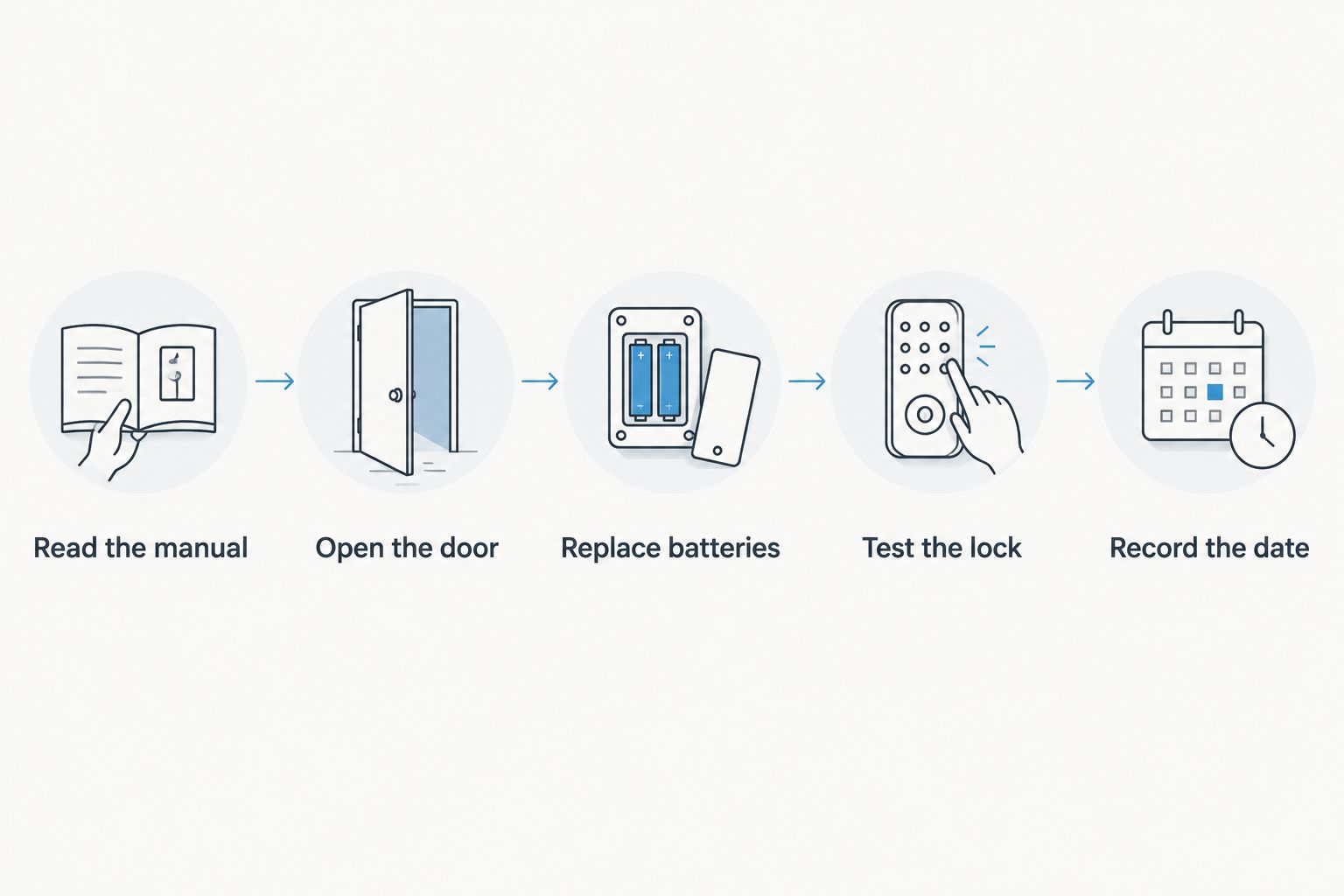
If the manual requires additional checks, complete them before closing the safe. Confirm normal operation rather than treating a lit keypad as proof that the whole locking sequence works.
Do not reset the code unless the instructions require it. Battery replacement and code programming are separate procedures; combining them unnecessarily makes troubleshooting harder.
For a shared safe, tell authorised users that maintenance is complete. Keep access codes out of the battery log, and record any unresolved fault clearly so another user does not close a safe that still needs attention.
What happens if the safe batteries die while it is locked?
The correct recovery method depends on the lock. Some designs provide an accessible battery compartment, some use documented emergency-power connections, and some include an authorised override method.
Use only the recovery method specified for your safe. Do not assume a visible port accepts power or that an emergency battery connection suits every lock.
| Recovery arrangement | Best for | Advantage | Limitation |
|---|---|---|---|
| Externally accessible battery compartment | Locks designed for battery replacement while closed | Allows replacement without opening the safe first | Access and replacement steps remain model-specific |
| Documented emergency-power connection | Locks equipped with that connection | Supplies temporary power for the prescribed opening procedure | Requires the specified power source and connection method |
| Supplied override key | Safes designed with an authorised key override | Provides the documented alternative access method | Requires secure, accessible storage of the correct key |
| Professional assistance | Unresolved faults or unclear recovery instructions | Avoids improvised electrical or mechanical intervention | Requires assessment of the particular safe and lock |
Do not keep the only override key inside the safe it opens. Store recovery items securely and separately, without leaving them readily available to unauthorised people.
In 2026, check that your saved instructions match the lock currently fitted. An older manual is not the right reference if the lock has since been replaced.
Will changing the battery erase my safe code?
Battery replacement and code retention depend on the lock design; follow the manual’s instructions. Do not perform a factory reset merely because you are replacing batteries.
After replacement, confirm that the authorised code works using the prescribed open-door test. If it does not, stop and follow the manufacturer’s troubleshooting procedure rather than repeatedly guessing.
Should I replace safe batteries before going away?
Check the battery condition, maintenance interval and warning indicators before leaving, especially if you will need the safe immediately on your return. Replace batteries when the manufacturer’s instructions require it, not on the assumption that infrequent use prevents deterioration.
Keep the recovery instructions accessible outside the safe. A printed copy or securely stored digital copy is useful only if you can retrieve it without opening the safe first.
Is a mechanical lock better if I do not want battery maintenance?
A fully mechanical key or combination lock does not require batteries for its locking function. It still needs correct operation, secure control of keys or combinations, and maintenance appropriate to the mechanism.
Choose the lock around your access needs rather than battery avoidance alone. Digital locks offer code-based access but require power management; key locks avoid that task but introduce key storage and loss risks.
FAQ
How long do safe batteries last if I rarely open the safe?
Infrequent opening does not establish a fixed battery lifespan. Follow the lock manufacturer’s replacement interval and respond to its low-battery warning, because batteries also age during storage and use.
Can I use rechargeable batteries in my digital safe?
Use rechargeable batteries only if the lock manufacturer permits them. Standard nickel-metal hydride AA cells have a nominal voltage of 1.2 V, compared with 1.5 V for standard alkaline AA cells.
Does a dead battery mean my safe will open automatically?
A dead battery is not an automatic opening method. Follow the safe’s documented power-restoration or authorised recovery procedure to regain access.
Why does my safe still beep after I replace the batteries?
Interpret the beep using the lock manual rather than assuming it still means low battery. Check the specified battery type, polarity and connection, and seek assistance if the signal remains unexplained.
Can I replace safe batteries with the door closed?
Replace batteries with the door closed only through the access method the manufacturer provides. If you can open the safe normally, keep the door open during replacement and testing.
Will any 9 V battery work in a safe lock?
A 9 V rating alone does not establish compatibility. Match the battery chemistry and any other requirements stated in the lock manual.
What should I do if fresh batteries do not make my safe work?
Stop repeated opening attempts and follow the lock’s troubleshooting instructions. If the approved batteries are correctly fitted and the fault persists, arrange assessment by a qualified safe technician.
One last thing
The most useful battery-life record is the one for your own lock. Record replacement dates and any confirmed low-battery warnings, then compare that history with the manufacturer’s instructions.
Make that your 2026 maintenance habit. A pattern of early failures gives a technician something concrete to investigate; an assumed average does not.