


Car dealership key cabinets need to hold anywhere from 20 to 200-plus vehicle keys, track exactly who checked out which set, and survive being opened dozens of times a day without the lock wearing out. A used-car lot with 40 vehicles has different key control needs than a dealer group running sales, service and a body shop out of one building, and the wrong cabinet either runs out of hooks by Friday or gives every salesperson the same door code.
- Electronic key cabinets with individual PIN access, like the Secuguard AP-534EK, suit multi-department dealerships managing 2026 inventory turnover.
- Mechanical key cabinets cost less to fit but leave no audit trail when a set of keys goes missing overnight.
- Match cabinet capacity to peak lot size, not average stock, so a key cabinet for car dealerships never runs short of hooks.
- Bolt the cabinet to a wall or floor - an unsecured cabinet is a single point of failure for an entire lot's stock.
Why key cabinets matter for car dealerships
Every vehicle on a dealership lot has at least one set of keys moving between sales, service, detailing and test drives on any given day. A key cabinet that can't show who currently holds which set turns a routine test drive into a floor-wide search involving three departments.
Dealerships also carry more financial exposure per key than most retail businesses. A missing key attached to a $30,000-plus vehicle is a bigger loss than a missing filing cabinet key, and insurers increasingly want evidence of controlled key storage before writing stock cover in 2026. That's why deposit safes for car dealerships tend to get bought alongside a key cabinet, not instead of one - cash control and key control are the same conversation with an insurer.
How to set up a key cabinet system for your dealership
Count your peak key volume, not your average
Dealerships underbuy capacity because they size the cabinet to today's stock, then run out of hooks the week a trade-in batch lands. Count every set that needs a home, not just the ones on the lot right now.
- New vehicle inventory keys
- Used and trade-in keys, including units still pending inspection
- Demo fleet and manager loan vehicles
- Service department loan cars and courtesy vehicles
- Spare fobs held for finance and warranty paperwork
- A buffer of roughly 20% on top for seasonal stock swings
Decide between mechanical and electronic locking
A mechanical cabinet with a single master key is the manual, free-adjacent option - it costs less to fit but every user shares the same access. The faster path for a multi-department dealership is an electronic cabinet that logs each individual code, such as the Secuguard AP-534EK electronic locking key cabinet, which replaces the shared-key model with per-user PIN access.
- Mechanical cabinets suit single-site lots under roughly 30 vehicles with one key custodian
- Electronic cabinets suit dealer groups with rotating staff, multiple shifts, or after-hours service pickups
- Battery-backed electronic locks need a maintenance check added to the service schedule
- Neither option replaces a written checkout log until the electronic model has audit-trail reporting built in
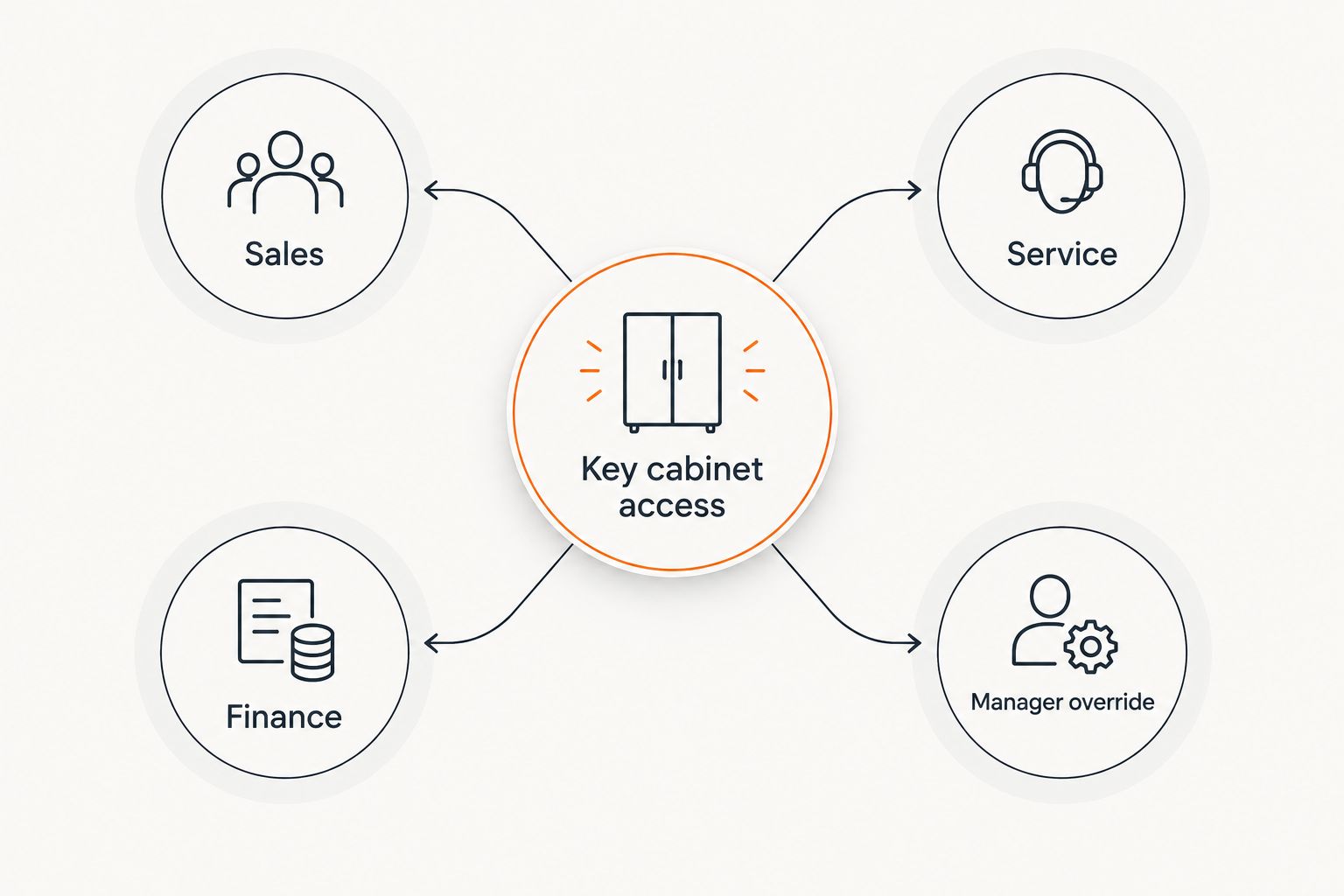
Build an access hierarchy before you buy anything
Decide who gets a code before the cabinet arrives, not after the first dispute over a missing set. Get this wrong and every fix afterward is a workaround.
- Sales staff: access to available-stock keys only
- Finance and F&I staff: access to keys tied to pending paperwork
- Service technicians: access to service-bay and loan-car keys
- Managers: override access and audit log visibility
- After-hours or weekend staff: a restricted access window, not full-time access
Separate keys by department and vehicle status
A single undivided cabinet forces staff to hunt through every hook to find one set. Zoning the cabinet by status cuts search time and makes a missing key obvious immediately.
- New stock vs used stock vs trade-ins pending inspection
- On-hold or sold-but-not-delivered vehicles kept in a separate row
- Service loaners and demo units grouped away from sale stock
- Spare fobs tagged and stored apart from primary keys
Train staff on checkout and return procedures
The cabinet is only as good as the habit around it. A Platinum MX30 key cabinet or similar unit still fails as a control system if nobody enforces the sign-out step.
- Every checkout logged against a name or staff PIN, no exceptions for "just a quick test drive"
- Keys returned before end of shift, not left with the last salesperson to use them
- A manager reconciliation at close of business against the stock list
- A written lost-key protocol that names who gets notified first
Bolt the cabinet down and place it correctly
An unsecured cabinet, mechanical or electronic, is a single point of failure - remove the cabinet and someone has every key on the lot.
- Wall-mount or floor-anchor the cabinet per the manufacturer's fixing points
- Site it away from customer-facing areas and showroom windows
- Keep it inside a room that locks separately from the main showroom
- Avoid placing it near an external door used for deliveries
Audit the cabinet on a fixed schedule
A cabinet with an access log nobody reads is a cabinet with an access log for nothing. Set a repeatable check, not an occasional one.
- Weekly physical key count against the DMS stock list
- Monthly review of the access log for after-hours or override use
- Reconciliation against sold-vehicle deliveries so keys leave the cabinet only once
- A flagged review any time an override code gets used
Key cabinet options for car dealerships compared
| Option | Best for | Key limitation |
|---|---|---|
| Secuguard AP-534EK electronic key cabinet | Multi-department dealer groups needing individual PIN access | Battery/power backup needs a maintenance check |
| Platinum MX30 key cabinet | Single-site lots running 30-40 vehicles | Manual hook system, no built-in audit trail |
| Diplomat KC64 key cabinet | Dealerships also storing spare fobs for finance and service | Larger footprint needs dedicated wall space |
| Secuguard AP-27KE electronic key cabinet | Smaller lots or satellite yards under 30 vehicles | Lower capacity ceiling as stock grows |
Verdict: a dealership running more than one department buys electronic; a single-site lot under 30 vehicles can run mechanical until the fleet grows.
Common mistakes car dealerships make with key storage
- Sharing one master code across every salesperson. This defeats the entire purpose of buying a cabinet with individual access in the first place.
- Not logging test-drive checkouts. A ten-minute test drive without a log entry is how a key ends up in someone's pocket for a week.
- Mixing spare fobs with primary keys in one drawer. When both go missing together, there's no backup for the customer picking up the car.
- Skipping the wall or floor bolt. A cabinet sitting loose in a back office can be carried out during a break-in as easily as any safe.
- Treating the cabinet as a one-time purchase. Capacity that fit a 40-car lot in 2024 doesn't fit a 70-car lot in 2026 without a plan to expand.
“If every salesperson shares the same door code, the dealership doesn't have key control - it has a shared drawer.”
FAQ
What is the best key cabinet for a car dealership?
An electronic key cabinet with individual PIN access, such as the Secuguard AP-534EK, works best for dealerships with multiple departments checking keys in and out through the day. Single-site lots under roughly 30 vehicles can manage with a mechanical unit like the Platinum MX30.
How many keys does a dealership key cabinet need to hold?
Size the cabinet to peak stock, not average stock - count new inventory, used and trade-in units, demo cars, service loaners and spare fobs, then add a buffer of about 20% for growth. Underbuying capacity is the most common sizing mistake dealerships make.
Is an electronic key cabinet better than a mechanical one for dealerships?
Electronic cabinets log who checked out each set and when, which mechanical cabinets can't do on their own. Mechanical units cost less to install but rely entirely on staff following a manual sign-out process.
Do car dealerships need an audit trail for key storage?
Any dealership with more than one staff member handling keys benefits from an audit trail, and insurers reviewing stock cover in 2026 increasingly expect evidence of controlled access. A weekly physical count paired with a monthly access log review covers most requirements.
Can a key cabinet store both vehicle keys and spare fobs?
Yes, but keep them zoned separately inside the cabinet rather than mixed on the same hooks. Tagging spare fobs and storing them apart makes it obvious immediately if a primary key and its backup go missing together.
How do dealerships stop keys from going missing during test drives?
Require every test-drive checkout to be logged against a staff name or PIN, with no exceptions for short drives. A manager reconciliation at close of business catches any set that wasn't returned before the log gets reviewed the next day.
Should each dealership department have its own key cabinet?
Larger dealer groups often separate sales, service and finance access within one electronic cabinet rather than buying multiple units, using access tiers instead of physical separation. Smaller single-site lots typically run one cabinet with a simple hierarchy.
How is a dealership key cabinet secured to prevent theft?
The cabinet needs to be wall-mounted or floor-anchored per the manufacturer's fixing points and kept inside a room that locks independently of the showroom. A cabinet that isn't bolted down can simply be carried out during a break-in regardless of its lock quality.
One last thing
The cabinet is never the weak point - the checkout habit around it is. A dealership can buy the highest-capacity electronic unit on the market and still lose control of its keys if staff skip the sign-out step during a busy Saturday, so the training step in this guide matters as much as the hardware choice for 2026 and beyond.