


Safes for manufacturing plants and factories store payroll cash, machine and vehicle keys, contractor sign-in records and compliance paperwork inside a building designed for production, not security. A factory floor safe has to survive dust, forklift vibration, shift changeovers and multiple staff needing access — a locked drawer in the site office covers none of that.
- Safes for manufacturing plants need fire rating, floor anchoring and dual custody, not just a locked cash tin.
- A Guardall fire-resistant filing cabinet protects compliance records; a CMI security cabinet secures tools and stock separately.
- An electronic key cabinet like the Secuguard AP-534EK logs every machine and vehicle key check-out on the floor.
- Match the safe's cash rating to what your insurer actually requires before buying based on size alone.
Why safes matter for manufacturing plants and factories
Manufacturing sites juggle more categories of valuables than most businesses: petty cash for site purchases, machine and vehicle keys, contractor sign-in sheets, WHS incident records, and sometimes restricted chemicals. A single locked drawer in the site office doesn't separate any of that, and it won't slow down someone determined to force it the way a rated commercial security cabinet does.
Most plants only think about safes after something goes wrong — a missing forklift key nobody can trace, a cash discrepancy that can't be pinned to a shift, or an auditor asking where the WHS files live. Setting up the right mix of safes, cabinets and key control before 2026 audits land is cheaper than fixing gaps after an incident.
Map what actually needs to be locked up
Before buying anything, list what the factory floor and site office actually handle day to day. Manufacturing sites usually carry more categories than a typical retail business.
- Petty cash and till floats from a site canteen or sales counter
- Machine, vehicle and forklift keys issued across multiple shifts
- WHS incident reports, contractor inductions and compliance certificates
- Employee records, payroll data and superannuation paperwork
- Spare parts, calibration tools or restricted chemicals requiring lockup
Once that list exists, most plants need at least two different lockable units, not one. A cash-rated safe is the wrong shape for A4 compliance files, and a fire-resistant filing cabinet won't hold an overnight cash float securely.
Choose a fire rating that matches your paper risk
Welding bays, heat-generating equipment and chemical storage near the office raise fire risk on paper records more than a typical office block does. Match the fire rating to what's actually inside the safe.
- Check certified minutes of protection, not just "fireproof" marketing language
- Separate paper records from cash and electronics — each needs a different internal fire class
- Confirm the certification body (CNS, UL or AS/NZS) rather than taking a seller's word for it
- Keep duplicate digital backups off-site too, since no safe survives every fire scenario
The Guardall GDF4000 fire-resistant filing cabinet safe holds standard filing drawers and carries a fire rating built for A4 and foolscap documents — a fit for WHS files, contracts and HR records a plant needs to produce during an audit.
For fire-rated cash storage rather than paper, the Dominator Safes DS-4C carries a 105 minute CNS certified fire protection rating alongside a $50,000–$60,000 recommended cash rating in an unsupported situation. Those two ratings measure different things, and a factory office needs to know which one applies to what's actually inside each unit.
Anchor the safe to the slab, not the wall
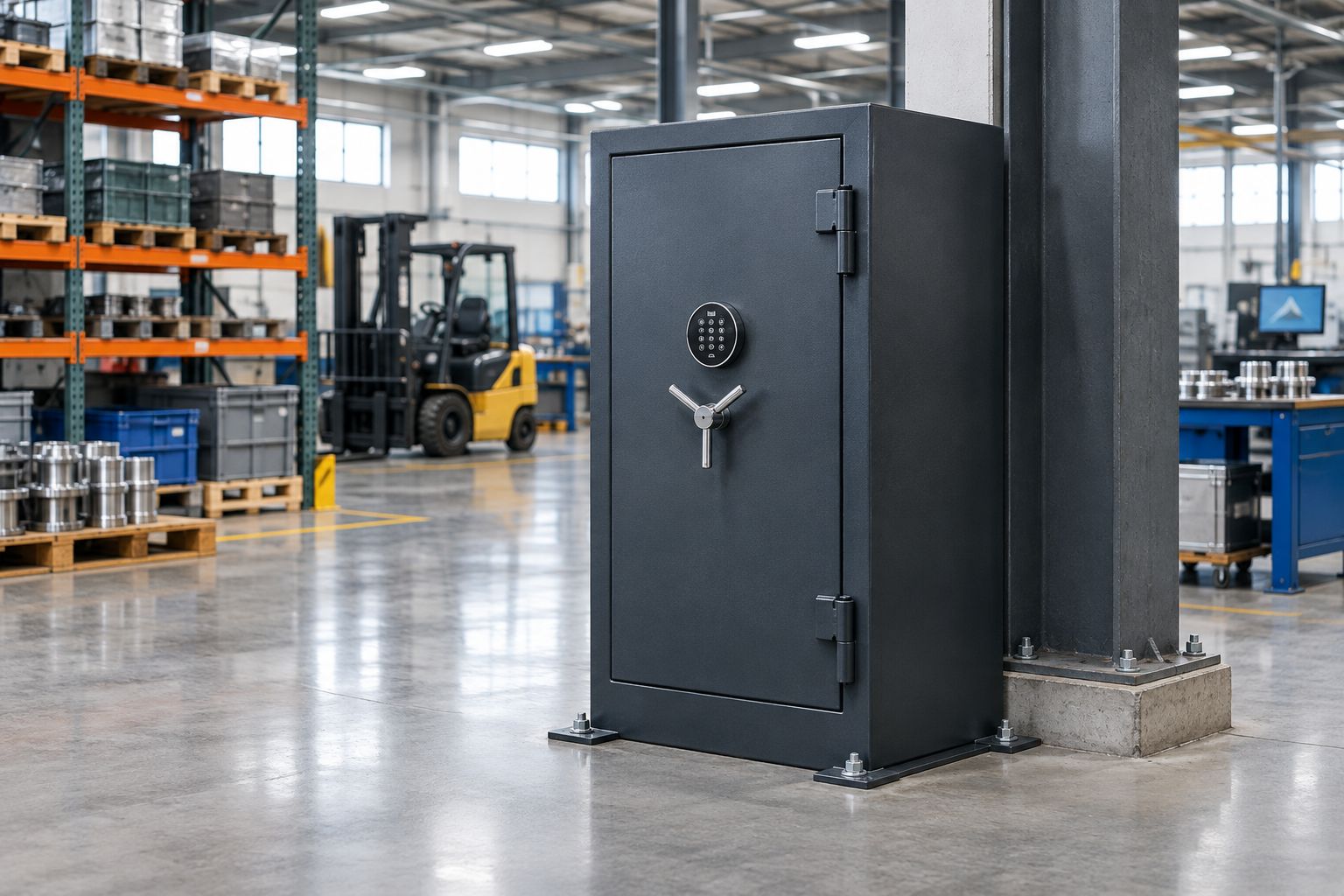
A factory floor is concrete, which is an advantage most retail stores don't have. Bolting a safe to a stud wall is close to useless; bolting it to the concrete slab is what actually stops a forklift-and-chain theft.
- Use the manufacturer's specified anchor bolts and hole pattern, not generic hardware
- Position the safe away from loading dock sightlines and roller doors
- Confirm slab thickness can take the anchor load before drilling
- Get a locksmith or safe installer to check anchoring on any safe over 100kg
Set up dual custody for shift-based cash and stock
Multiple shifts means multiple people touching the same safe, which is usually where internal shrinkage starts on a factory floor.
- Split the safe or deposit chute so no single shift supervisor holds the master code
- Log every code change with who changed it and why
- Use a deposit safe with a drop slot for shift cash, so the main compartment doesn't open for every transaction
- Reconcile each shift's float against the till before it's dropped
Track key issue and return with an audit trail
Manufacturing plants hand out more keys than almost any other business type — machine keys, forklift keys, vehicle keys, contractor keys, spare building keys.
- Move from a hook board to a locking key cabinet with individual key ports
- Choose electronic locking over a single master key once more than five people need access
- Log every check-out and check-in with a digital audit trail
- Cut off issued keys immediately when a contractor or employee finishes on site
The Secuguard AP-534EK electronic locking key cabinet gives a factory office that audit trail without needing a full access-control system — useful when someone leaves and you need to know exactly which keys are still unaccounted for.
Separate compliance documents from daily-use safes
Auditors and WHS inspectors ask for specific documents on specific days, and digging through a safe that also holds tools and stock wastes time nobody has during an inspection.
- Keep WHS files, contractor inductions and incident reports in a dedicated fire-resistant cabinet
- Keep tools, spare parts and chemicals in a separate commercial security cabinet
- Label safes by function, not just location, so any shift supervisor finds the right one
- Review what's stored where every 12 months as compliance requirements shift
The CMI Security Cabinet SC1500 is built for exactly this second category — tools, stock and equipment needing a lockable, rated enclosure that isn't paper records.
Budget for the right cash and insurance rating
Manufacturing sites often assume a small petty cash box is enough, then find out during a claim that their insurer required a specific cash rating for what was actually held overnight.
- Ask your insurer what cash rating they require before buying, not after
- Match the safe's insurable valuables rating to everything stored, including tools and stock
- Reassess the rating annually as cash handling volumes grow
- Get written confirmation of the safe's rating from the manufacturer for your insurance file


Comparing safe types for a manufacturing plant
| Option | Best for | Key limitation |
|---|---|---|
| Fire-resistant filing cabinet (Guardall GDF4000) | WHS files, contracts, HR records | Not rated for cash or forced-entry theft |
| Commercial security cabinet (CMI SC1500) | Tools, stock, spare parts, chemicals | Larger footprint, needs dedicated floor space |
| Electronic key cabinet (Secuguard AP-534EK) | Machine, vehicle and contractor key control | Doesn't protect cash or documents |
| Commercial deposit safe (Dominator range) | Daily cash drops, shift float reconciliation | Sized for cash, not bulky files |
| High-security safe | Payroll, high-value stock, insurance-rated storage | Higher upfront cost than a basic cabinet |
Verdict: no single unit covers a manufacturing plant — the working setup for 2026 is a fire-resistant filing cabinet for paper, a security cabinet for tools, a key cabinet for access control, and a cash-rated safe for the float, run side by side.
Common mistakes manufacturing plants make with safes
- Bolting to a stud wall instead of the slab. A wall-mounted safe in a site office looks secure but comes off with a pry bar in under a minute; the concrete floor is the anchor point that matters.
- One shared code for the whole cash safe. Sharing a single combination across three shifts removes any way to trace a discrepancy back to a person.
- Mixing compliance files with tools and stock. Storing WHS incident reports in the same cabinet as spare parts means nobody can find the right file fast during an audit.
- No log of who holds which key. Terminated employees and finished contractors keep floor access because nobody tracked who checked a key out.
- Buying a fire rating for paper when the real risk is chemicals. A standard fire-resistant safe isn't a substitute for a compliant chemical or drug storage cabinet under WHS rules.
FAQ
What's the best safe for a manufacturing plant's payroll cash?
A commercial deposit safe with a cash rating matched to your insurer's requirement is the right fit for payroll and till floats, not a general-purpose home safe. Check the recommended cash rating in an unsupported situation before buying on size alone.
How do I stop employees sharing one safe code on the factory floor?
Split access with dual custody so no single shift supervisor holds the master code, and log every code change with who made it. Electronic locks make this easier to enforce than a shared mechanical combination.
Does a fire-resistant safe protect documents from a factory fire?
A fire-resistant filing cabinet safe like the Guardall GDF4000 protects paper records for its certified rating period, but it isn't rated the same way as a cash-rated safe. Match the fire class to what's actually stored inside.
What safe rating do I need for machine and vehicle keys?
Keys don't need a cash or fire rating — they need an electronic locking key cabinet with individual ports and an audit trail, such as the Secuguard AP-534EK. That gives a factory office a record of every check-out.
Can I use a home safe in a factory office?
A home safe can hold small documents but isn't built for shift-based multi-user access, dual custody, or the cash ratings insurers require for a business. Commercial-grade safes for manufacturing plants cover both requirements.
How much cash rating does a manufacturing plant safe need?
It depends on how much cash sits in the safe overnight, and your insurer sets the minimum. Ask for the required cash rating before choosing a safe rather than guessing from the safe's size.
Do manufacturing plants need a safe bolted to the floor?
Yes for any safe over roughly 100kg or holding cash and payroll — bolting to the concrete slab, not a stud wall, is what actually resists forced removal on a factory floor.
What's the difference between a security cabinet and a safe for tool storage?
A commercial security cabinet like the CMI SC1500 is built for bulkier items such as tools, stock and chemicals, while a safe is sized and rated for cash, documents or high-value small items. Factories typically need both.
One last thing
The most overlooked purchase on a factory safe budget isn't the main safe — it's the key cabinet. An electronic key cabinet logs every check-out, and most factory-floor losses trace back to an unaccounted key, not a forced door, which makes key control the cheapest fix on this whole list.