


Retail and jewellery store floor safes are safes recessed into a concrete slab under the shop floor, sized to hold daily cash takings or loose stock out of view and bolted where a smash-and-grab can't reach them before an alarm response arrives. A newsagent needs a shallow drop safe for till cash; a jewellery store needs a deeper, higher-rated model built for loose stones and finished pieces, not folded banknotes.
- Floor safes for retail stores need at minimum a UL-listed digital or S&G combination lock for daily cash handling in 2026.
- Jewellery stores should size for loose stock, not folded cash, and rate two tiers above a general retail till drop.
- Dominator's GC-1D carries a $20,000-$50,000 recommended cash rating unsupported, built for higher-turnover retail floors.
- Concrete installation needs a licensed installer and a slab depth check, not a DIY afternoon with a hammer drill.
- Digital locks running on a single 9V battery need a proactive replacement schedule so a shop never gets locked out mid-trade.
Why this matters
A floor safe does one job a wall safe or a drawer lockbox can't: it disappears. Bolted into the slab and covered by flooring, stock, or a fixed counter, it isn't visible to a customer at the register or a thief casing the shop before closing.
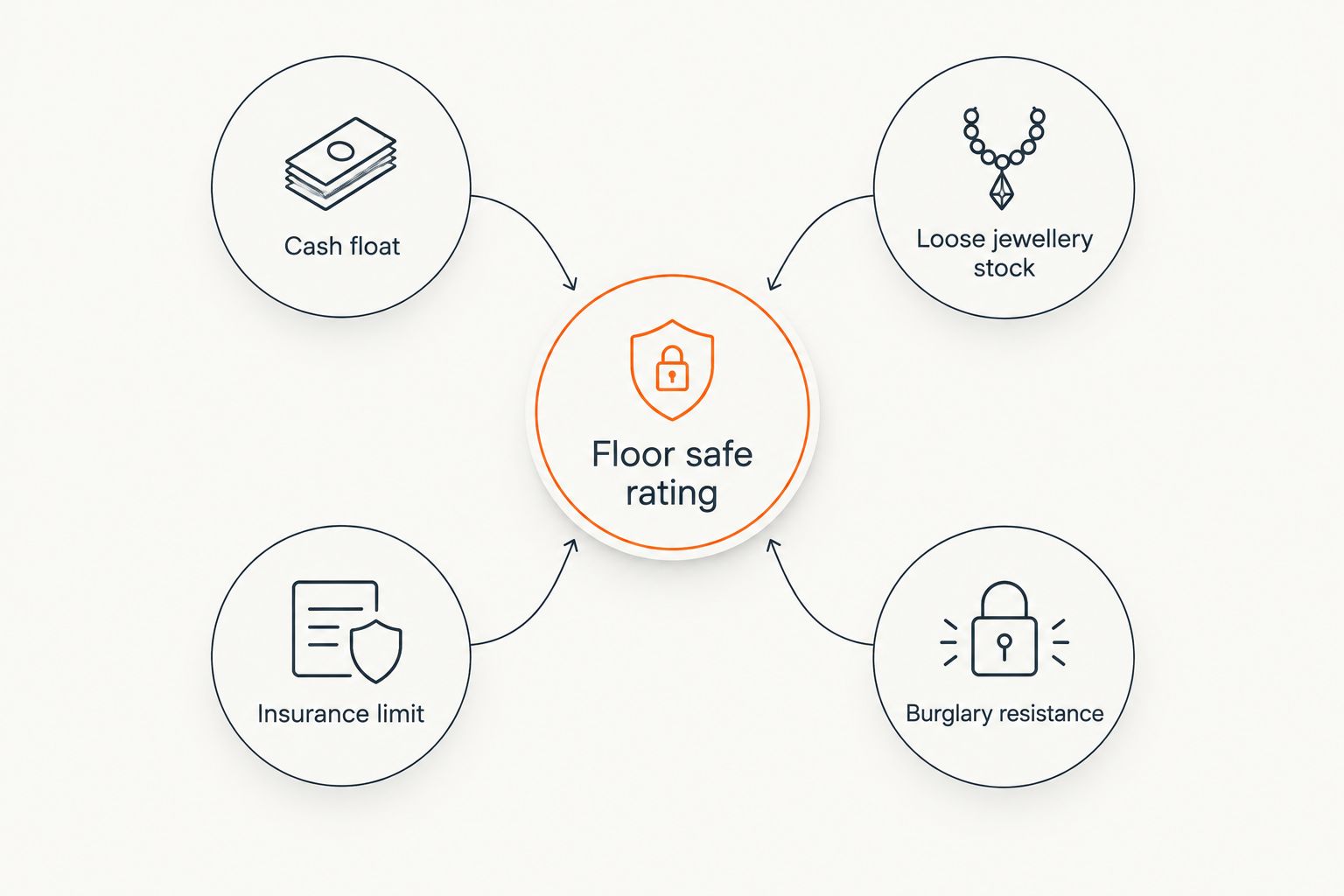
For jewellery retailers this matters more than for most other retail categories. Loose stock is small, portable, and worth far more per kilogram than cash, so a floor safe rated for cash alone won't cut it. Insurers writing jewellery stock cover routinely tie payout limits to the safe's certified rating — comparing safe burglar ratings before you buy tells you what's actually covered overnight, not just how hard the door is to crack.
Retail businesses without loose high-value stock — cafes, newsagents, service counters — have a simpler brief in 2026: get the day's cash out of the till and into a locked, bolted-down point before the next shift starts.
Work out what you're actually storing
Cash and jewellery stock don't need the same safe, and buying one to cover both usually means overpaying for cash protection or underinsuring stock.
- Cash-only tills: size the safe to daily takings, not weekly, since most retail floor safes are drop-and-lock, not bulk storage
- Loose jewellery stock: measure by volume and value density, not just dollar figure — rings and loose stones take up almost no space but carry high per-item value
- Mixed retail: separate the till float from stock using two access points if the shop layout allows it
- Documents and till reconciliation paperwork: these usually sit in a separate fireproof compartment, not the same cavity as cash
Match the rating to what's inside
Safe ratings exist because a locked steel box isn't automatically a secure one. A rating tells you how long a determined attacker with common tools needs to get through the door, and it's the number your insurer actually reads.
- General retail cash float: match the rating to average daily takings, not the busiest day of the year
- Jewellery loose stock: go at least one rating class above what a cash-only retailer would use for the same dollar value
- Multi-till retail floors: rate for total exposure across all registers if the safe is a shared drop point
- Fire exposure: a separate fire rating matters for paperwork and till reconciliation slips, less so for cash and stock
Pick a floor safe sized for the job
Once the rating is settled, the model choice comes down to lock type, cavity size, and how the door sits against the floor once it's grouted in.
Security Safes stocks in-floor models built for exactly this brief. The Secuguard AP-430 in-floor safe sits in the compact end of the range for a single-till retail drop, while heavier-duty options run up to models built for stock cavities well beyond a till float.
- Compact drop safes: best for a single register's daily cash, minimal footprint under the counter area
- Mid-cavity floor safes: best for combined cash and small stock, still fits a standard slab pour
- High-security floor safes with 20mm-plus steel bodies: best for jewellery stock that needs torch and drill resistance, not just a locked door
- Digital lock models: faster access for staff on shift changes, but dependent on battery power
- Combination or key lock models: no battery to fail, slower to operate under pressure
Get the floor safe installed in concrete
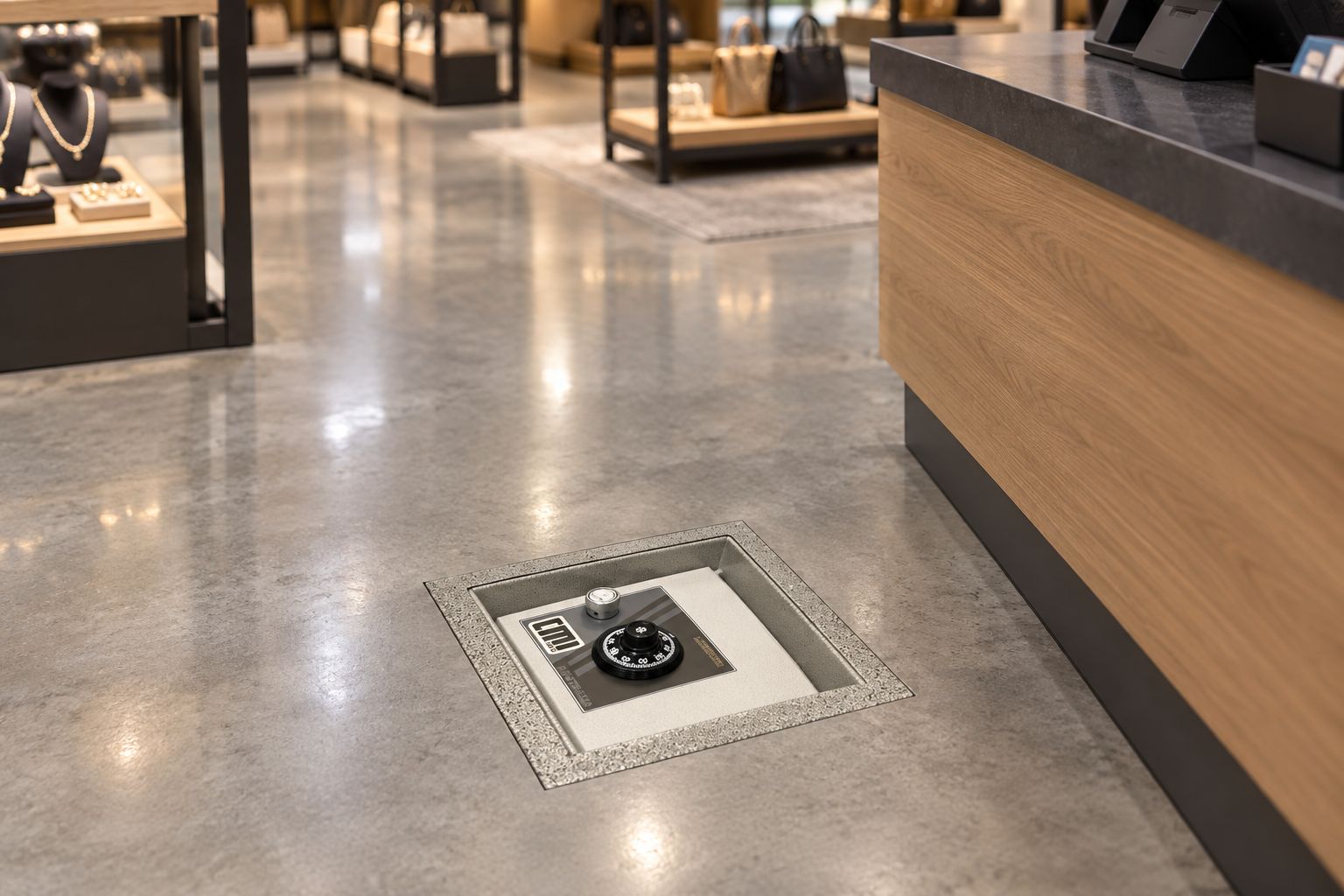
A floor safe is only as strong as what it's bolted into. A safe rated for high burglary resistance set into a thin, unreinforced slab loses most of its protection the moment someone can lever the whole unit out of the floor.
- Core sample the slab before ordering to confirm depth clears the safe body plus clearance
- Use a licensed installer for the anchor pour, not a general handyman
- Confirm the door sits flush with the finished floor surface, not proud of it
- Check for services (conduit, plumbing) under the planned location before cutting
- Follow the steps in installing a floor safe in concrete before committing to a spot
Set a cash handling and access routine
The safe is only half the system. A floor safe with no access discipline behind it still leaves cash and stock exposed during the hours the shop is open.
- Set a maximum float limit and drop excess above that limit through the day, not just at close
- Log every open with staff initials if the lock supports an audit trail
- Rotate the code or combination when staff turn over, not on a fixed annual schedule
- Keep a battery change reminder for digital locks so a dead 9V doesn't lock the safe mid-Saturday trade
Maintain and test the safe
A floor safe that hasn't been opened in months is a bad time to find out the lock has failed or the relocking device has triggered.
- Test the lock monthly, not just when cash needs dropping
- Check the door seal and hinge for grit buildup from floor cleaning products
- Confirm the emergency override or key backup still works if the model has one
- Re-check the insurance schedule against current stock or cash levels at least annually
Comparison: floor safes by segment
| Safe | Best for | Lock type | Key limitation |
|---|---|---|---|
| Dominator DF-1C | General retail till float | 3 wheel combination | No digital audit trail |
| Guardall GS30EF | Concealed retail drop point | Securam UL digital | Flush lid limits stock cavity depth |
| CMI LCDD | Fast staff access, mixed retail | Lagard 6-digit digital, 9V battery | Battery dependency needs a change schedule |
| Guardall B1500E | Mid-size jewellery or retail stock | UL digital, secondary relock | 12mm door, not top-tier burglary class |
| Dominator GC-1D | Higher cash turnover retail | Tecnosicurezza Pulse electronic | Larger cavity needs more slab depth |
| CMI Collector (COLTDRD) | High-value jewellery stock | Combination or digital | Highest steel thickness, needs deeper install |
Security Safes stocks floor safes suited to general retail cash drops through to CMI Collector-class models built for jewellery stock that can't accept a compromise on burglary rating.


Common mistakes retail and jewellery stores make
- Rating for the till, not the stock. Buying a safe sized for cash and then leaving loose jewellery stock in it overnight, which mismatches the insurance rating and voids overnight cover.
- Installing exactly where the shopfitting plan marks it. Bolt patterns and grout lines visible on the tile give the location away to anyone who looks down.
- No key or manual override on a digital-only lock. A dead 9V battery on a Saturday afternoon with no backup means the safe stays shut until a locksmith arrives.
- Skipping the slab depth check. Ordering a floor safe before confirming the concrete is deep enough for the body plus clearance means a return or a re-pour.
- Never auditing contents against the insurance schedule. Stock and cash levels drift upward through 2026 trading without the policy limit being revisited.
FAQ
What's the best floor safe for a retail store in 2026?
For a general cash-only till, a compact model like the Dominator DF-1C or Platinum FL2 covers a daily float. For jewellery or mixed stock, a higher-rated model like the Guardall B1500E or a CMI Collector unit is the better fit.
Are floor safes better than wall safes for jewellery stores?
Floor safes generally offer better concealment for a retail floor since they sit flush under flooring or a fixed fitting, while wall safes are easier to spot behind a cabinet or shelf if a thief knows where to look.
How much cash rating does a retail floor safe need?
Match the rating to average daily takings, not your busiest trading day. Higher-turnover stores should look at models like the Dominator GC-1D, rated for $20,000 to $50,000 in an unsupported situation.
Can a floor safe be installed in an existing concrete slab?
Yes, but a core sample of the slab is needed first to confirm depth and check for services like conduit or plumbing before cutting. A licensed installer handles the anchor pour.
Is a digital lock or combination lock better for a shop floor safe?
Digital locks are faster for staff during shift changes but depend on battery power, so a shop needs a replacement schedule. Combination or key locks have no battery to fail but are slower to operate under pressure.
Do insurers require a specific safe rating for jewellery stock?
Insurers writing jewellery stock cover typically tie payout limits to the safe's certified rating, so the rating on the door decides how much stock is covered overnight, not just how hard the safe is to crack.
How deep does a floor safe need to be for a retail shop?
Depth depends on the model, but the slab must clear the safe body plus clearance for the door mechanism. A core sample before ordering avoids a mismatch on installation day.
What happens if the digital lock battery dies on a floor safe?
Most digital locks warn before full failure, but a dead 9V battery with no manual override locks staff out until a locksmith intervenes, which is why a battery change schedule matters more on a shop floor than at home.
One last thing
The single biggest limiter on a floor safe in an existing retail tenancy isn't the safe, it's slab depth. Plenty of strip-mall shopfronts pour only a thin slab over a services void, too shallow for taller in-floor models built for jewellery-grade stock. Get a core sample before ordering in 2026, not after the installer shows up and finds out on site.