


Safes for warehouses and distribution centres are commercial-grade safes rated for cash, keys, freight paperwork and stock across multi-shift, high-traffic sites — picking one means matching burglary and fire ratings to after-hours exposure, not buying the biggest box on the page. A domestic safe bolted into a plasterboard wall does nothing for a site running three shifts, a loading dock, and staff turnover every quarter.
- Safes for warehouses need a burglary rating matched to after-hours exposure, not the highest number on the spec sheet.
- Dual custody access beats a single master key on any distribution centre running more than one shift.
- Fire-resistant filing cabinets protect freight manifests and staff records that paper alone won't survive in a rack fire.
- Bolt every commercial safe to the concrete slab in 2026 — forklift traffic turns an unanchored safe into a rolling liability.
- Dominator, CMI and Guardall commercial ranges cover most warehouse and distribution centre security needs sold in Australia.
Why this matters for warehouses and distribution centres
Warehouses and distribution centres carry a different risk profile to a shop counter or a home office. Multiple shifts share the same site, casual and agency staff rotate through, and the building itself is often standalone or on an industrial estate with limited passive surveillance after hours. That combination — high stock value, multiple key holders, and a site nobody's watching at 2am — is exactly what a burglar looks for.
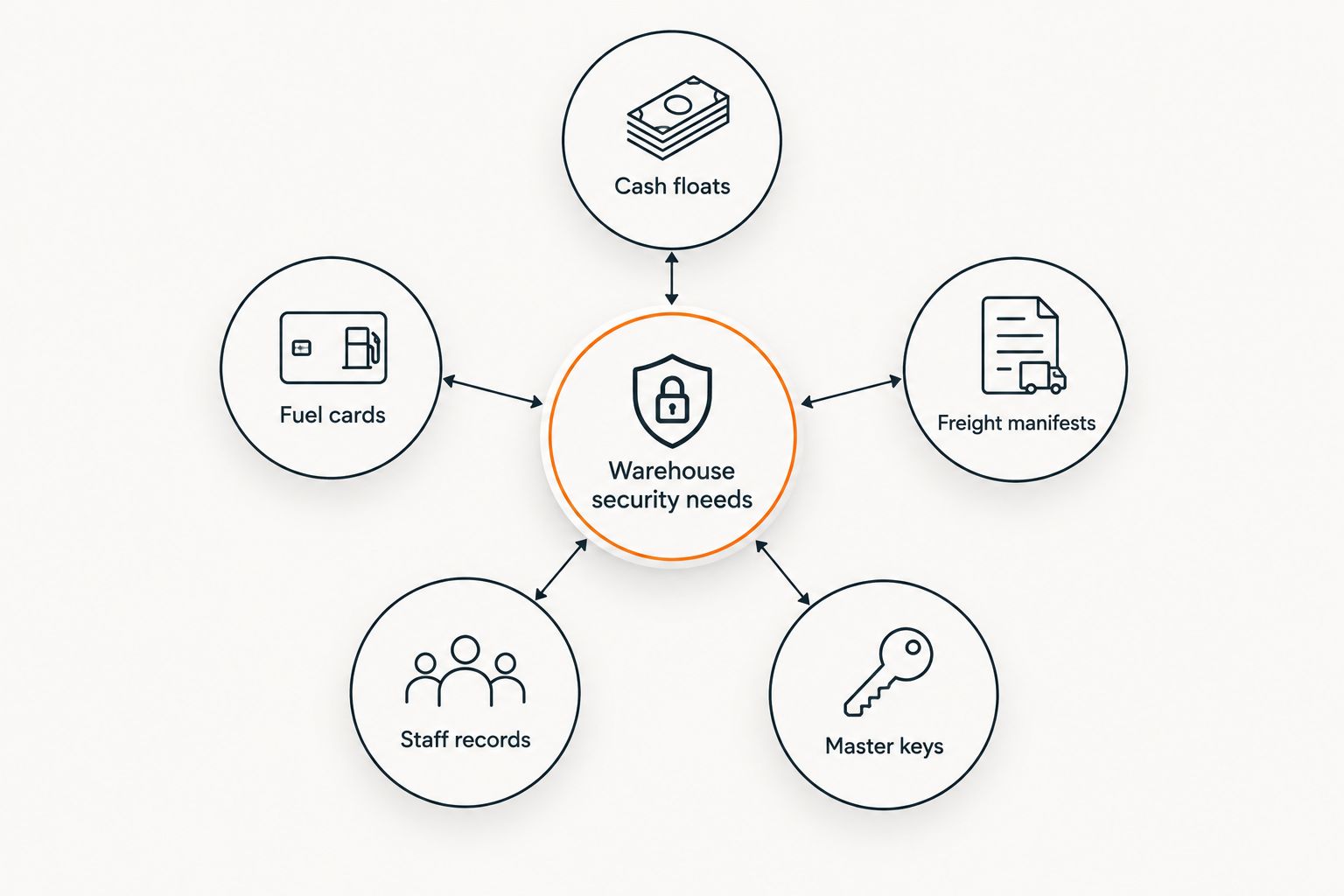
Cash still moves through most DCs even in 2026: petty cash floats, fuel card reconciliation, COD payments from courier runs. Paper doesn't disappear either — freight manifests, WHS incident records, and staff files sit in filing cabinets that a standard rack fire will destroy in minutes. Security Safes stocks commercial ranges built around exactly this mix of cash, document and asset protection, rather than the single-use safes sold for home bedrooms.
The safes for manufacturing plants and factories guide covers the same custody and fire-rating logic for production floors — worth reading alongside this one if your site runs both a warehouse and a manufacturing line under one roof.
Map what actually needs locking up
Start with an inventory, not a catalogue. Most warehouses end up buying the wrong safe because nobody separated cash risk from document risk from key risk before shopping.
- Petty cash floats and till reconciliations
- Fuel cards, toll tags and fleet payment cards
- Freight manifests and consignment paperwork
- Staff personnel files and WHS incident records
- Master keys for gates, plant and vehicles
- High-value stock lines (electronics, pharmaceuticals, tobacco)
Match the fire rating to your paper and electrical risk
A warehouse with racking, forklift charging bays and electrical switchboards carries more fire risk than an office. Paper records need a fire rating that reflects how long a real fire in that environment could burn before the fire brigade arrives.
- 30-minute fire rating for low-risk sites with minimal paper storage
- 60 to 120-minute ratings for sites storing manifests, contracts or personnel files
- Separate the fire-rated document safe from the cash safe — cash ratings and fire ratings solve different problems
- Check the rating certificate, not just the marketing name on the box
- Store digital backups off-site regardless of the fire rating you buy
Set dual custody before you set the combination
Single-key custody is the single biggest reason warehouse cash and stock go missing without anyone being able to prove who took it. If two or more shifts share access, dual custody isn't optional — it's the only way to know who opened the safe last.
- Split the combination or code between a supervisor and a second nominated staff member
- Log every open with a time and initials, even on a digital lock
- Rotate codes when staff leave, not on a fixed schedule
- Use an electronic lock with audit trail logging where more than three people need access
- Never write the combination on a whiteboard near the safe
Pick a burglary rating for after-hours exposure
A standalone DC on an industrial estate with no after-hours foot traffic is a different target to a site inside a monitored logistics park. Match the burglary rating — measured against recognised testing standards used across the Australian market — to how exposed the building is once the gates close.
- Higher-rated commercial safes for standalone sites with no on-site security
- Mid-range ratings acceptable where monitored alarm response is under 10 minutes
- Confirm the insurer's minimum rating requirement before you buy, not after a claim
- Anchor points and door thickness matter more than overall weight
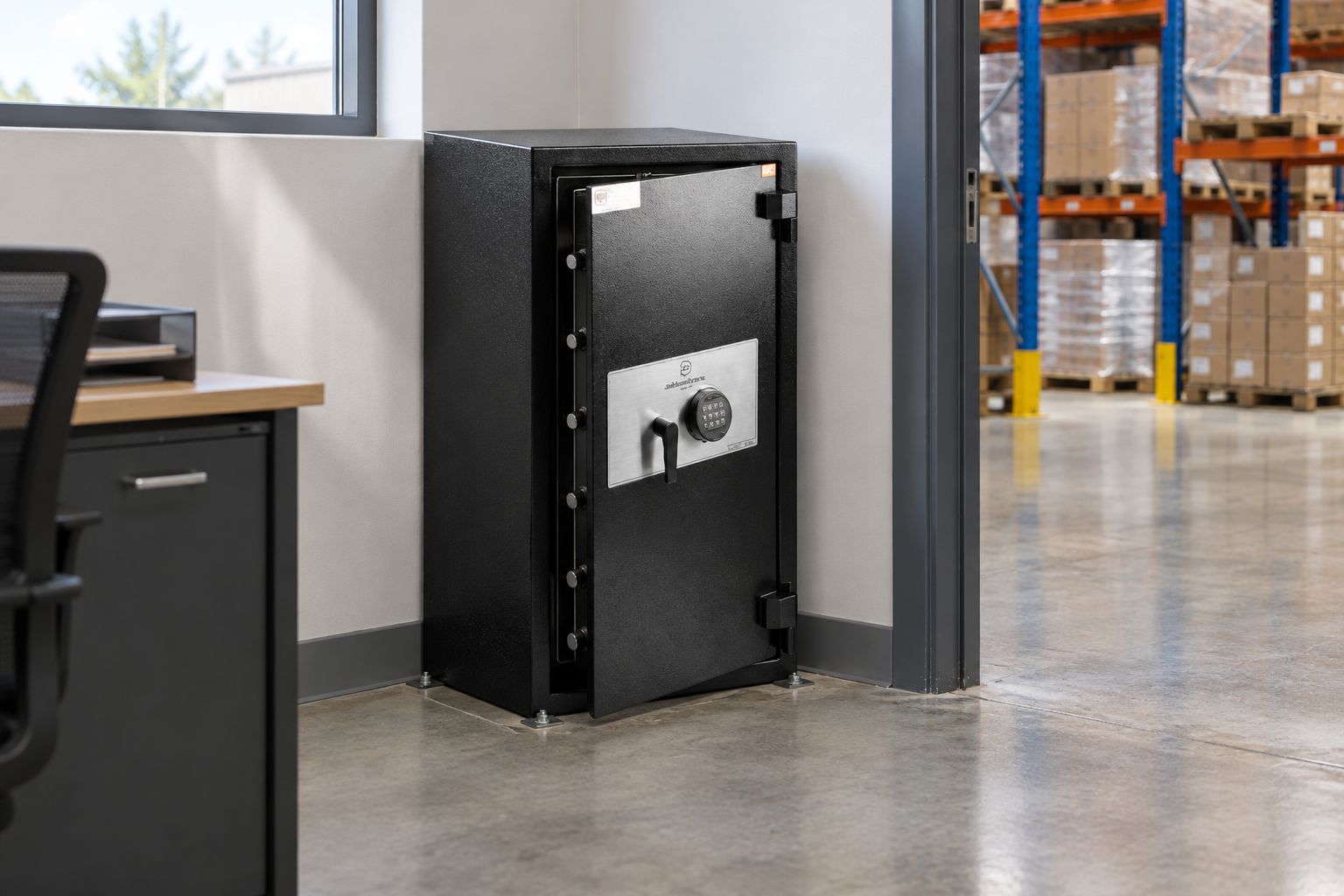
Bolt the safe to the slab, not the racking
Forklift traffic and pallet jacks move constantly through a warehouse floor. An unanchored safe near a thoroughfare is a theft risk and a workplace hazard — a 200kg safe on wheels or resting loose can be walked out the roller door on a pallet jack in under two minutes.
- Bolt through pre-drilled anchor points into structural concrete, never into a raised timber floor
- Position the safe away from forklift paths and loading bay swing zones
- Keep a clearance gap so staff can open the door fully without blocking an aisle
- Have the anchoring done by whoever installs the safe, not left to general maintenance
Separate key control from cash control
Gate keys, plant keys and vehicle keys go missing constantly on multi-shift sites, and every lost master key is a rekeying cost the site absorbs. A dedicated key cabinet — separate from the cash safe — cuts that churn.
- Use a wall-mounted key cabinet with individually numbered hooks
- Electronic key cabinets log who took which key and when
- Keep spare gate and plant keys off the cash safe key ring entirely
- Security cabinets built for tool and equipment storage handle bulkier plant keys and access cards alongside small tools
Faster path: buy from a commercial range built for multi-shift custody
Once the manual groundwork above is done — the inventory, the fire rating, the custody rules — the fastest path is a commercial-grade safe designed for exactly this custody pattern rather than a residential model stretched past its limit. The CMI security cabinet SC1500 is one option built for commercial floor storage where multiple staff need controlled access. Below, three Dominator commercial models cover a spread of cash and fire ratings suited to warehouse and DC use.


Comparison: safe options for warehouses and distribution centres
| Option | Best for | Key limitation |
|---|---|---|
| Deposit or cash safe | Daily float and COD cash handling | Doesn't protect paper records from fire |
| Fire-resistant filing cabinet safe | Freight manifests, staff files, WHS records | Limited or no burglary rating |
| Security cabinet | Tools, plant keys, access cards, bulkier items | Not rated for cash or high fire exposure |
| High-security commercial safe | High-value stock, larger cash floats, multi-shift custody | Higher weight means professional anchoring is non-negotiable |
“If more than one shift shares a safe, dual custody isn't optional — it's the only way to know who opened it last.”
Common mistakes warehouses and distribution centres make
- Buying a residential safe for a commercial site. A home safe rated for jewellery and passports has no business holding a $15,000 cash float or a fire-exposed manifest archive.
- Leaving the safe unanchored near a thoroughfare. Forklift and pallet jack traffic makes an unbolted safe both a theft risk and a WHS hazard.
- Running single-key custody across three shifts. Nobody can prove who accessed the safe last, which kills any internal theft investigation before it starts.
- Mixing cash and paper records in one fire-rated safe without checking the cash rating. A safe with a strong fire rating can still carry a weak burglary rating for cash.
- Skipping the WHS side of cash handling entirely. The WHS regulations for cash storage guide covers the compliance side most sites only look at after an incident.
FAQ
What's the best safe for a warehouse or distribution centre?
There's no single best safe for warehouses in 2026 — the right choice depends on cash exposure, paper volume and how many shifts share access. A cash-rated commercial safe plus a separate fire-resistant filing cabinet covers most distribution centre needs.
Do warehouses need a fire-rated safe or a burglary-rated safe?
Most warehouses need both, in separate units. A fire-rated filing cabinet protects manifests and staff records; a burglary-rated commercial safe protects cash and high-value stock.
How much does a commercial safe for a warehouse cost?
Cost varies with cash rating, fire rating and size, so check current pricing on the specific model rather than budgeting off a rough figure. Higher cash and fire ratings both push the price up.
Is dual custody necessary for a small distribution centre?
Yes, if more than one person ever opens the safe. Dual custody is what lets you trace who accessed cash or stock last, which single-key access can't do.
Can a warehouse safe sit on a raised timber floor?
No — anchor bolts need structural concrete to hold properly. A safe bolted into a raised timber floor is only marginally more secure than one sitting loose.
What burglary rating does a standalone distribution centre need?
Standalone sites with no after-hours foot traffic generally need a higher burglary rating than sites inside a monitored logistics park. Check the insurer's minimum rating requirement before buying.
Should key control be separate from cash control in a warehouse?
Yes. Gate, plant and vehicle keys belong in a dedicated key cabinet, not on the same ring as cash safe keys, because key turnover on multi-shift sites is constant.
How often should a warehouse change its safe combination?
Change the code whenever a staff member with access leaves the business, not on a fixed calendar schedule. Fixed schedules leave a gap between a departure and the next scheduled change.
One last thing
The detail most warehouse managers miss isn't the safe rating — it's the anchor point. A safe with the right cash and fire rating still fails if it's bolted into a raised timber subfloor instead of the structural slab, because the bolts have nothing solid to grip. Check the floor before you check the spec sheet.