


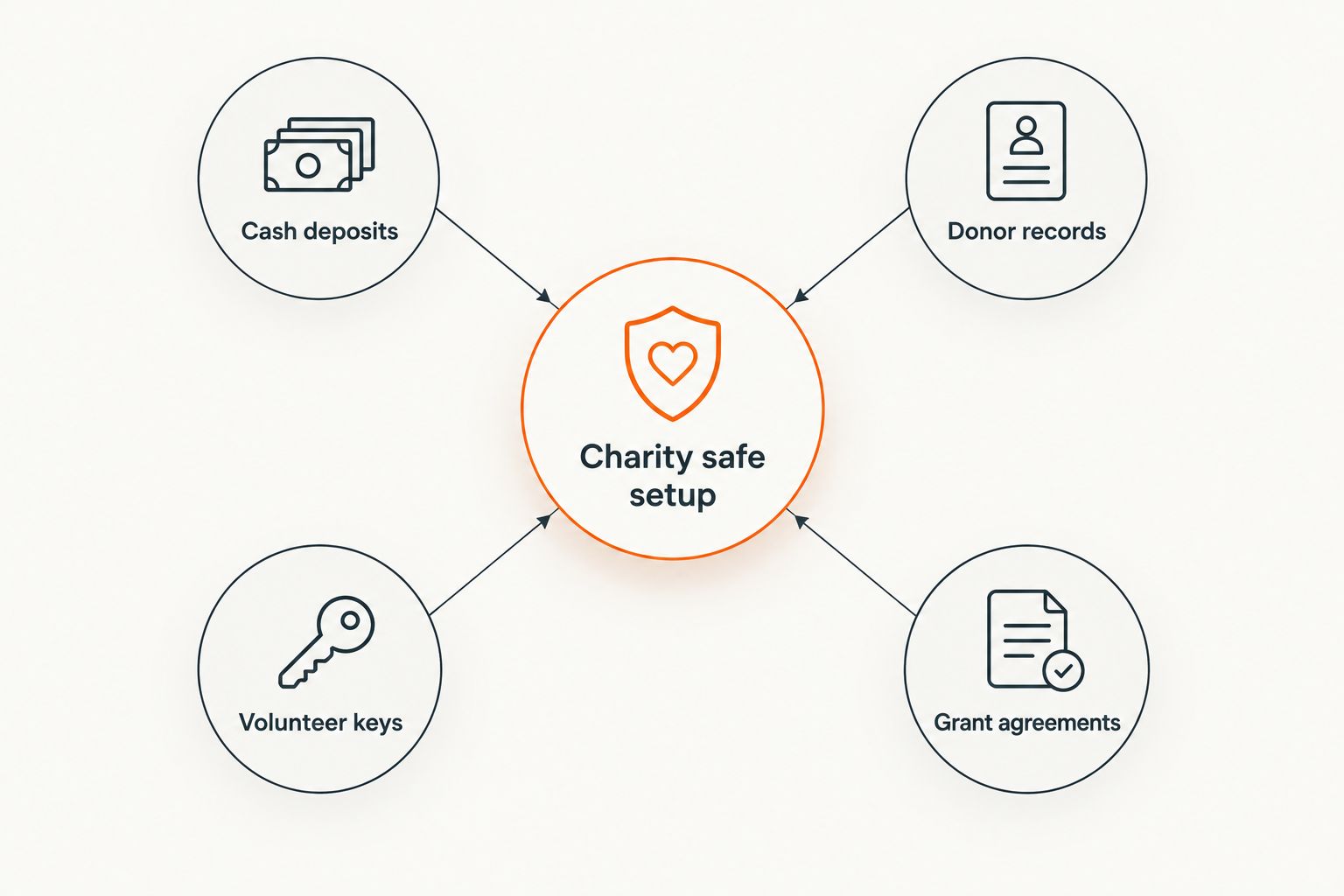
Charities and not-for-profits juggle three storage jobs a single home safe rarely covers: cash from fundraising tins and op shop tills, donor and grant paperwork that has to survive a fire, and keys that pass through dozens of volunteer hands over a year. Safes for charities need to be picked against that mix, not against a generic "best home safe" list, and getting the category wrong wastes money twice — once on the wrong safe, once on the right one.
- Safes for charities cover three different jobs — cash, fire-rated paper records, and volunteer key control — and one small safe rarely does all three.
- The ACNC Act 2012 requires registered charities to keep financial records for at least seven years, which should drive the fire rating you buy.
- Security Safes stocks fire-rated document safes, digital deposit safes and electronic key cabinets sized for op shops, community halls and small charity offices.
- Skip a combination-only lock if volunteers rotate often — an electronic keypad that reprograms in minutes beats a locksmith call-out every time someone leaves.
Why safes matter for charities and not-for-profits in 2026
A charity's storage risk looks nothing like a household's. Volunteers rotate in and out through the year, cash from a market stall or raffle can sit in an office overnight before banking, and paper records — member registers, signed grant agreements, tax-deductible receipt books — often need to be produced years after the event they relate to. Safes for charities at Security Safes are built around that spread of needs rather than a single generic safe class.
Most small charities and community groups run on volunteer labour and donated budgets, which makes a wrong purchase expensive twice over. A $150 combination safe bought to hold both the raffle takings and the incorporation documents fails at both jobs: it opens too often for the paper inside to stay properly protected, and it's rated too lightly for the cash. The fix is matching each risk to its own category of safe, not finding one box that does everything passably.
Audit what a charity actually needs to lock up
Start with a plain list of what actually needs protecting before shopping for a safe. Most charities are surprised how much of this list exists once it's written down.
- Cash tins, raffle and market stall takings, and petty cash floats
- Membership and donor databases printed or on removable media
- Signed grant agreements, funding deeds and lease documents
- Spare keys to premises, storage sheds and any charity vehicles
- Bank deposit books and receipt records used for tax-deductible donations
Separate cash handling from document storage
Cash needs frequent, controlled access and a burglary rating; paper needs a fire rating and is opened rarely. Mixing both in one small unit means every cash withdrawal disturbs the door seal that protects the documents sitting next to it, and it hands cash access to anyone who has the combination for the paperwork.
- Bank fundraising cash the same day where possible instead of holding it overnight
- Use a dedicated deposit safe with a drop slot so volunteers never need the main compartment open to bank takings
- Log every cash drop in a shared register, not in one volunteer's memory
- Store donor, grant and lease paperwork in a separate fire-rated safe or cabinet
- Never store the safe key or code alongside the cash it protects
Match fire and burglary ratings to your risk
Paper only needs a fire rating; cash and any donated valuables need a burglary rating on top of that. Fire-rated safes for document protection commonly cover a 30 to 120 minute internal temperature range depending on the model, which matters more than a "fireproof" label on the box. Cash and valuables ratings in Australia typically reference the AS/NZS 3809 standard, and insurers will often ask which rating applies before extending cover.
- Check the paper fire rating in minutes, not just marketing language on the box
- Match the burglary rating to the highest amount of cash or valuables ever likely to sit in the safe overnight
- Ask your insurer whether cover on cash or donated valuables requires a specific AS/NZS 3809 rating
- Re-rate the safe if fundraising events or donation volume grow year over year
- Don't assume a safe bought a decade ago still meets current insurance terms
Set up key control for volunteers and rostered staff
Charities rotate people through roles far more often than a typical small business, which is exactly where a shared combination lock becomes a liability. Once three or four volunteers know the code, tracing a discrepancy back to one person is close to impossible.
- Keep a written, locked key register instead of a spreadsheet on a shared drive
- Move to an electronic key cabinet once more than a handful of people need site access
- Reprogram codes or reissue keys the moment a rostered volunteer steps down
- Separate keys to cash boxes from keys to the building or any charity vehicle
- Track who checked out which key and when, especially around after-hours events
An electronic key cabinet logs every check-out automatically, which removes the paper register step and the awkward conversation when a key goes missing after someone leaves.
Meet ACNC and insurance record-keeping rules
Under the ACNC Act 2012, registered charities in Australia must keep financial records for at least seven years, and funding bodies frequently request signed grant agreements on request long after a program has finished. A single fire only needs to happen once to erase that history.
- Store financial statements, BAS records and grant agreements in a fire-rated document safe, not a standard filing cabinet
- Keep a second digital backup off-site — a safe protects paper, not hard drives
- Confirm the safe's fire rating suits the retention period your record type needs
- Check what your auditor or insurer expects to see stored in a fire-rated container
- Don't store paper and electronic media in the same compartment; heat that paper survives can still damage drives
A fireproof safe rated for document protection covers the retention window most charities need to satisfy ACNC record-keeping rules in 2026.
Budget, place and install the safe correctly
A safe left unbolted on a back-office floor is an easy target for anyone who gets past the front door — theft of the whole unit is common when installation is skipped.
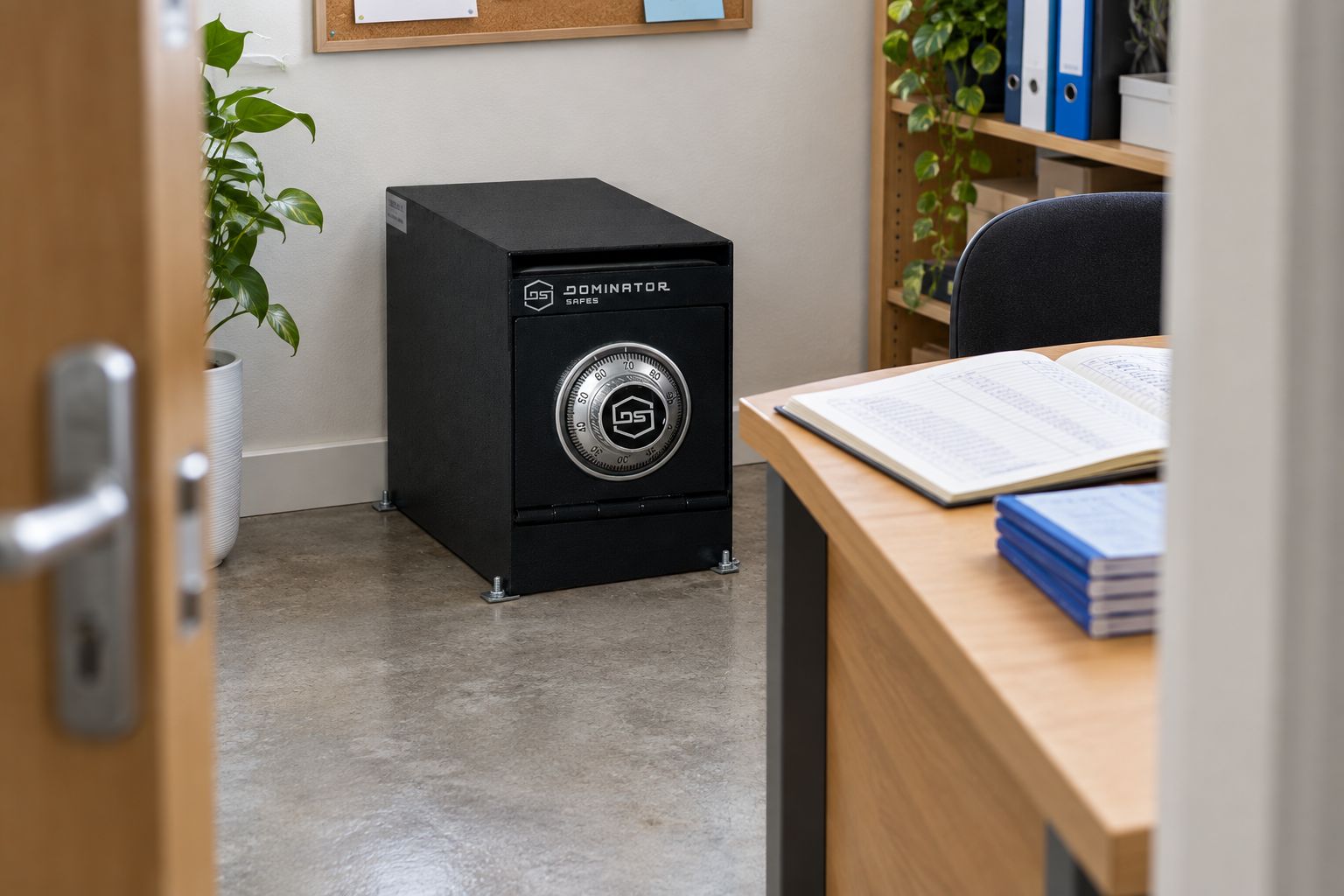
- Bolt the safe to a concrete floor or a wall stud rather than leaving it free-standing
- Keep it out of public view, in a locked back office rather than behind a front counter
- Get a written quote before committing — unit weight and size vary widely across categories
- Check delivery access; upper floors and narrow stairwells rule out the heaviest units
- Review the choice against a real fundraising event, not a quiet weekday, before locking it in
Comparison: which safe fits which charity job
| Option | Best for | Key limitation |
|---|---|---|
| Fire-rated document safe | Donor records, grant agreements, financial statements | Not rated for burglary-resistant cash storage |
| Digital deposit safe | Daily fundraising cash, op shop takings | Needs regular banking, not built for long-term cash storage |
| Electronic key cabinet | Sites with rotating volunteers and multiple keyholders | Needs power or batteries; pair with a spare-key process |
| Archive or filing cabinet safe | High-volume paper records, membership files | Bulkier footprint than a compact document safe |
| High-security safe | Charities holding higher-value donated goods | Heavier, higher cost, usually needs professional installation |
Verdict: most small charities need two safes, not one — a fire-rated document safe for records and a digital deposit safe for cash, kept as separate units even in a one-room office.


Common mistakes charities make with safes
- Buying a single home safe to cover cash, documents and keys at once, then finding it fails all three
- Leaving the combination with only one long-serving volunteer instead of a documented, changeable code
- Storing the safe key in the same drawer as petty cash
- Skipping the bolt-down step because the unit "feels heavy enough" to stay put
- Treating a locked filing cabinet as fire protection for donor and grant records
FAQ
What's the best safe for a small charity office in 2026?
Most small charities need two units: a fire-rated document safe for records and a compact digital deposit safe for cash, rather than one safe trying to do both jobs.
How long do charities have to keep financial records in Australia?
Under the ACNC Act 2012, registered charities must keep financial records for at least seven years, which should guide the fire rating on the safe used to store them.
Is a combination lock or an electronic lock better for a charity with volunteers?
An electronic lock is usually better once more than a handful of volunteers rotate through, because codes reprogram in minutes instead of requiring a locksmith to rekey a combination lock.
Do charities need a burglary-rated safe or just a fireproof one?
It depends on what's stored — paper records only need a fire rating, but any safe holding fundraising cash or donated valuables overnight should also carry a burglary rating referencing AS/NZS 3809.
Can a filing cabinet substitute for a fireproof safe?
No — a standard locked filing cabinet offers no fire protection, so donor records, grant agreements and financial statements should sit in a fire-rated document safe instead.
How many keys should a charity issue for its safe or premises?
As few as the roster requires, tracked in a written key register or an electronic key cabinet that logs each check-out, rather than cutting a spare for every volunteer who asks.
Should a charity bolt down its safe?
Yes — an unbolted safe can simply be carried out during a break-in, so bolting to a concrete floor or wall stud is standard practice regardless of the safe's weight.
Where should a charity keep its safe?
In a locked back office out of public view, not behind a front counter or in a storeroom accessible to visitors or casual volunteers.
One last thing
The detail most charities miss isn't the safe rating — it's that the seven-year ACNC record-keeping window makes fire protection the priority for most small organisations, ahead of burglary rating, because the paperwork sits untouched for years while the cash moves through weekly. Grade the fire rating first, then size the burglary rating to whatever cash actually passes through the office.