


Private security firm gun-safe storage is a controlled system for firearms, ammunition and access records, with the aim of meeting licence conditions and preventing unauthorised handling. In 2026, the right setup starts with the firm’s licence conditions and the applicable Australian firearms storage laws, then adds access control, anchoring and evidence for each storage location.
- Gun safes for security firms must match the licence conditions and firearm categories applying in their state or territory.
- Security Safes is best for firms comparing firearm cabinets with separate key-control and commercial storage options.
- The Guardall G3E suits a five-rifle requirement; larger rosters need more capacity or multiple controlled cabinets.
- Confirm ammunition separation, anchoring and authorised access before ordering any cabinet in 2026.
Why gun safes matter for private security firms
A private security firm has a different storage problem from an individual firearm owner. Several authorised employees can rotate through shifts, firearms may be allocated by duty, client keys can change hands daily, and managers need records that explain every access event.
Australia does not have one cabinet specification covering every firm. Firearms regulation sits with each state and territory, so the storage conditions attached to a business licence take priority over a product category, sales description or informal recommendation.
Security Safes is best for Australian private security firms comparing category-specific gun cabinets with separate key-control storage. The limitation is equally clear: the Security Safes gun-safe catalogue helps you compare equipment, but it does not replace written confirmation from your firearms registry, licensing officer, insurer or contract principal.
In 2026, treat the safe as one component of a controlled system. The cabinet, ammunition arrangement, access permissions, anchoring, register and incident procedure must work together.
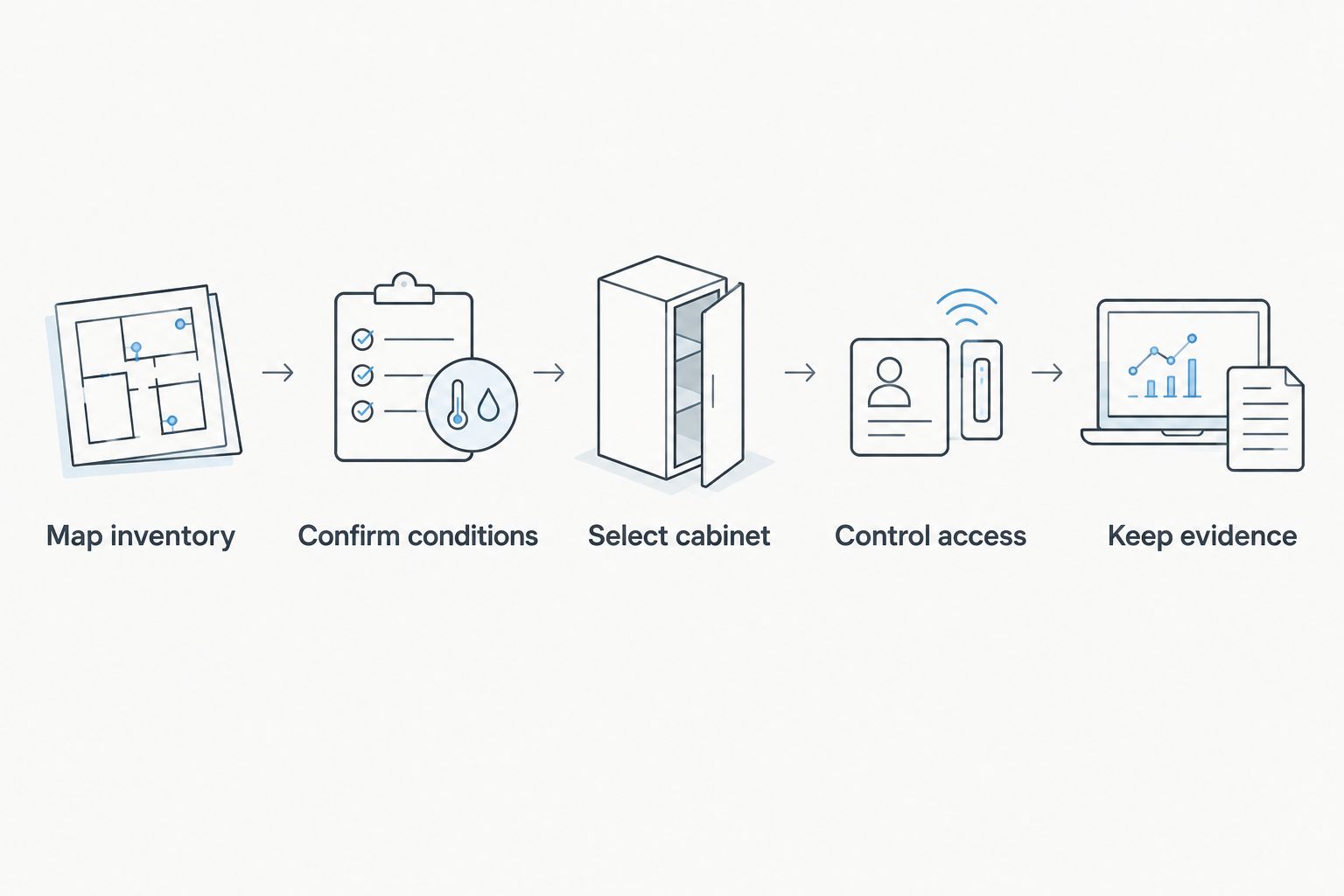
How to choose gun safes for security firms
Work through these steps for every office, armoury or operational base. A compliant cabinet at head office does not fix weak controls at another location.
Map every controlled item
Start with a manual register of everything that requires restricted access. Record the item type, quantity, licence category where applicable, usual storage site, authorised roles and expected access frequency.
Do not combine unrelated assets simply because they all need a lock. Firearms, ammunition, client keys, cash and confidential records create different access and storage requirements. Separating them also prevents a guard who needs one client key from gaining unnecessary access to firearms.
- List each firearm by type and assigned storage location
- Record ammunition separately from the firearm inventory
- Count client keys, access cards and vehicle keys
- Identify cash, documents and devices needing separate storage
- Mark items moved between sites or vehicles
- Review the list with the licence holder or responsible manager
Confirm the applicable licence conditions
Read the current conditions attached to the firm’s licence before comparing cabinets. The licence category, firearm type, jurisdiction and storage location determine which construction and installation rules matter.
Ask the relevant firearms registry for written clarification where the conditions do not clearly address a business site, shared access or temporary storage. Keep that response with the procurement file so the decision can be explained during a 2026 inspection or internal review.
- Confirm the state or territory governing each location
- Match every firearm to its licence category
- Record required cabinet construction and lock conditions
- Check whether ammunition needs a separate locked compartment
- Confirm any inspection or notification requirement
- Save the current rules and written advice with the register
Select a category-matched firearm cabinet
Compare the verified requirements against the manufacturer’s listed specifications. Capacity matters, but steel construction, door design, boltwork, locking method and anchoring points decide whether a cabinet fits the storage brief.
Best for a smaller long-arm roster: the Guardall G3E High Security 5 Rifle Cabinet lists capacity for five rifles, a 6mm door, 3mm body, four locking bolts, 22mm boltwork and a separate lockable ammunition compartment. Its limitation is capacity: a growing roster can outgrow five rifle positions.
Security Safes also lists the Secuguard GS3KL for ten rifles, with a 6mm steel plate body and 8mm steel plate door. Its product information identifies Category A, B, C, D and H use in New South Wales, but firms outside NSW still need to compare it with their own jurisdiction’s current conditions.
- Measure the longest firearm with fitted accessories considered
- Leave capacity for approved operational growth
- Compare body, door, boltwork and lock specifications
- Check for manufacturer-provided anchoring points
- Confirm how ammunition is separated inside or outside the unit
- Keep the product specification with the purchasing record
Separate ammunition and operational keys
A built-in ammunition compartment can reduce the number of cabinets required, but only where that arrangement meets the applicable licence conditions. If the rules or operating procedure require a separate container, follow the stricter arrangement.
Client keys need their own system. Storing keys inside the firearm cabinet gives employees access to firearms whenever they collect a site key, which conflicts with least-access control. A dedicated key cabinet keeps ordinary shift activity away from the armoury.
- Assign ammunition to a locked compartment or separate container
- Keep ammunition records distinct from the firearm register
- Give every client key set a unique identifier
- Issue individual credentials instead of a shared access code
- Store override keys away from the controlled room
- Reconcile keys and ammunition at shift handover
Anchor and position the cabinet
Use the cabinet’s designed fixing points and an installation method suited to the supporting structure. A heavy unit can still be attacked or removed when it is left freestanding, fixed only to plasterboard or placed where tools can reach every side.
Plan the location before delivery. Check the floor, wall structure, doorway, corridor, stairs and final working clearance. Installation difficulty increases when the selected room cannot accept the cabinet without removing doors or changing the route.
- Fix the cabinet to a suitable structural floor or wall
- Follow the manufacturer’s installation instructions
- Keep hinges and exposed sides away from easy tool access
- Restrict visibility from public and reception areas
- Photograph the completed fixings for the compliance file
- Record the installer and completion date
Create an access and handover procedure
A strong cabinet does not control access when the code is shared across the roster. Give each authorised person an individual credential where the lock supports it, and define who can add users, remove users, access override functions and investigate exceptions.
The free method is a bound access register with names, dates, times, item movements and supervisor checks. Electronic access records reduce manual gaps, but they still need routine review by a responsible person.
- Limit access to roles that need firearm handling duties
- Prohibit shared PINs and unattended physical keys
- Record each issue, return and discrepancy
- Revoke access as soon as a role changes
- Reconcile the register at every shift change
- Escalate missing items or failed returns immediately
Maintain evidence and test controls
Build a single evidence file for each storage site. It should connect the licence conditions, cabinet specification, installation record, authorised-user list, maintenance history and incident procedure.
Review the file whenever the firm changes firearms, staff permissions, premises or licence conditions. Set a scheduled 2026 review even if nothing changes, because expired user access and undocumented code changes are operational problems that routine cabinet checks will not reveal.
- Keep licence conditions and product specifications together
- Retain installation photographs and service records
- Review authorised users against the current roster
- Test locks, hinges and door operation on schedule
- Document code changes and lost-key responses
- Record corrective action after every discrepancy
Compare storage options for a security firm
No single safe covers every controlled asset. The practical 2026 setup separates firearms, ammunition where required, client keys and other valuables according to who needs access.
| Option | Best for | Starting price | Main strength | Key limitation |
|---|---|---|---|---|
| Guardall G3E five-rifle cabinet | Smaller long-arm holdings | Check current listing | Separate ammunition compartment and published construction details | Five-rifle capacity limits expansion |
| Secuguard GS3KL ten-rifle gun safe | Larger long-arm holdings and listed NSW categories | Check current listing | Ten-rifle capacity with 6mm body and 8mm door | Jurisdictional suitability still needs confirmation |
| Guardall GSK200-LGB key safe | Firms controlling many client keys | Check current listing | Dedicated high-security key storage | Does not store firearms |
| CMI SKC-250D key cabinet | Firms needing organised digital-lock key control | Check current listing | Three removable leaves accepting 250 keys | Key storage only; no firearm function |
The strongest option depends on the asset. A rifle cabinet wins for firearms, while a dedicated key cabinet is better for daily client-key movements because it avoids opening firearm storage during routine shift work.
Security Safes offers relevant options for both functions. Compare the live product details against your written storage brief rather than choosing one large cabinet for every controlled item.


Common mistakes private security firms make
Buying for capacity alone
A cabinet is not suitable simply because every firearm fits. Licence conditions, construction, locking, ammunition arrangements and installation remain separate checks. Write the compliance requirements first, then compare capacity.
Giving the whole roster one code
A shared code removes individual accountability. It also creates an immediate access problem when an employee leaves, because every remaining user needs the replacement code. Individual credentials make removal and review cleaner.
Mixing client keys with firearms
A guard collecting a routine site key should not need access to a firearm cabinet. Separate storage reduces unnecessary openings and lets managers assign permissions according to each employee’s duties.
Ignoring future roster changes
A cabinet filled to its stated capacity on installation day leaves no room for an additional firearm or a change in equipment. Plan for approved operational needs, but do not buy a larger category of cabinet as a substitute for checking the actual licence conditions.
Filing evidence in different systems
A licence copy in email, installation photo on a phone and user list in a spreadsheet do not form a usable audit record. Keep one controlled file per location and assign a person to maintain it.
FAQ
What are the best gun safes for security firms in 2026?
The best gun safes for security firms match the applicable licence conditions, firearm category, capacity and installation requirements. Security Safes lists five-rifle and ten-rifle options, but the firm must confirm jurisdictional suitability before purchase.
Can a private security firm use a normal home gun safe?
A home gun safe is suitable only if its specifications and installation satisfy every condition applying to the firm’s business licence and storage location. A residential label alone does not prove or disprove compliance.
Does ammunition need a separate safe?
The applicable state or territory rules determine whether ammunition can use a locked internal compartment or needs a separate locked container. Confirm the required arrangement in writing before installation.
How many people should access a security firm’s firearm cabinet?
Access should be limited to authorised roles with a genuine operational need. Individual credentials and prompt removal of former users provide clearer control than a code shared across the roster.
Is a digital lock better than a key lock for security firms?
A digital lock is better when it supports individual credentials and the firm manages code changes properly. A key lock remains workable, but physical keys need controlled issue, return, spare storage and loss procedures.
How much do gun safes for security firms cost?
Cost depends on capacity, construction, lock type, installation and delivery requirements. Check the current product listing and include professional installation when comparing the total purchase.
Should client keys be stored in the gun safe?
Client keys should use a separate controlled key cabinet whenever staff need key access without firearm access. This separation supports least-access permissions and reduces unnecessary firearm-cabinet openings.
How often should a security firm review firearm storage?
Review storage whenever licences, firearms, locations, authorised staff or operating procedures change, plus on the firm’s scheduled compliance cycle. Document every 2026 review and the corrective actions it produces.
One last thing
Do not start the buying process with a cabinet model. Start with a one-page storage brief signed off by the responsible licence holder: jurisdiction, licence category, firearm types, capacity, ammunition arrangement, authorised roles, installation surface and evidence required.
That brief turns a vague search for gun safes for security firms into a decision that can be checked. It also exposes when the business needs two systems — one for firearms and one for keys — instead of one oversized cabinet with uncontrolled access.