


Insurance brokers and agencies safes are fire-and-burglary rated storage units built to protect policy files, premium cash and client data, with the aim of meeting duty-of-care obligations without slowing daily file access. A brokerage handles paper volumes a home office never sees, plus premium cash, digital backups and staff who rotate in and out, so the safe has to do three jobs at once instead of one.
- Safes for insurance brokers need a fire rating for paper records, not just a burglary rating.
- Dominator's DS-0D carries a 105-minute CNS fire rating and up to $600,000 insurable valuables cover per its own spec sheet.
- Archive cabinets suit multi-branch agencies with years of retained policy files; compact document safes suit single-office brokers.
- Electronic locks with multi-user codes are the standard for agencies where more than one staff member needs access.
Why this matters for insurance brokers
A brokerage in 2026 sits on years of retained policy documents, client identification records and, in many agencies, same-day premium cash. None of that belongs in a standard office filing cabinet. Ordinary steel cabinets stop a casual look-through; they do nothing in a fire and very little against a determined break-in.
The insurance-approved safes collection at Security Safes exists because brokers ask for the same thing repeatedly: a unit rated to protect paper for long enough that records survive a fire, with a lock system that more than one staff member can use without sharing a single combination. That combination of paper-fire protection plus multi-user access is what separates a broker-grade safe from a generic office safe.
Privacy obligations under the Privacy Act add another layer — client files containing personal and financial information need to be secured, not just locked away casually. A safe with an audit trail lock gives an agency a record of who opened it and when, which matters if a compliance question ever comes up.
Assess what actually needs protecting
Before picking a model, separate what's going in the safe. Paper, cash and electronics have different protection needs and mixing them without planning wastes capacity.
- Active policy files and renewal paperwork
- Client ID copies and signed authority forms
- Same-day premium cash or cheques awaiting banking
- Backup drives or USBs holding client databases
- Staff and vehicle keys for multi-site agencies
- Signed contracts, deeds or trust documents held on behalf of clients
Match the fire rating to your paper records
Paper chars around 177°C, well below the temperatures a house or office fire reaches within the first 20-30 minutes. A safe's fire rating tells you how long its interior stays below that threshold, not whether it's fireproof forever.
- Look for a stated minute rating (30, 60 or 105 minutes) rather than a vague "fireproof" label
- Check whether the rating covers paper only or also covers digital media, which needs a lower interior temperature
- Confirm the rating comes from an independent test standard, not just a manufacturer claim
- Match the rating to how long it would realistically take emergency services to reach your office location
The Guardall GDF4000 fire-resistant filing cabinet safe is built for exactly this: filing-cabinet format so it slots into an existing office layout, with fire protection built into the cabinet body rather than added as an afterthought.
Pick a burglary rating for the office location
A street-front brokerage with a shopfront window needs a higher burglary rating than an agency tucked inside a serviced office building with a manned reception. Rating scales (B-rate, S1, S2 and above) reflect resistance to tools, not just weight.
- Ground-floor or street-facing offices need a higher-rated body and door
- Agencies inside secured commercial buildings can often use a lighter-duty rated unit
- Check whether the rating covers the door only or the full body — cheaper units sometimes rate the door and skimp on the sides
- Factor in alarm response time; a slower response justifies a higher rating
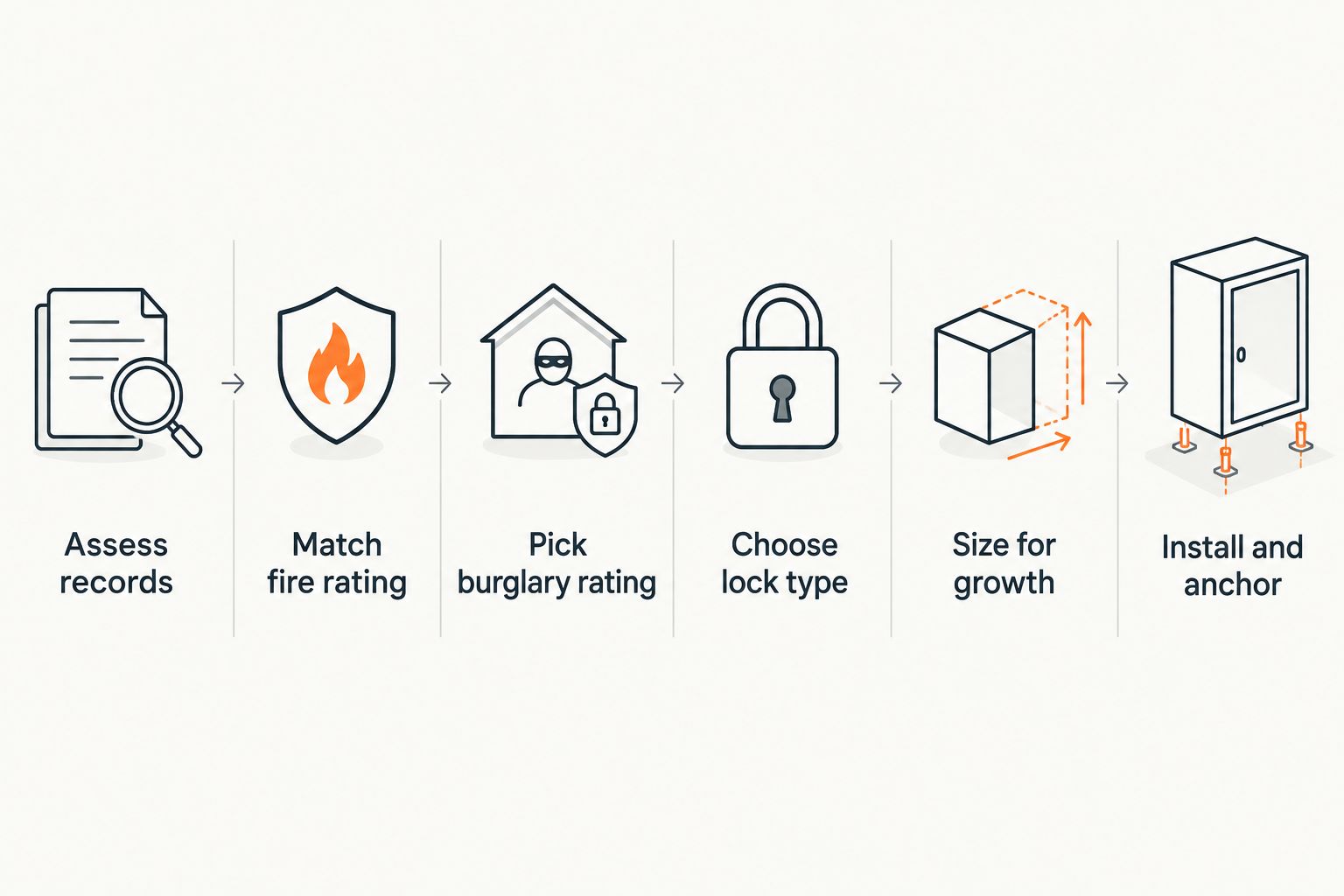
Choose a lock type that fits multi-staff access
A combination-only lock works for a sole trader. It falls apart the moment three staff members need access and nobody wants to share one number.
- Electronic locks with individual user codes support staff turnover without re-keying
- Audit-trail locks log every open event with a timestamp, useful for compliance reviews
- Dual-custody settings require two codes to open, appropriate for cash-heavy agencies
- Mechanical key backup is worth keeping for battery failure, even on an electronic unit
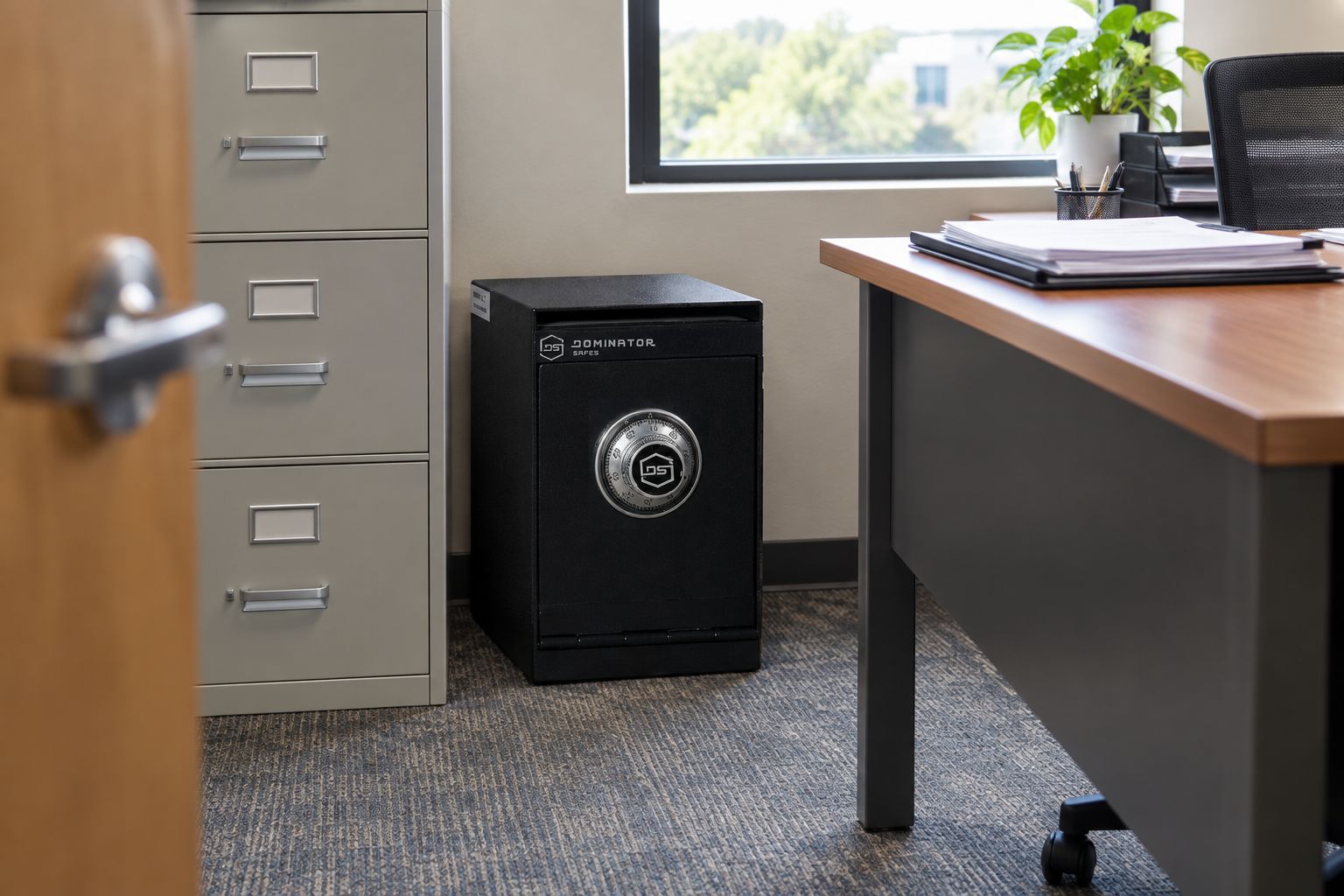
Dominator's UC-3D uses a Tecnosicurezza Pulse electronic lock built for exactly this kind of multi-user commercial setting, where a deposit or cash safe needs staff to access it independently through a shift.
Size the safe for growth, not for today
Policy retention rules mean files stack up for years before they're eligible for disposal. Buying to fit this year's file volume guarantees a second purchase within 24 months.
- Count current linear file capacity, then add at least two years of projected growth
- Archive cabinets suit agencies with multi-year retained files across several product lines
- Compact document safes suit single-broker offices with a lighter file load
- Leave internal shelving adjustable rather than fixed, so mixed file sizes fit
The Chubbsafes Archive Cabinet 640 is sized for agencies carrying a genuinely heavy paper archive rather than a single filing drawer's worth of documents.
Install and anchor it properly
An unanchored safe, however well rated, can be carried out the door in under a minute by two people. Anchoring is not optional for a broker-grade unit.
- Bolt through the base into concrete slab where the floor allows it
- Position away from windows and loading dock sightlines
- Keep it out of the direct path a break-in would take from the point of entry
- Confirm the anchor points are rated for the safe's weight class, not just any bolt hole
Set an audit and access policy
A safe is only as secure as the process around who opens it. Agencies that skip this step end up with five staff sharing one combination and no record of access.
- Assign individual codes per staff member on electronic locks
- Review the access log monthly, not just after an incident
- Remove departing staff codes on their last day, not weeks later
- Document the safe's contents periodically for insurance and compliance purposes
Which safe fits your agency
| Option | Best for | Key limitation |
|---|---|---|
| Fireproof filing cabinet (Guardall GDF4000) | Agencies archiving years of paper policy files | Bulky footprint, not built for cash |
| Document fire safe (Yale YFM-520-FG2) | Single-office brokers needing A4/A3 file protection | Limited shelving for mixed valuables |
| Commercial deposit safe (Dominator UC-3D) | Agencies collecting premium payments on-site | Not fire-rated for long-term paper storage |
| Archive cabinet (Chubbsafes Archive Cabinet 640) | Multi-branch agencies with high file volume | Needs floor space and professional install |
| Key cabinet (Secuguard AP-534EK) | Agencies managing multiple office or vehicle keys | Doesn't protect documents or cash |
Verdict: an agency handling both paper files and daily cash needs two units, not one — a fire-rated document safe or cabinet for files, and a separate commercial deposit safe for cash. Trying to make one unit do both jobs usually means compromising on one of them.


Common mistakes insurance brokers make
- Buying a burglary-rated safe with no fire rating. A brokerage's real risk is often fire damage to irreplaceable paper files, not just theft.
- Sharing one combination across the whole office. This erases any audit trail and makes a departing staff member's access impossible to revoke cleanly.
- Undersizing for archive growth. Agencies routinely outgrow a document safe within two years of retained policy files.
- Storing backup drives next to cash in an unrated compartment. Digital media needs a lower interior temperature than paper to survive a fire; the two shouldn't share a shelf without checking the rating covers both.
- Skipping the anchor bolt. A safe that isn't fixed to the floor or wall is a portable target, regardless of its rated body.
FAQ
What's the best safe for an insurance brokerage in 2026?
A brokerage handling both paper files and cash typically needs two units in 2026: a fire-rated document safe or archive cabinet for policy records, and a separate commercial deposit safe like the Dominator UC-3D for daily cash.
Is a fireproof filing cabinet better than a document safe for brokers?
A fireproof filing cabinet suits agencies with years of retained paper files needing bulk storage, while a compact document safe suits single-broker offices with a lighter file load.
How long does a fire-rated safe protect paper documents?
Fire ratings are stated in minutes, commonly 30 to 105 minutes for commercial units. Dominator's DS-0D carries a 105-minute CNS-certified rating per its own specification.
Do insurance agencies need an electronic lock or a combination lock?
Agencies with more than one staff member accessing the safe generally need an electronic lock with individual user codes, since a shared mechanical combination leaves no audit trail.
Can one safe store both cash and client documents?
It can if the interior is rated for both, but most agencies split the two: cash in a dedicated deposit safe, paper files in a fire-rated cabinet or document safe.
How much cash rating does a brokerage safe need?
It depends on how much premium cash sits in the office between banking runs. Dominator's PH-1C, for example, carries a $40,000-$50,000 recommended cash rating in an unsupported situation per its specification.
Does a safe need to be bolted down?
Yes. An unanchored safe can be removed bodily from the office regardless of its rated body, so anchoring to a concrete floor is standard practice for a broker-grade unit.
What happens to unrated digital backups in a fire?
Digital media fails at lower temperatures than paper, so a safe rated only for paper does not guarantee a surviving backup drive; check the rating explicitly covers digital media before storing one.
One last thing
Most agencies size their safe for this year's file volume and end up buying a second unit within two years once retained policy files pile up. Buy one size bracket larger than looks necessary today — the fire-rated interior doesn't get cheaper to add later, and a half-full archive cabinet in 2026 costs nothing extra to run.