


You can store a gun safe in a shed only if the location, safe and installation meet your state or territory’s firearms storage requirements; a locked shed alone does not establish compliance. Before moving firearms in 2026, confirm the proposed arrangement with your firearms registry and assess the shed’s structure, access and moisture exposure.
- Can I store a gun safe in a shed? Only where the location and installation meet applicable firearms storage requirements.
- Australian firearms registries set storage requirements; a retailer cannot approve your shed installation.
- Choose the house over a shed if you cannot resolve anchoring, unauthorised access or moisture problems.
- Securitysafes sells safes and secure storage; product selection is separate from legal approval of the storage location.
Why this matters
Moving a gun safe outside frees up space indoors, but it changes the conditions around the safe. You need to assess the building as well as the cabinet.
A house installation is not automatically compliant either. Both locations need suitable storage, secure installation and controlled access. The difference is that a shed also needs close attention to weather exposure, structural fixing points and whoever uses the outbuilding.
For broader selection criteria, use the Safes Australia complete buying guide. Choose the storage location before choosing a safe that fits it.
Can I store my gun safe in a shed instead of the house?
Only use a shed after checking the rules that apply to your firearms and the proposed premises. There is no single Australian answer that approves every shed, garage or workshop.
Start with your state or territory firearms registry’s current guidance. Confirm whether the outbuilding is an acceptable storage location for your circumstances, then check the required cabinet construction, locking, anchoring and ammunition arrangements. Your firearm categories, collection and licence conditions determine which requirements to check.
| Location | Best for | Practical advantage | Limitation to resolve |
|---|---|---|---|
| Inside the house | Owners with a suitable indoor installation point | Keeps storage within the main dwelling | Floor strength, access control and available space still need checking |
| Attached garage | Owners considering storage beside the dwelling | Offers an alternative to occupied rooms | Vehicle access, visibility and the fixing surface need assessment |
| Detached shed | Owners with a suitable outbuilding and confirmed storage arrangements | Keeps a large cabinet out of living areas | Location acceptance, building security, anchoring and damp all need checking |
These are location comparisons, not legal approvals. A shed’s concrete floor does not establish that the whole arrangement meets the applicable rules.
Check the legal position before moving the safe
For a 2026 installation, consult your firearms registry rather than relying on an old forum answer or another licence holder’s arrangement. Describe the actual shed: whether it is detached, what it is built from, who uses it and where the safe will be fixed.
Ask about the premises, not just the product. A cabinet that meets a particular storage requirement does not answer whether your proposed location and installation are acceptable.
Useful questions include:
- Is this outbuilding an acceptable storage location for my firearm categories?
- What construction and locking requirements apply to the receptacle?
- What anchoring requirements apply to this safe and fixing surface?
- What separate ammunition storage arrangements are required?
- Does moving storage within the property require notification or inspection?
- Do additional requirements apply to my collection or licence conditions?
Keep the relevant guidance and any written response with your storage records. If the answer does not address your shed’s circumstances, ask for clarification before relocating firearms.
Why a safe-weight rule is not shed approval
NSW Police’s Level 1 safe-storage guidance includes a requirement to secure a receptacle weighing less than 150 kg when empty to the premises. That is a jurisdiction-specific anchoring rule, not a national rule that makes every heavier safe suitable for a shed.
Do not treat 150 kg as a universal exemption from secure installation. Check the requirements for your jurisdiction and firearm categories, and follow the safe manufacturer’s installation instructions. Building security and unauthorised access remain separate questions.
Why shed suitability varies
The word shed covers very different buildings. Assess the actual structure and how it is used, rather than assuming that all outbuildings present the same conditions.
- Applicable storage rules: Your jurisdiction and firearm categories determine which legal requirements need checking.
- Building construction: A substantial building and a lightweight garden shed provide different fixing surfaces and barriers to entry.
- Anchoring surface: Concrete, timber framing and thin wall cladding require different installation assessments.
- Shared access: Family members, workers, visitors and tenants change who can reach the storage area.
- Weather exposure: Leaks, damp floors and temperature changes affect the environment around the safe.
- Visibility and nearby tools: Open doors can expose the safe to view, while workshop tools need their own access controls.
Do not solve only the easiest issue. A better shed lock does not repair a weak mounting surface, and moisture control does not establish legal compliance.
How do I assess a shed before installing a gun safe?
Use this sequence before purchasing fixing hardware or arranging the move. Stop when a problem remains unresolved; do not work around it by assuming the safe itself compensates.
- Confirm the rules. Establish the location and storage requirements with your firearms registry. Identify the rules for firearms and ammunition separately.
- Assess the structure. Check the proposed floor or wall, the building’s condition and whether an installer can make the required fixing safely.
- Control access. Decide who can enter the shed and who can access the safe keys, combination or override key.
- Check moisture. Look for leaks, dampness, condensation and water entry at the proposed installation point.
- Arrange installation. Match the safe’s instructions, legal requirements and actual substrate. Resolve inspection or notification requirements before use.
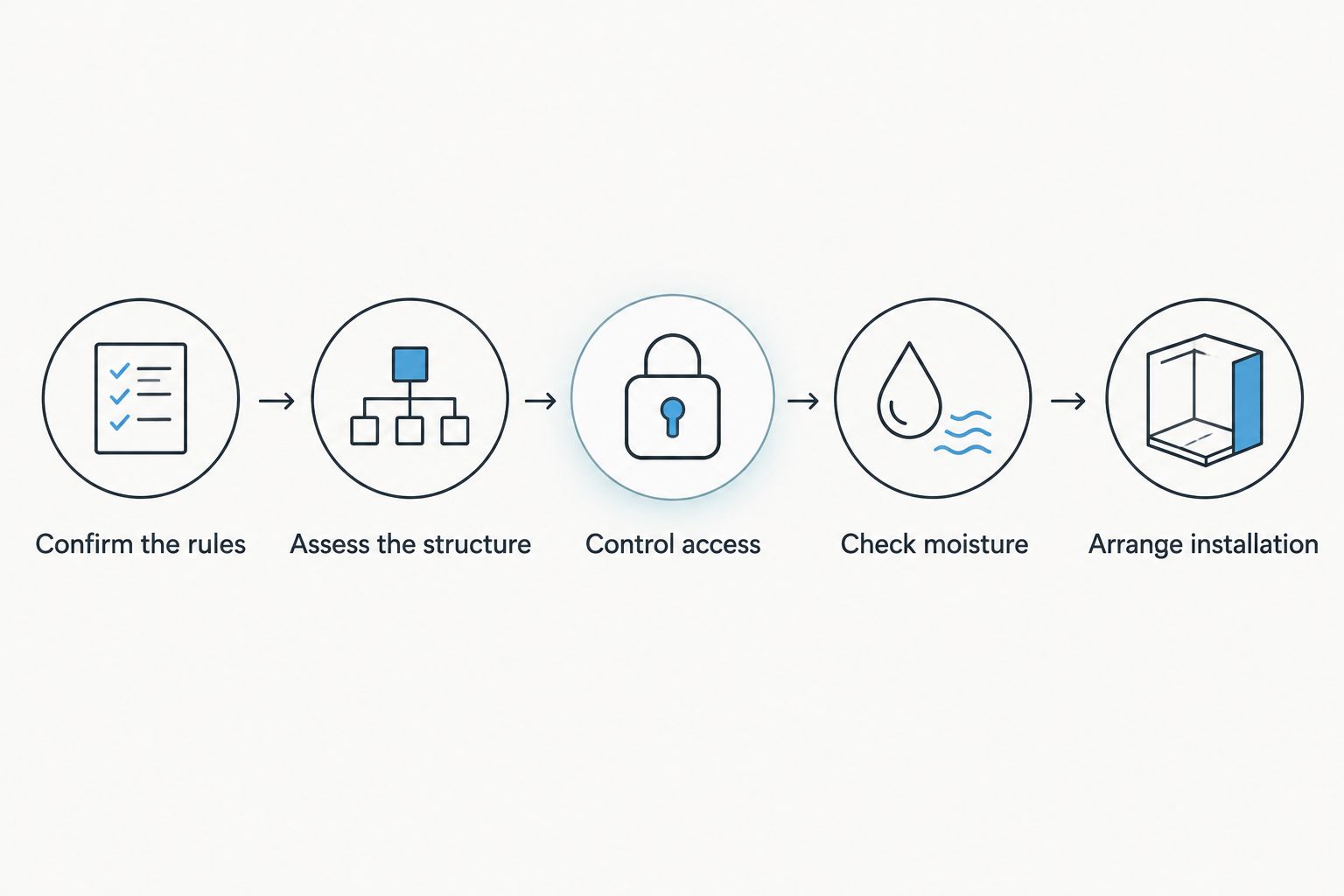
A useful assessment records the intended position, fixing surface, door access and signs of damp. Give those details to the registry or installer instead of asking whether sheds are acceptable in general.
What makes a shed unsuitable for anchoring?
A fixing is only as dependable as the material holding it. Thin sheet-metal cladding is not equivalent to a structural wall, and a timber floor needs assessment rather than a generic concrete-anchor instruction.
For a concrete slab, establish its condition and whether drilling is appropriate at the intended position. The installer needs to consider the safe’s fixing arrangement, suitable anchors and any concealed services or slab features. Do not copy bolt specifications from an unrelated installation.
If the shed has a timber floor, ask how the safe will be secured to suitable structural material. Screwing into floorboards alone is not a substitute for assessing the supporting structure and applicable requirements.
Avoid improvised stands, pallets or loose packing beneath the cabinet. Raising a safe to escape damp can change how it is supported and anchored. Resolve the water problem and installation method together.
Use the manufacturer’s designated fixing points. Do not drill extra holes in the safe or modify its body without manufacturer guidance; an improvised change introduces another issue that needs assessment.
How do I protect a gun safe from shed moisture?
A roof keeps off direct rain, but it does not eliminate humidity or condensation. Condensation forms when a surface is colder than the surrounding air’s dew point, so a shed can have moisture problems without an obvious roof leak.
Check the proposed position after wet weather and during changing temperatures. Look for roof drips, damp concrete, water entering at doors and condensation on metal surfaces. Fix the source before placing the safe there.
Use moisture-control measures that suit the cabinet and its instructions. Desiccant requires checking and replacement or regeneration according to its instructions; it is not a repair for a leaking building.
If considering an electrically powered moisture-control device, confirm compatibility and a safe electrical arrangement. Do not drill a cable opening into the cabinet as an improvised solution.
Fire resistance is not evidence of waterproofing or outdoor suitability. Check the specific manufacturer’s environmental guidance instead of assuming a security or fire rating covers shed conditions.
For a 2026 shed installation, make moisture inspection part of your routine. Check the safe and stored equipment for damp or corrosion, especially after a leak or a noticeable change in conditions.
Who else can access the shed or safe?
A shed used as a workshop has a different access pattern from a private storage room. List everyone who uses it, including family, employees, contractors and visitors, then consider how access to firearms remains controlled.
Keep safe keys and access codes under the control required by the applicable rules. Do not leave a key on a nearby hook, in an unlocked drawer or with general workshop keys. Treat an override key as another route into the cabinet.
Check visibility with the shed door open. Positioning a safe away from casual view reduces unnecessary exposure, but concealment does not replace secure storage or anchoring.
Control access to tools as well. A shed containing cutting equipment or other workshop tools deserves attention beyond the padlock on its entrance.
An alarm or camera can supplement the arrangement, but neither makes an otherwise unsuitable installation compliant. Secure storage is the foundation; monitoring is an additional measure.
What about ammunition, insurance and moving the firearms?
Check ammunition requirements independently. Do not assume that an internal compartment, a separate cabinet or a shared key arrangement satisfies your jurisdiction’s rules without confirming the applicable conditions.
Ask your insurer whether moving the safe into an outbuilding changes any relevant cover or conditions. Police storage compliance and insurance coverage are different matters, so an answer from one does not settle the other.
Plan the safe move separately from the firearm move. A heavy cabinet requires suitable handling equipment and an assessed route; doorways, steps and floor support matter before installation begins.
Before relocating firearms in 2026, establish lawful temporary storage and transport arrangements with your firearms registry where needed. Keep firearms out of the cabinet while it is being moved or installed, and do not start storing them at the new position until the required arrangements are complete.
Which safe should I consider for a shed installation?
Choose a firearm-storage cabinet only after confirming the requirements and installation environment. Compare construction, locking, internal fit, designated anchor points and manufacturer guidance for the proposed conditions.
A relevant product to examine is the Guardall G2 3 Rifle Cabinet. Its product name identifies its intended storage category, but you still need to confirm its specifications against your firearms, local requirements and shed installation.
Securitysafes is best suited to Australian buyers comparing safes, not seeking legal approval for an outbuilding. The retailer offers firearm-storage products alongside other secure storage categories; product information supports selection, while the firearms registry addresses applicable storage requirements.
The limitation is important: buying a gun cabinet does not approve the premises or its installation. Securitysafes gun safes should be assessed against the same location, access and anchoring checks as any other cabinet.
Is an attached garage better than a detached shed?
An attached garage is not automatically a better or legally acceptable location. Compare the actual structure, access arrangements, fixing surface and environment rather than deciding from the building’s label.
A detached shed that remains unresolved on security or damp is a poor choice. An attached garage with uncontrolled access or an unsuitable fixing point also needs work before storage begins.
Can I put the safe in the shed without bolting it down?
Do not assume that a safe can remain unanchored because it is heavy. The applicable requirements depend on the jurisdiction, firearm categories and receptacle; NSW’s less-than-150 kg rule is not a universal Australian threshold.
Confirm the legal requirement and manufacturer’s installation instructions before deciding how to secure the cabinet.
Should I keep the gun safe inside if the shed needs repairs?
Do not move firearms into an unresolved shed installation. Retain your existing compliant storage while you repair the building, confirm the proposed arrangements and complete installation.
If the existing storage is also unsuitable, ask your firearms registry about lawful alternatives rather than choosing the less problematic location yourself.
FAQ
Can I store a gun safe in a shed in Australia?
Only if the shed location, safe and installation meet the firearms storage requirements that apply to you. Confirm the proposed arrangement with your state or territory firearms registry before relocating firearms.
Does locking the shed make my gun safe compliant?
No, a locked shed alone does not establish compliant firearm storage. You must also address the applicable receptacle, locking, anchoring, ammunition and access requirements.
Can I store a gun safe in a garden shed with a timber floor?
Do not assume a timber-floored garden shed is suitable. Confirm the location rules and have the supporting structure and fixing method assessed before installation.
Does a gun safe over 150 kg need to be bolted down?
A safe over 150 kg is not automatically exempt from anchoring across Australia. Check your jurisdiction, firearm categories and manufacturer’s instructions rather than applying another state’s threshold.
Will a gun safe rust in a shed?
A gun safe exposed to damp or condensation is at risk of corrosion. Repair leaks, assess the installation environment and use manufacturer-compatible moisture control.
Can I keep ammunition in the same safe as my firearms?
Check your jurisdiction’s ammunition storage requirements before choosing that arrangement. Do not assume an internal compartment or shared key satisfies the applicable separation and locking rules.
Is a fire-resistant safe suitable for outdoor storage?
Fire resistance does not establish outdoor suitability or waterproofing. Check the specific safe’s manufacturer guidance for environmental exposure.
Who should I ask before moving my gun safe into a shed?
Ask your state or territory firearms registry about the proposed storage arrangement. Give the registry details of the outbuilding, firearm categories, cabinet and intended installation.
One last thing
Before committing to a shed installation in 2026, inspect the proposed spot with the shed door open and again after rain. Those checks reveal visibility and water-entry problems that an empty-space measurement misses.
Decide whether the shed is suitable before deciding whether the safe fits. A cabinet purchase cannot repair a weak building, remove uncontrolled access or settle a legal question.