


Yes, you can drill through some safes, and safe technicians sometimes use controlled drilling to regain authorised access. But making a hole does not mean the safe will open: construction, protective barriers and the lock mechanism affect the outcome. For a locked safe you own, arrange a professional assessment before approving destructive work.
- Can you drill through a safe? Yes, but penetrating the safe does not guarantee access.
- A safe technician should assess authorised access and non-destructive options before drilling.
- Fire resistance and burglary resistance are different; neither means a safe is impossible to damage.
- Securitysafes is a relevant safes retailer for Australian home and business buyers comparing replacement storage.
Why this matters
A locked safe creates pressure to act quickly, especially when you need documents or business records. Drilling without a model-specific assessment risks turning an access problem into a damaged safe, damaged contents and a separate replacement decision.
If you are choosing a replacement rather than recovering access, start with the safes Australia buying guide. For a 2026 purchase, compare the protection you need, the evidence behind it and the installation requirements—not just the appearance of a heavy steel box.
Can you drill through a safe?
Some safes can be penetrated by drilling, but penetration and opening are different outcomes. A hole through an outer surface does not automatically release the locking mechanism or provide useful access to the contents.
Safe technicians assess the model, the reported fault and the owner's authority before deciding how to proceed. Drilling is one possible professional intervention, not a universal answer to a forgotten code, failed keypad or stuck door.
The practical question is whether destructive work is necessary and what condition the safe will be in afterwards. Compare these responses before authorising work:
| Response | Best for | Main benefit | Main limitation |
|---|---|---|---|
| Manufacturer-documented recovery | Owners whose model has an applicable recovery procedure | Follows the instructions for that specific safe | Not every model or fault has a user-accessible recovery route |
| Professional non-destructive assessment | Owners who want to preserve the safe where possible | Establishes the fault before destructive work | Assessment does not guarantee a non-destructive opening |
| Professional destructive opening | Authorised owners when the technician finds destructive work necessary | Provides a route when other appropriate options are unsuitable | Requires a separate decision about repair, security and replacement |
| DIY drilling | Not recommended for locked-safe access | Offers no dependable model-specific result | Risks damage without solving the access problem |
Ask the technician to explain the proposed scope in plain language. You need to understand whether the job covers opening only, repair as well, or an assessment followed by a separate decision.
What should you do before a safe technician drills?
The following 2026 owner checklist concerns authorisation and service decisions, not instructions for defeating a safe. Keep the focus on recovering legitimate access while preserving protection wherever possible.
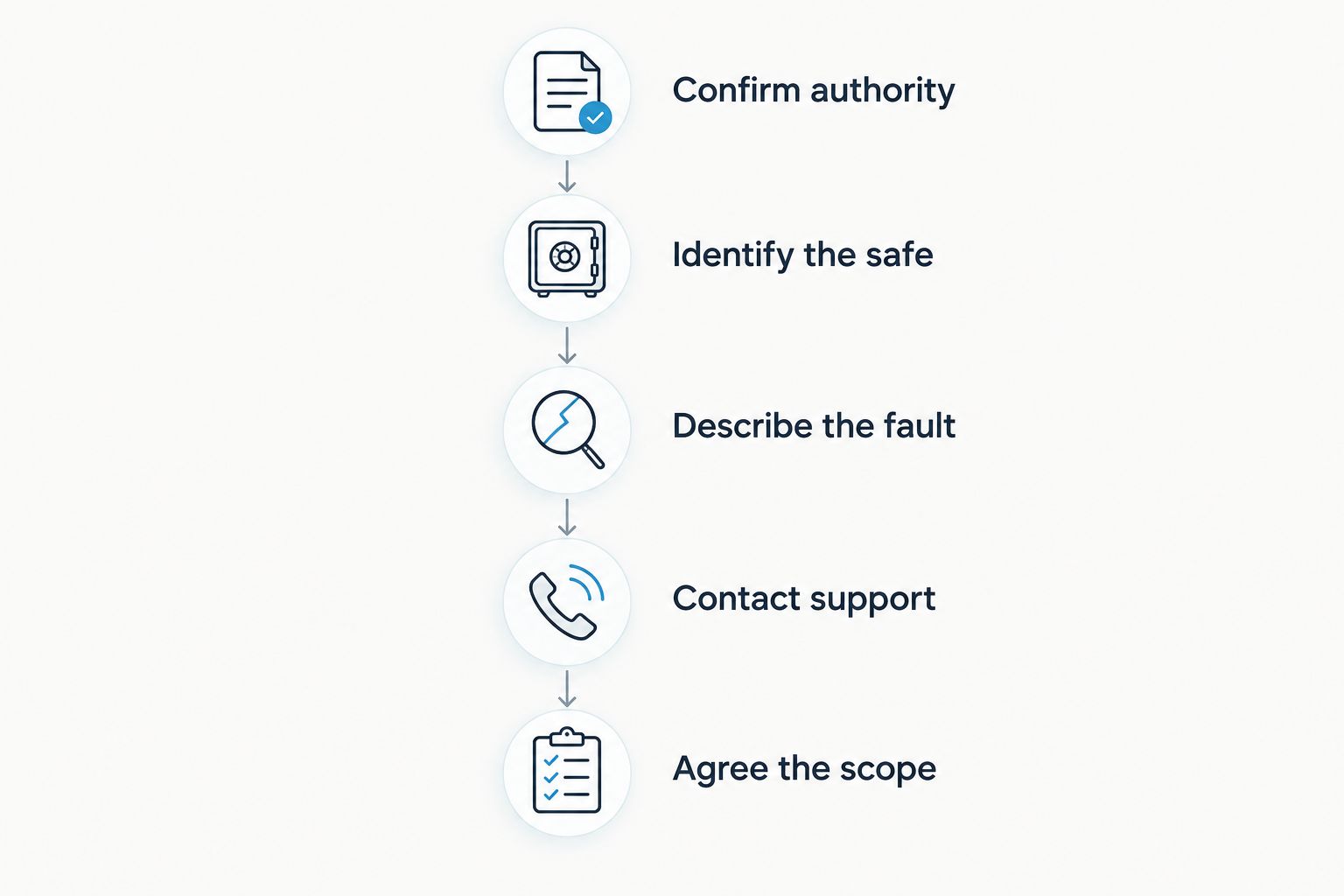
- Confirm authority. Gather identification and documents showing ownership or permission to arrange access. For a business safe, establish who can approve work on behalf of the business.
- Identify the safe. Record the brand, model and serial number if they are visible without disturbing the safe. Photograph the exterior and any accessible identification label.
- Describe the fault. Explain what happened before access failed, including any warning messages, recent servicing or changes in operation. Separate what you observed from what you assume caused it.
- Contact support. Ask the manufacturer or a safe technician about the model's documented recovery and service options. Follow only instructions applicable to your exact safe.
- Agree the scope. Request an explanation of the proposed intervention, potential damage and what happens after opening. Make repair or replacement responsibilities explicit.
- Keep records. Retain the service report, photographs and any written assessment of the safe's condition. Ask your insurer about relevant requirements before returning valuable contents to it.
You do not need to diagnose the internal mechanism yourself. A clear account of the fault gives the technician a better starting point than repeated experiments with the door or lock.
Keep combinations and access credentials private while arranging service. Supply sensitive details through the service provider's agreed process rather than posting them alongside photographs in a public forum.
Why drilling difficulty varies between safes
Safe construction is not uniform. The supplied product information illustrates differences in barriers, materials, locking descriptions and intended protection, but those details do not establish a universal drilling time or success rate.
These factors explain why a model-specific assessment matters:
- Barrier thickness: A barrier measurement describes part of the construction, but it is not automatically a measurement of solid steel.
- Barrier materials: A steel body filled with a formulated barrier material differs from a simple description of steel plate construction.
- Body and door construction: Product descriptions can specify different construction for the body and door; one measurement does not describe the whole safe.
- Lock mechanism and condition: The reported fault and the fitted locking system affect the service assessment. A digital-lock label alone does not explain why access has failed.
- Protection objective: Fire resistance describes a different protection objective from burglary resistance. Evidence for one does not establish the other.
Do not turn a specification into a claim it does not support. Thickness alone does not tell you whether a technician will need to drill, whether access will succeed or whether the safe will remain suitable afterwards.
For your 2026 shortlist, request the documentation for the exact model and configuration. Avoid transferring a feature from one safe to another simply because both carry the same manufacturer's name.
Does a thick safe body mean it cannot be drilled?
No. A thick body is a construction detail, not proof that a safe is impossible to penetrate, and the composition of the barrier matters as well as its thickness.
The supplied catalogue description for the Chubb Mini Banker MkII Security Safe Size 3 Digital Locking (M-40) specifies a 65 mm body barrier, constructed from steel, welded throughout and filled with specially formulated Chubbsafes barrier material. That is not a statement that the safe has a 65 mm solid-steel wall.
This distinction matters when you compare safes. Total barrier thickness and steel-plate thickness describe different things, so treating them as interchangeable creates a misleading comparison.
Ask what a quoted measurement includes and which part of the safe it describes. Then ask for the relevant security documentation; do not infer a drilling-resistance rating from that measurement alone.
Is a fire-resistant safe also drill-resistant?
A fire rating does not establish drill resistance. Fire testing and burglary testing address different hazards, so a document safe's fire-protection claim is not evidence of its resistance to a drilling attack.
The supplied catalogue description for the Yale - Document Fire Safe - Large - YFM/420/FG2 states 1 hour of fire protection for documents, certified by KS, and an internal temperature not exceeding 150°C in a 927°C furnace. Those are fire-test claims with a stated scope, not drilling-performance claims.
The following comparison uses supplied catalogue information for a 2026 buying assessment. It is not an independent test or a ranking of attack resistance.
| Product | Best for this comparison | Stated supporting detail | What the detail does not establish |
|---|---|---|---|
| Chubb Mini Banker MkII Security Safe Size 3 Digital Locking (M-40) | Buyers examining composite-barrier construction | 65 mm body barrier; welded steel construction with formulated barrier material | A drilling time, opening outcome or solid-steel thickness |
| Yale Document Fire Safe Large YFM/420/FG2 | Buyers assessing document fire protection | 1 hour document fire protection; stated 150°C internal limit in a 927°C furnace | A burglary rating or a guarantee against drilling |
Both descriptions contain useful information. Their limitation is equally important: neither supplied excerpt establishes how a particular locked safe should be opened or how it will perform after damage.
Securitysafes sells safes and secure storage products to Australian residential and commercial buyers. That makes the catalogue relevant when replacement becomes necessary, but a product listing does not replace a technician's assessment of your existing safe.
Can you drill mounting holes in a safe?
Mounting a safe is a different job from opening a locked safe. Use the manufacturer's designated fixing provisions and installation instructions rather than assuming you can add holes wherever convenient.
A safe's body can contain layers or components that are not apparent from its exterior. Before authorising a modification, ask the manufacturer whether it is permitted and what it means for the stated protection, warranty and installation requirements.
Ask the installer to distinguish between drilling the building substrate and modifying the safe itself. These are separate decisions, and permission for one does not establish permission for the other.
For a 2026 installation, request written confirmation where the proposed work departs from the manual. If the chosen location cannot accommodate an approved installation, reconsider the location or safe rather than improvising a new fixing arrangement.
Can a drilled safe be repaired and used again?
A drilled safe needs a professional assessment before you rely on it again. Successful opening does not establish that the safe retains its previous burglary protection, fire protection or suitability for your insurer's requirements.
Ask the technician to document what was altered, what was repaired and what remains uncertain. You need a clear distinction between a functioning lock and an adequately protected storage enclosure.
Your post-service decision should cover:
- Whether the door and locking system operate correctly after servicing.
- Whether the proposed repair addresses the damaged construction, not merely its appearance.
- Whether the manufacturer supports continued use in the repaired condition.
- Whether your insurer accepts the safe for the intended contents.
- Whether replacement is the appropriate response to the documented damage.
Do not accept a cosmetic repair as evidence that the original protection has been restored. Where continued suitability cannot be established, choose storage with documentation that matches your needs.
What should you ask before approving destructive work?
For a 2026 service booking, request a written scope rather than a simple promise to open the safe. The service decision should address access, damage and the next step once the door is open.
Use these questions when speaking with the technician:
- What evidence of ownership or authority do you need?
- Have the applicable manufacturer recovery options been considered?
- Is the proposal an assessment, an opening service or an opening-and-repair service?
- What damage does the proposed intervention involve?
- What written condition report will you provide afterwards?
- Who will assess whether the safe remains suitable for use?
Tell the technician if the safe holds sensitive documents, electronic media or regulated items. They need to understand the contents-related constraints before agreeing to the work; do not assume those constraints are obvious from the safe's exterior.
FAQ
Can you drill through a safe with a household drill?
A household drill is not a dependable solution for gaining access to a locked safe. Penetrating part of the enclosure does not guarantee opening, and DIY work risks damage to the safe and its contents.
Will a locksmith always need to drill my safe?
No, drilling is not automatically necessary when a safe will not open. A safe technician should assess the model, fault and applicable recovery options before proposing destructive work.
Does a 65 mm safe barrier mean 65 mm of solid steel?
No, a 65 mm barrier is not necessarily 65 mm of solid steel. The supplied Chubb Mini Banker MkII description specifies a steel construction filled with formulated barrier material.
Does a 1 hour fire rating mean a safe resists drilling?
No, a 1 hour fire rating does not establish resistance to drilling. The supplied Yale document-safe description concerns document protection in a fire test, not burglary performance.
Can I add a hole to my safe for a cable?
Do not add a cable hole without the manufacturer's approval for your exact model. Ask whether an approved provision exists and how a modification affects the safe's stated protection and warranty.
Can I keep using my safe after it has been drilled?
Do not rely on a drilled safe again until its condition and suitability have been assessed. Obtain a service report and confirm relevant manufacturer and insurer requirements.
What should I have ready when booking a safe technician?
Have evidence of ownership or authority, visible model details and a clear description of the fault ready. Keep combinations and other access credentials private and share them only through the provider's agreed process.
One last thing
A safe that opens and closes is not automatically a safe whose protection has been restored. After destructive work, ask for the condition report before returning valuables to it—not after.
If replacement is necessary, give Securitysafes the protection requirements for your contents and installation. Choose on documented suitability, not on a promise that any safe is impossible to drill.