


Yes, a fireproof safe can protect its contents during a house fire, but only within the conditions covered by its stated fire rating. A rating does not guarantee that every item will survive a longer fire or that the safe will keep out water used to extinguish it. In 2026, the practical answer is to match the rating to what you store, then check what the manufacturer actually tested.
- Can a fireproof safe survive a house fire? Yes, within its stated fire-protection limits—not under every fire condition.
- The Yale Document Fire Safe YFM/520/FG2 lists 1 hour of certified protection for documents.
- Choose a rating for your contents; do not treat a document rating as proof of protection for digital media or water.
Why this matters
The word fireproof sounds absolute. Fire ratings are not: they describe protection under specified test conditions, while a house fire has its own duration, heat exposure and aftermath. If you are comparing safes in 2026, start with the contents you cannot replace. A passport, a signed document and a backup drive do not present the same storage question.
For a broader look at security, size and intended use, see the safes Australia buying guide. For fire protection specifically, the stated rating and the type of contents matter more than a fireproof label on its own.
Can a fireproof safe really survive a house fire?
Yes, a fire-rated safe can protect suitable contents during a house fire that stays within its tested protection limits. It is not a promise that the safe will remain undamaged or that its contents will survive every possible fire. Read the duration alongside the test details and the type of item the rating covers.
These listed products show why the distinction matters:
| Safe | Stated fire protection | Best for | Advantage | Limitation to check |
|---|---|---|---|---|
| Yale Document Fire Safe Extra Large YFM/520/FG2 | 1 hour for documents; the listing says the interior stays at or below 150°C in a 927°C furnace | Buyers prioritising paper documents | Its listing identifies a certification and test conditions | The document claim does not establish protection for digital media or water |
| Platinum DOCO DC-750 Fire Resistant Storage Safe | 90 minutes, as stated in the product description | Buyers seeking a longer stated fire duration for storage | The listing states a fire-rating duration | Check the applicable test details and permitted contents before relying on the rating |
| Guardall FRD(2)41 Fire Resistant Filing Cabinet Safe | 2 hours, as stated in the product title | Offices organising files in drawers | Filing-cabinet format with a stated fire duration | The supplied description does not establish the test conditions or water protection |
The times in that table are product-specific claims, not predictions of how long any safe will protect contents in your home. The Yale listing provides more test detail than the supplied descriptions for the other 2 products: it identifies KS certification, a furnace temperature and an interior-temperature limit. Do not assume the 3 ratings were measured under identical conditions.
A safe can also remain recognisable after a fire while its contents are damaged. Survival of the cabinet and protection of what is inside are separate questions. Decide which one you need answered before comparing models.
What does a fire rating tell you?
A fire rating gives you a stated protection period under the conditions attached to that rating. To use it properly in 2026, read beyond the time printed in a product title. Look for the test or certification, the contents covered and any stated interior-temperature limit.
The Yale Document Fire Safe YFM/520/FG2 is a useful example because its supplied product description gives all 3 pieces of context: KS certification, 1 hour of protection for documents and an interior temperature that does not exceed 150°C in a 927°C furnace. That is a claim about documents in a specified test. It is not a claim that the safe will make an entire house fire harmless.
A listing that says fire resistant without showing its test conditions leaves you with a question to resolve before purchase. Ask for the model's fire-test documentation and check that it applies to the exact model you are considering. Do not borrow a rating from another size or product in the same range.
Why fire protection varies
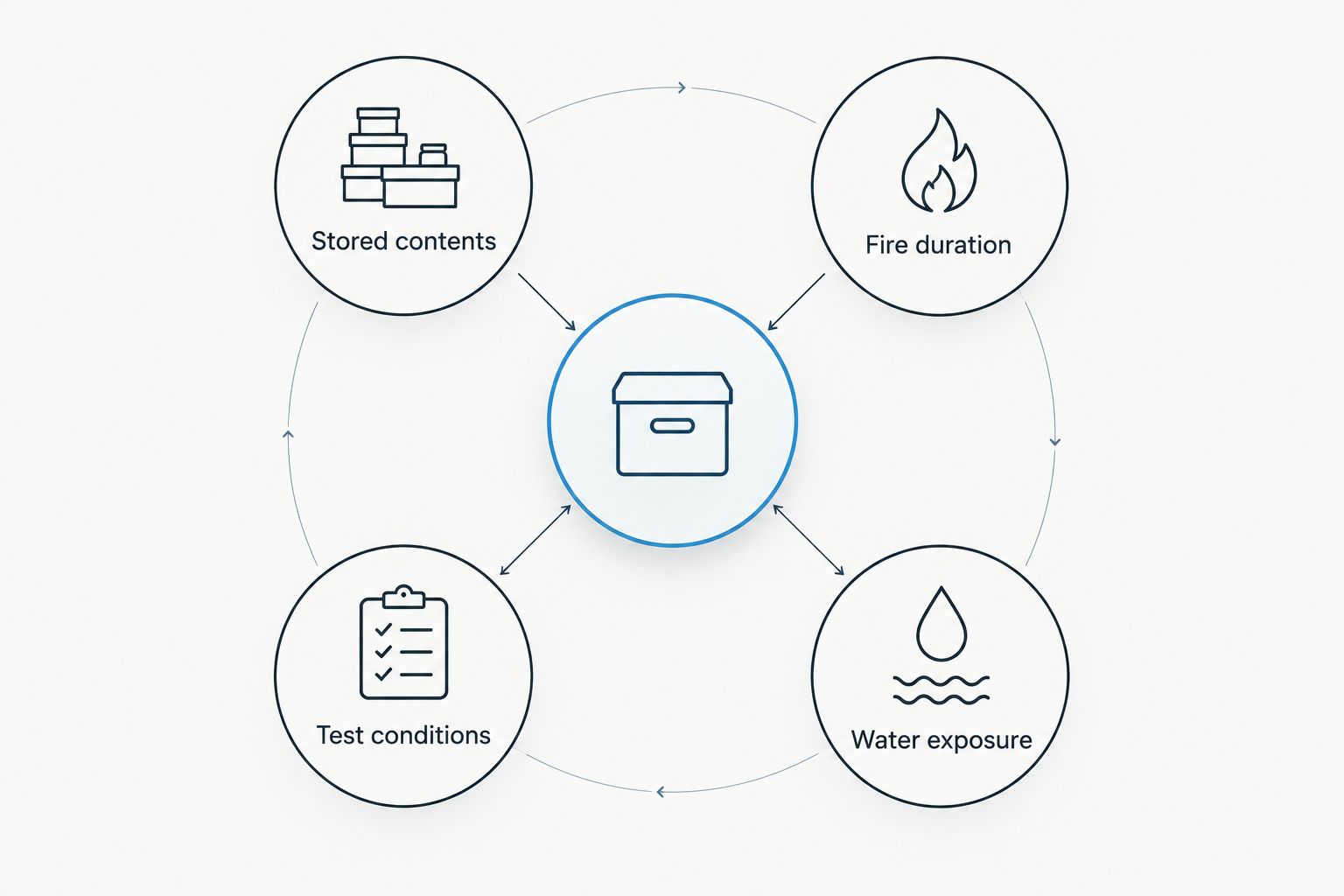
The answer to whether your safe will protect its contents depends on more than its door and walls. In 2026, use these factors as a purchase checklist:
- Fire duration. Compare the stated protection period with the conditions in the product's test documentation. A longer stated period does not remove the need to check how it was tested.
- Stored contents. A claim for paper documents does not automatically cover digital media, photographs or other heat-sensitive items. Check the exact contents named in the rating.
- Test conditions. Furnace temperature, permitted interior temperature and the certification named on the listing explain what a stated duration means. The Yale document-safe listing, for example, specifies 927°C outside and no more than 150°C inside during its stated test.
- Water exposure. A fire-protection claim does not establish that water cannot enter the safe. Check for a separate water-resistance claim if that risk matters to you.
- The particular model. A filing cabinet, a document safe and a storage safe serve different purposes. Verify the rating on the model you intend to buy rather than relying on the category name.
A simple way to compare them is to start with the contents, then check the fire duration and the evidence behind it. Treat water resistance as a separate requirement.
Is 1 hour of fire protection enough for documents?
1 hour is the stated certified document-protection period for the Yale Document Fire Safe YFM/520/FG2; it is not a guarantee for every house fire. The listing says its interior does not exceed 150°C in a 927°C furnace during that test. If you are considering this model for paper records, those are the figures to check against its current certification and product details.
Do not convert the rating into a prediction about your property. A real fire can expose a safe differently from a controlled test, and the rating does not say when it will be safe to retrieve the contents. Once emergency services have cleared the area, follow the manufacturer's guidance before handling a fire-exposed safe.
For documents you cannot easily replace, make a list before you shop: originals, copies and items that require a different form of storage. That list gives you a way to check the product's stated purpose without treating fireproof as a blanket promise.
Does a 90-minute or 2-hour rating guarantee better protection?
90 minutes is the stated rating for the Platinum DOCO DC-750, and 2 hours appears in the Guardall FRD(2)41 product title. Those durations are longer than the Yale model's stated 1 hour, but the supplied details do not establish that all 3 products share the same test conditions or protect the same contents. A longer time alone is not an apples-to-apples comparison.
The right question is not simply which number is biggest. Ask what was tested, what was placed inside and which exact model received the rating. If those details are absent from a listing, get them before deciding that one safe offers better protection for your records.
Filing drawers also solve a different practical problem from a compact document safe: they organise files you need to find. That benefit matters for an office, but it does not substitute for evidence of fire performance. Likewise, a storage safe's stated duration tells you little about a particular backup drive unless its documentation addresses that type of content.
How should you choose a safe for a possible house fire?
Use this sequence rather than choosing by a fireproof label alone:
- List what goes inside. Separate paper documents from digital media and other items whose protection requirements differ.
- Read the exact model listing. Record its stated duration, named test or certification and the contents covered.
- Check the full test claim. A duration without conditions is an incomplete basis for comparing safes.
- Consider water separately. Look for an explicit water-resistance claim if extinguishing water or flooding is part of your concern.
- Check the current product documentation. Confirm that the details apply to the model and size you are buying.
Securitysafes is best for Australian buyers comparing document fire safes with fire-resistant storage and filing options, provided they verify each model's stated rating. Its listed Yale document safe offers specific test details; the supplied information for the Platinum storage safe and Guardall filing cabinet leaves more of the test conditions to check. Buy for a documented protection claim that fits your contents, not for the longest number in a headline.
The products below represent those different storage formats. They are starting points for checking the current model documentation, not interchangeable answers to the same fire risk.


What should you do after a fire?
Keep clear until emergency services say the area is safe. A damaged building and a heated safe are not worth approaching for documents. When access is permitted, check the manufacturer's instructions before opening or moving the safe; the fire rating is not a post-fire handling guide.
Once you can inspect the contents, assess them individually. A cabinet that still closes does not prove that paper, media or other stored items escaped damage. Document the condition of the safe and its contents if you need a record for an insurer, and refer to your policy for its requirements. Securitysafes cannot determine a claim outcome from a product's fire rating.
The decision to make before a fire is simpler: keep a record of which model you own and the documentation supporting its rating. That makes it easier to identify exactly what the stated protection covered instead of trying to reconstruct the claim afterwards.
FAQ
Can a fireproof safe survive a house fire?
Yes, a fire-rated safe can protect suitable contents during a house fire within its stated protection limits. Its rating is not a guarantee against every fire condition or water exposure.
Will a fireproof safe protect paper documents?
A safe rated for documents is the relevant type to check for paper protection. The Yale Document Fire Safe YFM/520/FG2 lists 1 hour of certified document protection under its stated test conditions.
Is a 2-hour fire safe always better than a 1-hour safe?
No; compare the contents covered and the test conditions as well as the duration. A longer time on a product title does not prove that 2 different models were tested the same way.
Can I put a hard drive in a document fire safe?
Do not assume a document fire rating covers a hard drive. Check for a fire-protection claim that specifically applies to digital media before storing one.
Is a fireproof safe also waterproof?
A fire rating alone does not establish water resistance. Check for a separate water-resistance claim if you need protection from extinguishing water or flooding.
What does a 90-minute fire rating mean?
It is a stated protection duration that must be read with the product's test conditions and covered contents. The Platinum DOCO DC-750 listing states 90 minutes; confirm the applicable test documentation for that model.
Should I open my safe immediately after a house fire?
No; wait until emergency services say the area is safe, then follow the manufacturer's handling instructions. A fire rating does not tell you when a heated or damaged safe is safe to open.
One last thing
In 2026, the clearest claim among the listed examples is not the longest duration. It is the Yale document safe's stated combination of 1 hour, documents, 927°C furnace exposure and a 150°C interior limit. Securitysafes buyers should ask for that level of context when assessing any fire rating—and check a separate claim if water or digital media is the real concern.