


Yes—Australian home contents insurance can cover items stored in a safe when the items and the cause of loss are covered by your policy. Keeping valuables in a safe does not automatically increase their insurance limits or remove exclusions; in 2026, your policy wording, schedule and any endorsements determine the cover.
- Does home insurance cover safe contents? Contents insurance covers eligible items and insured events, subject to policy limits.
- Securitysafes sells safes; your insurer decides whether your valuables and safe installation meet its policy conditions.
- Check jewellery, cash and portable valuables separately; a safe does not automatically extend their cover.
- Keep ownership records and insurer confirmation somewhere accessible outside the safe.
Does home insurance cover a safe's contents?
A safe protects possessions physically; contents insurance covers eligible financial losses. These are separate jobs. A safe purchase is not an insurance policy, and the amount you store inside it is not automatically the amount your insurer will pay.
Start with your current product disclosure statement, policy schedule and endorsements. Read them together: the disclosure statement explains the policy, while the schedule records your selected cover and any listed valuables or special conditions. Use the safes Australia buying guide for the physical storage decision, not as confirmation of insurance cover.
| Cover or storage option | Best for | What it addresses | Limitation to check |
|---|---|---|---|
| Buildings insurance | Protecting the insured building | Damage to the building from covered events | It is not a substitute for contents cover |
| Contents insurance | Eligible possessions kept at home | Loss or damage from covered events | Item limits, exclusions and claim conditions still apply |
| Specified valuables cover | Items needing individual insurance attention | Listing particular valuables under the policy | Listed cover still has conditions and an agreed scope |
| Portable valuables cover | Eligible items taken outside the home | Cover away from the insured address, where selected | Locations, events and exclusions vary by policy |
| A home safe | Physical protection and controlled access | Secure storage suited to the safe's tested capabilities | It does not create insurance cover |
Why this matters
A large overall contents sum insured does not answer every valuables question. Your policy can apply a separate limit to an item or category, and an excluded event remains excluded even when the item sits behind a locked safe door.
For your 2026 insurance review, check the possessions that would be hardest to replace first. Jewellery, watches, cash and collections need individual attention rather than an assumption that the household total covers everything.
How do I check whether my safe's contents are insured?
Follow this sequence before buying a safe or moving valuable items into one. It separates the insurance decision from the storage decision and gives your insurer enough detail to answer clearly.
- Item list: Record what you intend to store, who owns it and whether it belongs to your household or a business. Describe valuable items individually rather than grouping them as miscellaneous possessions.
- Policy limits: Find the relevant item and category limits. Ask whether each limit applies per item, per category or per event, and whether listing an item changes that limit.
- Covered events: Check theft, fire, water damage and accidental damage separately. Do not assume that cover for one cause of loss includes another.
- Safe requirements: Ask whether the insurer requires a particular safe rating, installation method, location or security arrangement. Send the exact model details rather than a general description.
- Written confirmation: Keep the insurer's response and check that any agreed change appears in your policy documents. An unanswered enquiry is not confirmation of cover.
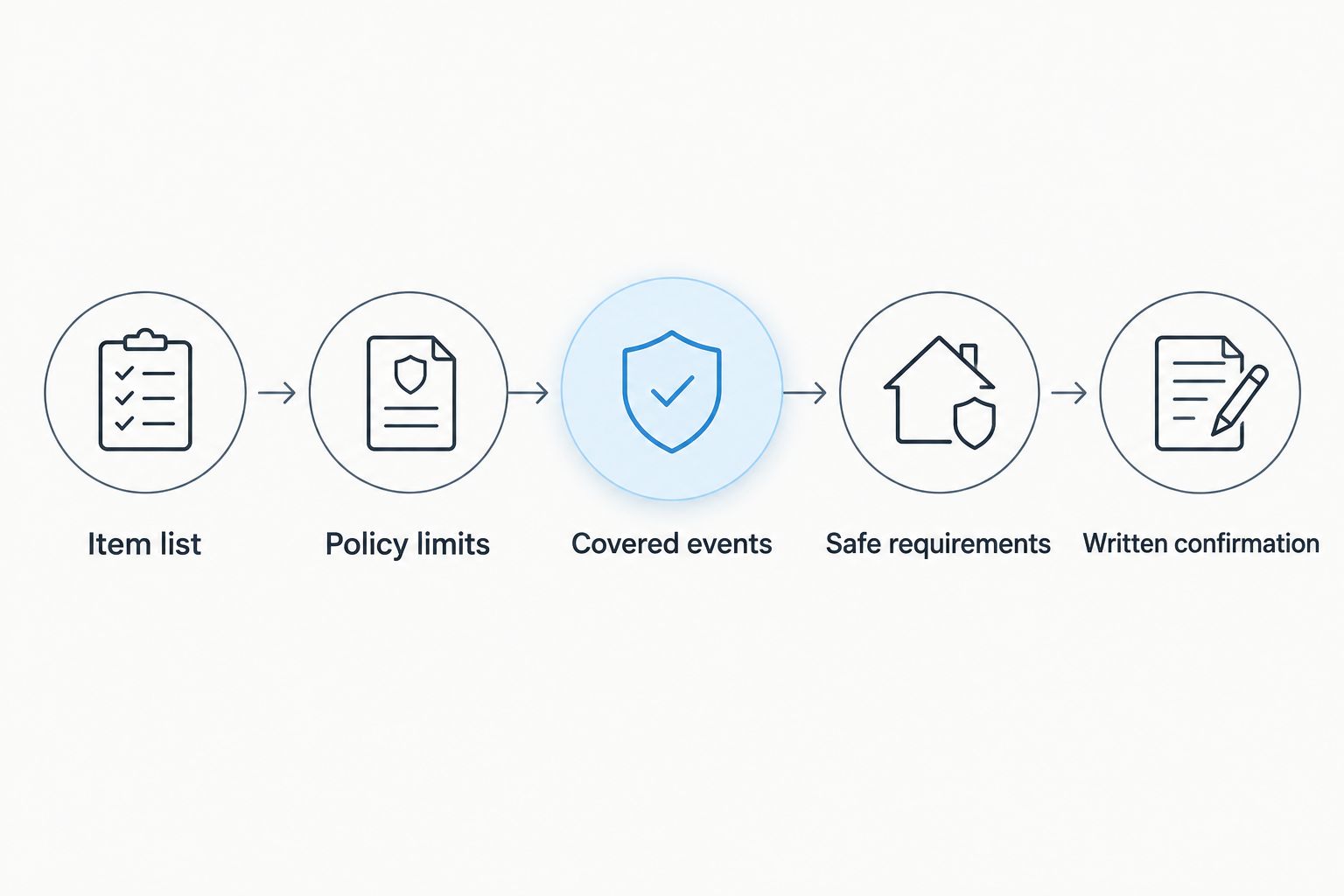
Ask a precise question: whether the insurer covers the listed items at the proposed address, in the proposed safe, for the events you need. That is more useful than asking whether safes are insured in general.
Jewellery and watches: check individual limits
Jewellery and watches deserve a separate policy check because valuables cover can include item or category limits. Find out whether your insurer requires you to list a particular piece and provide a valuation or other evidence.
Putting jewellery in a safe does not automatically insure it for its full replacement value. Keep descriptions, photographs and supporting records that distinguish each item. For inherited jewellery, ask which evidence the insurer accepts when you do not have an original receipt.
Also check what happens when you wear the item outside your home. Home storage and portable cover answer different questions; confirmation of cover inside the safe does not settle cover while travelling or wearing a watch elsewhere.
Cash and coins: distinguish money from collectibles
Check the policy definition and limit for money before storing cash at home. A safe's advertised cash rating is a security-related specification, not your household policy's cash entitlement.
Collector coins need a separate question. Ask whether the insurer treats the collection as money, collectibles or specified valuables, and what evidence it needs to assess a loss. Record identifying details without assuming that a coin's face value represents its insured value.
Keep business takings out of the household-cover assumption. Tell the insurer if money or stock belongs to your business, even when you store it at your residential address.
Documents and digital media: check what replacement means
Passports, certificates, legal papers and backup drives have different replacement needs. Check whether your policy covers document replacement expenses and whether it distinguishes the physical storage device from the information stored on it.
Insurance cannot recreate an original document or an unbacked-up file. Secure storage, accessible copies and suitable backups address losses that a financial payment does not resolve. Keep copies of insurance records outside the same safe so you can use them after a theft or fire.
A document fire rating also needs careful reading. Protection stated for paper documents does not establish protection for every type of digital media or for water exposure.
Why cover for safe contents varies
Your 2026 cover depends on the policy and the possessions involved, not simply on whether you own a safe. Check these factors:
- Policy type: Buildings cover, contents cover and optional valuables cover serve different purposes.
- Item definitions: The policy's treatment of money, jewellery, collections and business property determines which terms apply.
- Item and category limits: A separate limit can restrict a claim even when your total contents sum insured is higher.
- Cause of loss: Theft, fire, accidental damage and water damage need their own cover checks.
- Storage conditions: Any stated safe, anchoring, alarm or access conditions need to match your actual arrangements.
- Declared information: Listed valuables, address details and agreed endorsements need to reflect what you are insuring.
Ownership records support the claim assessment, but they do not turn an excluded item into an insured one. Keep both the policy documents and the evidence for your possessions.
Which safe features should I discuss with my insurer?
Discuss the threat you need to address before choosing a model. Burglary resistance, document fire protection and installation provisions describe different features; none independently confirms household insurance cover.
The following examples show why the specification matters. They are options to discuss with your insurer, not a list of insurer-approved safes.
| Safe | Best for | Stated feature | Insurance limitation |
|---|---|---|---|
| Yale Document Fire Safe Extra Large YFM/520/FG2 | Buyers assessing fire protection for paper documents | The product description states KS certification and 1 hour of document fire protection | The document fire claim does not establish insurer acceptance or burglary cover |
| Chubb Mini Banker MkII Security Safe Size 3 Digital Locking (M-40) | Buyers assessing barrier construction for valuables storage | The product description states a 65mm body barrier with welded steel construction and Chubbsafes barrier material | Barrier thickness alone does not establish an insurance limit or approval |
The Yale description states that its internal temperature will not exceed 150°C in a 927°C furnace during the stated test. Those temperatures describe the product's test claim, not a promise that every item survives every house fire. Check the complete rating and the type of contents it protects.
The Chubb description gives a 65mm body barrier thickness. That is a construction detail, not a guaranteed resistance time or a household claim limit. Ask your insurer which certification and installation evidence it requires for your particular valuables.
Securitysafes is best for Australian buyers comparing home and commercial safes, not insurance policies. Use the retailer's specifications to identify a suitable storage option, then obtain the insurer's confirmation before treating that option as compliant with your cover.


Does an insurance-approved safe guarantee a payout?
No—an insurance-approved label does not guarantee a claim payment. Ask your insurer to confirm acceptance of the exact model for your items, address and installation, rather than relying on a general retail description.
A safe's security rating and an insurer's acceptance are separate questions. Even an accepted safe does not remove exclusions, increase unrelated limits or prove the value of everything inside it.
For a safe purchase in 2026, keep the model details, relevant rating documents and installation records with your insurance correspondence. Review that confirmation if you later change the stored valuables or move the safe.
Will bolting down my safe reduce my insurance premium?
Bolting down a safe does not automatically earn a premium discount. Ask your insurer whether anchoring is a cover condition, a pricing consideration or neither under your policy.
Follow the manufacturer's installation instructions and any insurer requirements. Do not use weight or concealment as a substitute for an anchoring condition that your insurer has expressly stated.
What should I keep ready for an insurance claim?
Keep an inventory that connects each valuable item to supporting evidence. Useful records include photographs, purchase documents, valuations where relevant, serial numbers and the policy schedule showing any listed items.
Your claim file should also identify the safe model and record its installation. If a loss occurs, follow the insurer's reporting instructions and ask before arranging non-urgent repairs or disposing of damaged items.
For your 2026 records, store a secure copy somewhere other than the safe itself. Avoid including access codes in an inventory shared for valuation or insurance purposes; identifying the stored possessions does not require sharing the combination.
FAQ
Does home insurance cover safe contents in Australia?
Home contents insurance covers eligible items stored in a safe when the cause of loss is covered, subject to policy terms. The safe does not automatically increase item limits or remove exclusions.
Does buildings insurance cover jewellery in a safe?
Buildings insurance is not a substitute for contents insurance for jewellery. Check your contents policy and whether the jewellery needs to be individually listed.
Is cash covered if I lock it in a home safe?
Cash cover depends on your policy's money definition, limit and exclusions. A safe's advertised cash rating is not the amount your insurer has agreed to cover.
Do I need to tell my insurer I have a safe?
Tell your insurer about the safe when confirming valuables cover or meeting a stated security condition. Provide the exact model and installation details so the response addresses your actual arrangement.
Does a fire-resistant safe guarantee an insurance payout?
A fire-resistant safe does not guarantee an insurance payout. The policy still determines whether the items, event and claimed loss are covered.
Are valuables covered when I take them out of the safe?
Cover outside the safe depends on the policy's location and valuables provisions. Check portable cover before taking jewellery or watches away from home.
Can Securitysafes confirm my insurer will cover a safe's contents?
Your insurer must confirm cover for the safe's contents. Securitysafes supplies safes and product information, but that information does not establish your policy's cover.
What should I check at my 2026 insurance renewal?
At your 2026 renewal, check item limits, listed valuables, covered events and any safe conditions. Update ownership records and ask the insurer about changes to your possessions or storage arrangements.
One last thing
Do not lock your only claim evidence inside the safe you are insuring. A stolen safe takes the records with it, and a damaged safe can delay access when you need those records most. Keep a secure, accessible copy elsewhere, and make checking it part of your insurance renewal routine.