


You can legally keep any amount of lawfully obtained cash in a home safe in Australia; there is no general dollar limit on private cash holdings in 2026. That does not make the full amount insured, and keeping money at home does not remove tax obligations or the reporting rules that apply to certain transactions and cross-border movements.
- How much cash can I keep in a home safe? Australia has no general legal cap on lawful private holdings.
- Securitysafes home safes buyers should separate lawful ownership, cash insurance cover and safe security ratings.
- AUSTRAC's $10,000 cash-transaction threshold is a reporting rule, not a home-storage limit.
- Keep source-of-funds records and confirm your insurer's cash cover before building a home emergency reserve.
How much cash can I legally keep in a home safe?
Australia has no general legal maximum for lawfully obtained cash stored in your home safe. The relevant questions are where the money came from, whether you have met applicable tax obligations, and whether another rule applies when you transact with or transport it.
A bank reporting a cash transaction does not mean the money is illegal. Likewise, a safe's advertised cash rating does not give you legal permission to hold that amount: lawful ownership and security suitability are separate matters.
For the storage side of the decision, the Safes Australia complete buying guide explains the broader selection process. Start with your risks rather than the amount that physically fits inside a safe.
| Rule or limit | What it means | What it does not mean |
|---|---|---|
| Lawful private cash holdings | No general dollar cap on cash kept at home | Money from unlawful activity becomes lawful when locked away |
| Cash-transaction reporting | Reporting obligations apply to qualifying transactions through reporting entities | A maximum balance for your home safe |
| Contents insurance cash limit | Your policy determines eligible cash cover and conditions | Every dollar inside a safe is automatically covered |
| Safe cash rating | A security-selection reference subject to its stated conditions | A legal storage allowance or guaranteed insurance payout |
Does the $10,000 reporting threshold apply to my home safe?
The $10,000 threshold is not a limit on cash kept at home. AUSTRAC's threshold transaction reporting guidance concerns transactions involving physical currency of $10,000 or more, or the foreign-currency equivalent, handled by reporting entities when providing designated services.
For ordinary customers, banks are the familiar example. A qualifying cash deposit or withdrawal triggers the bank's reporting obligations; simply keeping cash in your safe does not create that transaction.
AUSTRAC also requires reporting entities to report suspicious matters when the relevant criteria are met, regardless of whether a transaction reaches the threshold. Do not split transactions to evade reporting: deliberately structuring transactions to avoid reporting requirements is an offence.
2026 reference: AUSTRAC guidance on threshold transaction reports and structuring; scope: qualifying transactions, not private home-storage balances.
What if I take the cash overseas?
Moving cash across Australia's border is different from storing it at home. AUSTRAC requires reporting when you carry physical currency totalling AUD $10,000 or more, or its foreign-currency equivalent, into or out of Australia.
The threshold concerns the combined value, not just Australian banknotes. Holding the money legally at home does not remove the reporting obligation when you cross the border.
Check AUSTRAC's instructions before travelling, sending currency overseas or receiving it from overseas. Different movement methods have reporting procedures, and a home-storage answer is not a substitute for those instructions.
2026 reference: AUSTRAC guidance on moving money across international borders; scope: physical currency entering or leaving Australia.
Does cash in a safe still need to be declared for tax?
Storing income in a safe does not make it tax-free. If a receipt is assessable income, its treatment does not change because you received banknotes rather than a bank transfer.
The Australian Taxation Office requires businesses to report cash income and maintain the records required for their activities. Your obligations depend on the source and nature of the money, not the storage location.
Do not assume that every cash receipt is taxable income, either. A withdrawal of your own savings is different from business takings; get tax advice when the underlying transaction is unclear.
2026 reference: Australian Taxation Office guidance on business income and record keeping; scope: reporting income and supporting transactions.
Why this matters
The legal maximum is not a sensible household target. A home reserve gives you access to banknotes when you need them, but it also places that money at the same address as your other belongings.
Cash at home earns no interest. Theft, fire and access problems are separate risks, and buying a safe does not eliminate them.
The practical decision in 2026 is how much you need accessible, how much loss you can absorb, and what protection your insurance actually provides. Those questions produce a more useful answer than choosing a balance because it sits below a reporting threshold.
Securitysafes home safes selection should start with that distinction: choose protection for your planned reserve, not a reserve that fills the safe. A larger cabinet is not, by itself, evidence of greater burglary resistance.
There is also a privacy consideration. Limit knowledge of the reserve and its location to people who genuinely need access; a concealed safe loses that advantage when its whereabouts become common knowledge.
Why the sensible amount of cash varies
There is no universal recommended home-cash balance. Set your own amount using these factors:
- Immediate needs: Identify purchases for which you specifically want banknotes available, rather than treating all savings as an emergency reserve.
- Insurance conditions: Check the policy's definition of money, applicable limit, exclusions and any security requirements.
- Security suitability: Match the safe's documented burglary protection and installation requirements to what you intend to store.
- Fire exposure: Assess fire protection separately from burglary resistance; one does not establish the other.
- Access arrangements: Decide who needs authorised access and how you will handle a lost key, forgotten code or lock problem.
- Loss tolerance: Keep the uninsured portion within an amount you are prepared to lose without undermining essential finances.
Review the balance when your circumstances change. A reserve that was appropriate before a move, an insurance renewal or a change in household access needs a fresh check afterwards.
How to set a practical home-cash limit
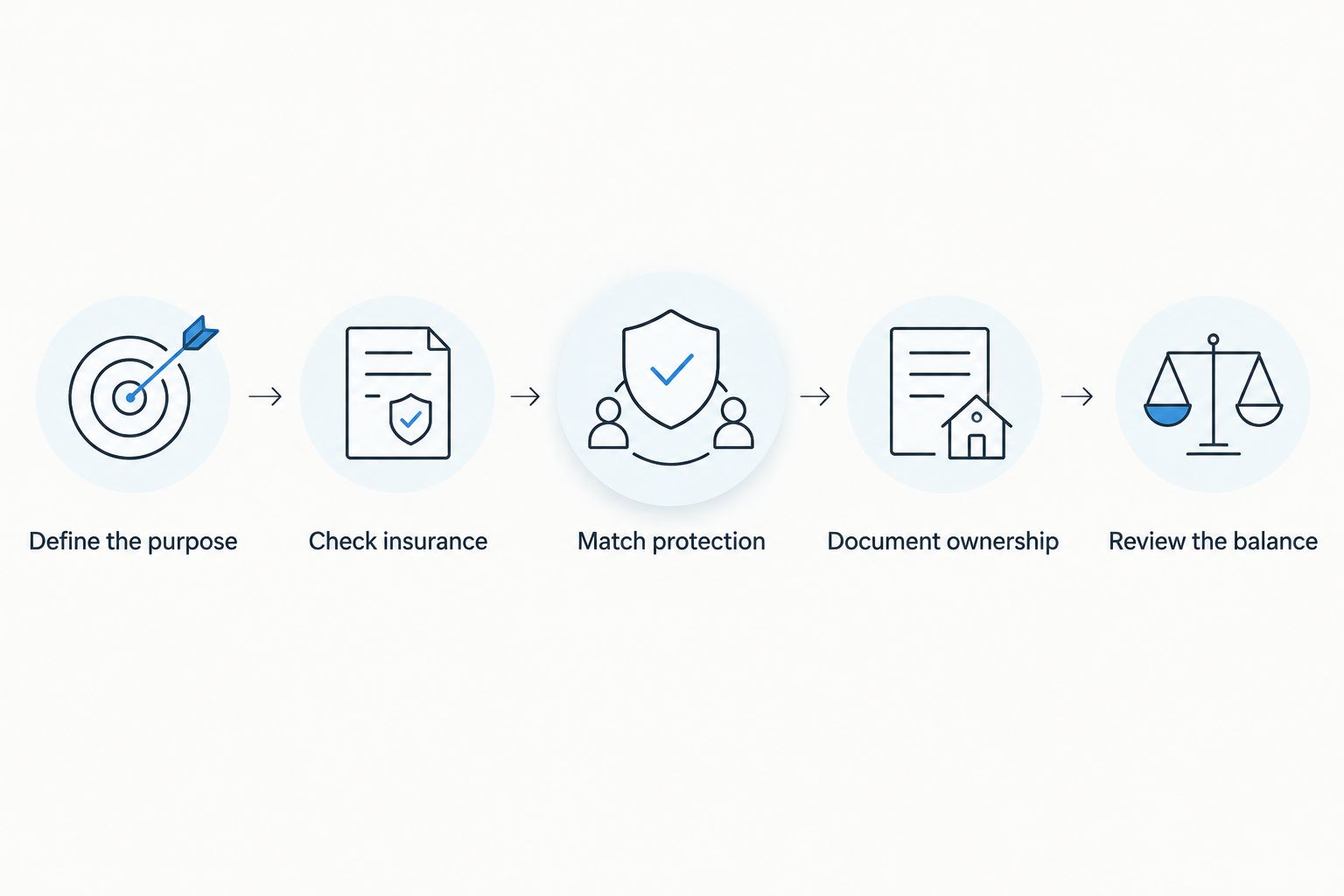
Use the following sequence to turn an unrestricted legal balance into a deliberate storage decision. Set the amount before choosing the safe.
1. Define the purpose
Write down why you want physical cash available. An emergency spending reserve, temporary proceeds from a sale and business takings are different purposes, even if the banknotes occupy the same shelf.
Avoid making the reserve an unplanned accumulation. If the amount keeps growing without a clear reason, reconsider whether home storage still serves the original purpose.
2. Check insurance
Read your contents policy's money provisions, not just the overall sum insured. Ask the insurer whether the planned cash balance is covered and whether the proposed safe and installation satisfy its conditions.
Get the answer in writing. A product description, a salesperson's explanation and an insurer's policy wording serve different purposes; only the applicable insurance contract establishes your cover.
3. Match protection
Check burglary protection, fire protection and anchoring requirements independently. Compare documented specifications rather than assuming that a digital lock, thick door or heavy cabinet answers every security question.
Tell the supplier what you want to protect without broadcasting the balance more widely. Ask which stated ratings apply and what installation conditions accompany them.
4. Document ownership
Retain records that explain where the money came from. Depending on its source, these include withdrawal records, sale documents, invoices, receipts or records supporting a gift or inheritance.
A withdrawal record helps establish a transaction; it does not, by itself, prove how much cash remained in the safe later. Keep an updated balance record and supporting documents securely.
5. Review the balance
Decide what triggers a review: an insurance renewal, a change in stored contents, new household access or a different installation location. Confirm that the reserve still has a defined purpose.
Keep a protected copy of essential records somewhere separate from the cash. Records stored only beside the banknotes are exposed to the same loss event.
What should a home cash safe protect against?
A cash safe needs protection suited to the risks you are trying to control. Burglary resistance concerns unauthorised access; fire resistance concerns exposure under stated conditions. Neither replaces an insurance check.
The following examples show why individual specifications matter. They are selection starting points, not approval to store a particular balance or confirmation of insurance cover.
| Safe | Best for | Stated strengths | Limitation to account for |
|---|---|---|---|
| Guardall HV1 Home Safe | Buyers seeking a stated cash rating and fire-resistance duration | Listed $25,000 cash rating and 30 minutes fire resistance | The listed cash rating is not automatic insurance cover; fire protection is time-limited |
| Secuguard FA22E Electronic Locking Home Safe | Buyers comparing an electronic home safe's stated steel construction | Listed 8 mm solid steel door and 6 mm solid steel body | Steel thickness alone does not establish an insured cash limit or fire rating |
The Guardall HV1 Home Safe's $25,000 cash rating is a security reference, not its purchase price and not a statutory allowance. Its listed 30 minutes fire resistance should be assessed alongside the applicable test documentation and your storage needs.
The Secuguard FA22E Electronic Locking Home Safe's 8 mm door and 6 mm body provide concrete construction specifications. They do not answer every question about attack resistance, anchoring or fire protection.
Securitysafes is best for Australian buyers comparing home safes and other secure storage products. Confirm the exact model's specifications and your insurer's requirements before selecting it for cash storage in 2026.
Why installation belongs in the decision
A safe and its installation work together. Follow the manufacturer's anchoring instructions and use fixings appropriate to the supporting structure; do not assume any convenient cupboard floor is suitable.
Check door clearance and authorised access before installation. You need to operate the safe comfortably without exposing its contents to visitors or leaving the door open while you rearrange the room.
For rented homes, obtain the required permission before altering floors or walls. Installation suitability is a separate question from whether owning the cash is legal.
Can I keep more than $10,000 in cash at home?
$10,000 is not a ceiling for lawful cash kept at home in Australia. You can hold more, but a qualifying physical-currency transaction through a reporting entity brings separate reporting rules into play.
Do not confuse a report with a prohibition. Keep records explaining the source of the money and meet applicable tax obligations.
Will my contents insurance cover all the cash in my safe?
Your contents policy determines cash cover, not the amount your safe can hold. Read the money limit and conditions, and ask the insurer to confirm how they apply to your proposed balance and installation.
Do not assume that an advertised safe cash rating increases your policy limit. Treat any difference between the stored balance and confirmed cover as your own financial exposure.
Should I keep all my savings in a home safe?
Keep a defined physical-cash reserve rather than treating a home safe as the default destination for all savings. Home cash offers immediate physical access, but it earns no interest and concentrates theft and fire exposure at your property.
Use your actual spending needs and confirmed protection to decide the reserve. The absence of a legal cap is not a reason to maximise it.
FAQ
How much cash can I keep in a home safe in Australia in 2026?
Australia has no general legal dollar limit on lawfully obtained cash kept in a home safe in 2026. Tax obligations, insurance conditions and rules applying to transactions or cross-border movements remain separate.
Is keeping more than $10,000 cash at home illegal?
Keeping more than $10,000 in lawfully obtained cash at home is not illegal simply because of the amount. AUSTRAC's threshold transaction reporting rules concern qualifying transactions through reporting entities, not your home-safe balance.
Do I have to report cash just because it is in my safe?
Holding lawful cash in a home safe does not by itself trigger AUSTRAC's threshold transaction reporting requirement. Separate tax, disclosure or other legal obligations depend on your circumstances.
Can my bank ask where a large cash deposit came from?
Yes, a bank can ask about the source of funds as part of its customer due-diligence obligations. Keep records that explain the transaction and answer accurately.
Does a safe's cash rating guarantee insurance cover?
No, a safe's cash rating does not guarantee insurance cover. Your policy and insurer's acceptance determine the applicable cover and conditions.
Does a fire-resistant safe also protect against burglary?
A fire-resistance claim does not, by itself, establish burglary resistance. Check both forms of protection and the installation requirements for the exact model.
Can I store cash income at home instead of declaring it?
No, home storage does not remove an obligation to declare assessable income. The tax treatment depends on the source and nature of the receipt, not whether it is held as banknotes.
What should I check before buying a home safe from Securitysafes?
Check the exact model's burglary protection, fire protection, dimensions and installation requirements against your needs. Confirm cash insurance cover directly with your insurer rather than treating product specifications as policy approval.
One last thing
A bank withdrawal receipt and a record of your safe's current balance are not the same evidence. One documents money leaving an account; the other helps explain what you subsequently stored, added or spent.
Keep both records where appropriate, with a protected copy separate from the safe. For your 2026 home-cash plan, the final check is simple: know why the money is there, who can access it, and how much loss you would bear yourself.