


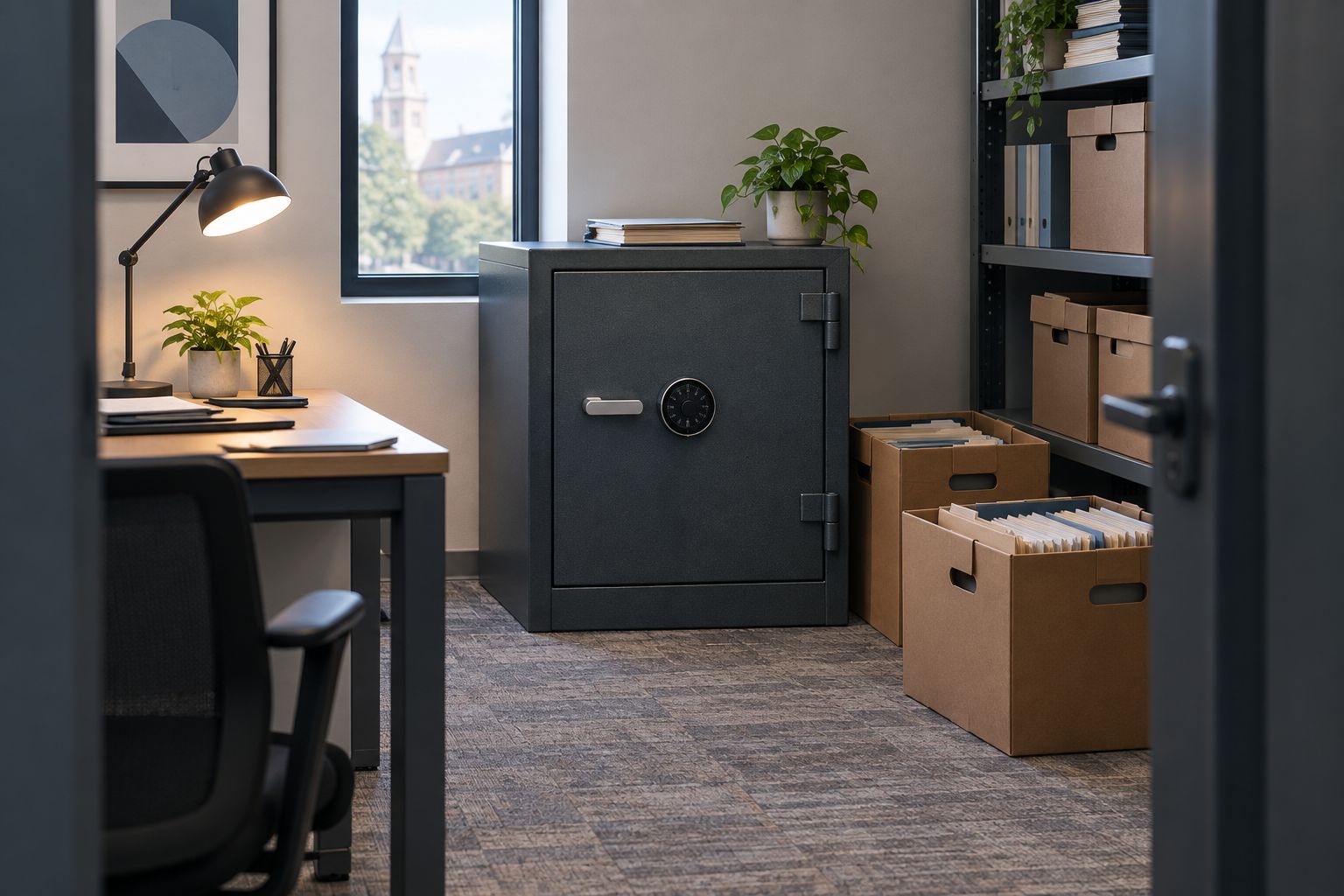
Safes for university administration offices are fire-rated, access-controlled storage units built to protect student records, HR files, exam papers and departmental cash under one coherent security plan, not a single locked drawer. Administration teams handle more document types and more staff access requests than almost any other office segment on campus, and that mix changes what "the right safe" actually means in 2026.
- A 60-minute fire-rated document safe protects student records and HR files; a separate deposit safe handles departmental cash because one box rarely does both well.
- Electronic key cabinets with individual PIN codes give safes for university administration offices an audit trail a shared spare key never will.
- Chubbsafes Archive Cabinet 640 suits high-volume enrolment and HR archives; the Yale Document Fire Safe Extra Large YFM-520-FG2 suits fire-rated master files.
- AS/NZS 3809 burglary ratings (Class B, C, D) matter more for cash and valuables than for paper-only document storage.
Why this matters
University administration offices sit on three overlapping risks at once: fire damage to irreplaceable paper records, unauthorised access to student and staff personal information, and cash handling for fees, deposits and event takings. A single filing cabinet with a lock satisfies none of these properly, and insurers increasingly want a rated safe on file before they'll cover a high-value document or cash loss.
Security Safes' guide to safes for schools and educational institutions covers the same mixed-use pattern across a wider education setting — administration offices just concentrate it into fewer square metres with more staff touching the same storage every day.
Exam integrity adds a wrinkle most office guides skip. Papers need to stay locked until a set distribution time, staff turnover means recoded locks beat rekeyed cylinders, and a shared department often means three or four people need legitimate access to the same drawer without one person's key opening everyone else's files.
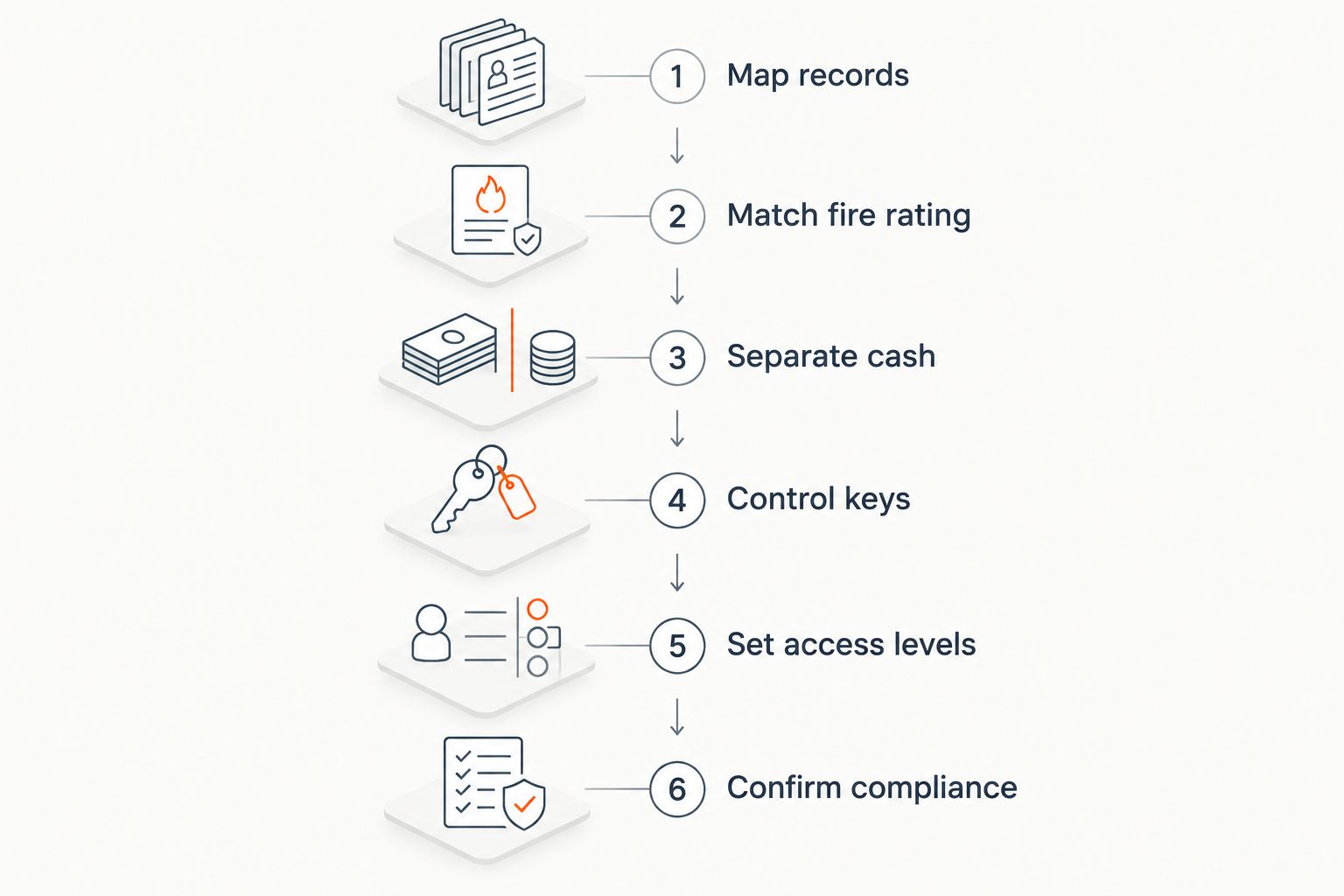
Map what actually needs to be locked away
Start with an inventory before you shop for a box. Administration offices typically hold:
- Student enrolment and enrolment-history files
- HR and payroll records for administrative and academic staff
- Exam papers before distribution and after marking
- Graduation certificates awaiting collection
- Master keys for lecture theatres, labs and plant rooms
- Departmental petty cash and event takings
Splitting this list across two or three purpose-built safes almost always beats cramming it into one oversized unit.
Match fire rating to what you're storing
Fire-rated document safes are sold in standard protection tiers, and paper is what most administration offices need to protect first.
- Paper-only records: a 30 to 60-minute paper-rated safe covers most standard retention needs
- Digital backups or USB drives stored alongside paper: look for a media-rated interior, not just a paper rating
- Exam papers awaiting distribution: a tamper-evident lock and a numbered seal matter more than fire rating alone
- Certificates and testamurs: treat as irreplaceable and size for the full print run of each graduation round
- Mixed HR and enrolment archives: a 60-minute rating is the common mid-point for Australian administration offices
Separate cash handling from document storage
Administration offices that take fee payments, event cash or exam fees on-site need a cash-rated safe that is not the same box holding HR files.
- Deposit-slot safes let front-counter staff drop cash without opening the main compartment
- Cash-rated safes carry their own burglary class separate from paper document safes — check both ratings, not one
- Keep petty cash floats in a dedicated small safe, not mixed in with archive files
- Reconcile and log drops daily if the office handles regular fee or ticket payments
Set up key control for shared building access
A hook board with a spare key on it is not key control. Electronic key cabinets fix that:
- They log who took which key and when, replacing the shared hook board entirely
- Assign individual PIN codes per staff member, not one shared code for the whole office
- Separate master keys for labs and plant rooms from day-to-day teaching space keys
- Audit the cabinet log against any building access incident at least once a term
Build in access levels, not just one combination
One combination shared by everyone defeats the point of a rated safe.
- Dual custody locks require two staff present for high-value drawers, useful for cash reconciliation
- Time-delay or time-lock settings stop after-hours access without a supervisor override
- Digital keypads make recoding after staff turnover a five-minute job, not a locksmith call-out
- Keep a sealed master override code with the department head, not circulated to all users
Confirm compliance and insurance sign-off before you buy
- Check your institution's records retention policy for the minimum fire rating it expects
- Confirm the insurer's required burglary rating class for the cash sum held on-site
- Get the safe bolted to floor or wall using the manufacturer's anchor points, not left freestanding
- Keep the AS/NZS 3809 rating plate details and purchase certificate on file for audits
Comparing the options for administration offices
| Option | Best for | Key feature | Limitation | Verdict |
|---|---|---|---|---|
| Chubbsafes Archive Cabinet 640 | High-volume HR and enrolment archives | Large lever-arch file capacity | Not fire rated on its own | Buy for bulk archive storage |
| Yale Document Fire Safe Extra Large YFM-520-FG2 | Master files and exam papers awaiting distribution | Fire-rated paper protection | Smaller footprint than an open cabinet | Buy for fire-rated master files |
| Electronic key cabinet | Shared building and lab key control | Individual PIN audit trail | Secures keys only, not documents or cash | Buy for multi-user key control |
| Commercial deposit safe | Front-counter fee collection and event cash | Deposit slot without opening the main compartment | Not built for paper fire protection | Buy for cash handling |
| Fireproof filing cabinet | Bulk paper archives needing fire cover | Filing-cabinet form factor with a fire rating | Bulkier than an open archive cabinet | Hold unless fire cover is mandatory |
For departments that collect fees, event takings or exam fees on-site, a dedicated deposit safe keeps cash movements separate from the archive cabinets above. The options below cover a spread of cash ratings and fire protection tiers suited to different office sizes.


Common mistakes university administration offices make
- One safe for everything. Exam papers, HR files and petty cash end up in the same drawer, so a fire-rated safe with no real burglary rating ends up holding cash it was never built to protect.
- Shared keys with no log. A single spare key on a hook means nobody can say who accessed a drawer after a discrepancy turns up.
- Sizing for today's file volume only. Enrolment numbers and HR archives grow every intake; a safe bought for last year's volume is full by 2026.
- Skipping the fire rating on "just documents". Paper ignites well below the temperatures that trigger most building fire alarms — an unrated cabinet offers no real protection once a fire reaches the room.
- No compliance paperwork on file. When an insurer or auditor asks for the AS/NZS 3809 rating plate details, the purchase certificate should sit in the same file as the safe's log book, not lost with a departed staff member.
FAQ
What fire rating does a university administration office need for paper records?
Most administration offices need a minimum 60-minute paper fire rating for HR and enrolment archives, with 120-minute options for records that can't be reconstructed. Check your institution's own records retention policy before buying, since some faculties require the higher tier.
Should cash and student records share the same safe?
No — keep departmental cash in a dedicated deposit safe and paper records in a fire-rated document safe or archive cabinet. Combining them means the compartment with the burglary rating you need for cash and the one with the fire rating you need for paper are rarely the same box.
Is a digital lock or key lock better for a shared administration office?
A digital lock with individual PIN codes suits shared offices best because it gives an audit trail without cutting new keys every time staff change. Key locks still work fine for single-user drawers with low turnover.
How many staff should have access to one safe?
Limit direct access to the smallest group that needs it day-to-day, and use a supervisor override code for exceptions rather than sharing the main code widely. Dual custody settings work well for cash reconciliation points.
What Australian standard applies to safes bought for university offices?
AS/NZS 3809 sets burglary resistance classes, including B, C and D, for safes sold in Australia, and insurers reference it when setting cash and valuables limits. Fire rating is tested separately and stated in minutes, not as part of the same class system.
How big a safe does a records office need?
Size to your current HR and enrolment file volume plus headroom for at least one more intake cycle, since archive volume rarely shrinks. An archive cabinet with multiple lockable drawers scales better over time than one oversized single-door safe.
Can one administration office use the same safe for exam papers and graduation certificates?
It can, provided the safe is sized for both without stacking documents against the door seal, but exam papers awaiting distribution should still be logged separately from long-term certificate storage. Treat exam integrity as a chain-of-custody problem, not just a locked-box problem.
One last thing
The detail most university administration offices skip in 2026 isn't the safe's rating — it's the anchor point. A 60-minute fire-rated document safe bolted to a slab floor is a materially different security proposition to the same safe sitting loose in a store room, and AS/NZS 3809 testing assumes the safe is fixed as intended. Check the anchor kit before the safe ships, not after it lands on a pallet in the mailroom.